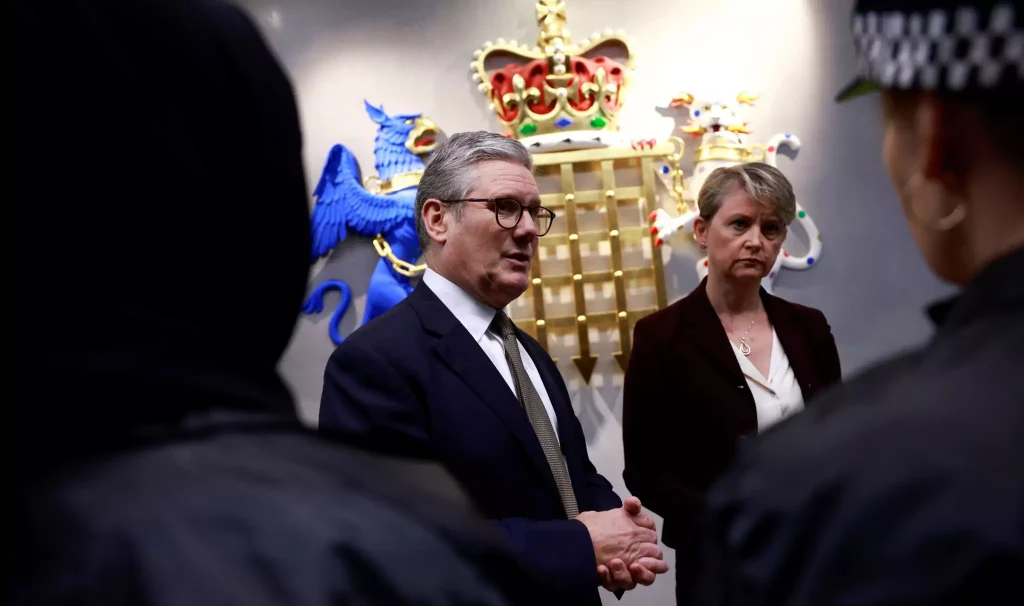
Yvette Cooper banned Palestine Action when she was Home Secretary. Photo: Benjamin Cremel/Alamy.
Yvette Cooper banned Palestine Action when she was Home Secretary. Photo: Benjamin Cremel/Alamy.
The Home Office’s decision to ban Palestine Action as a terrorist group last year was unlawful, a three-judge panel at the High Court has ruled.
In a hearing on Friday, Dame Victoria Sharp, one of the judges, said there had been “very significant interference with the right to freedom of speech and freedom of assembly”.
The court, she said, considered the proscription of the group “disproportionate”.
Despite the ruling, the group will remain proscribed until a further court order because it has “yet to hear argument on whether there should be a stay of any order setting aside the proscription order pending the possibility of appeal,” the judges said.
The judgment is a major blow for former home secretary Yvette Cooper as well as the Israeli arms companies who lobbied for a crackdown on the group.
It will be a relief for over 2,700 protesters who have been arrested for showing support for the group since the controversial ban.
The ruling comes a week after a jury decided not to convict six Palestine Action members accused of some of the most serious criminal charges leveled against the group.
Huda Ammori, the co-founder of Palestine Action who challenged the proscription order, said on Friday: “This is a monumental victory both for our fundamental freedoms here in Britain and in the struggle for freedom for the Palestinian people, striking down a decision that will forever be remembered as one of the most extreme attacks on free speech in recent British history.”
Ammori won on two of the four grounds that she brought in her challenge. The court found that the proscription decision violated rights enshrined in UK law, namely freedoms of expression, peaceful assembly and association with others.
It also upheld her claims that Cooper’s decision to proscribe the group was not consistent with the Home Office’s own policy.
The government will appeal the decision. Home secretary Shabana Mahmood said the court had acknowledged that Palestine Action had carried out acts of terrorism and that it was “not an ordinary protest or civil disobedience group”.
“For those reasons, I am disappointed by the court’s decision and disagree with the notion that banning this terrorist organisation is disproportionate,” Mahmood said.
The decision to authorise a judicial review had been made in part to expedite the unprecedented number of terrorism-related cases moving through the courts.
‘A lot of uncertainty’
Around 40 protesters stood outside the court on Friday ahead of the ruling, holding Palestine Action placards, poised for arrest with several Metropolitan Police vans parked nearby.
But police officers at the scene told Declassified that they hadn’t been given orders to make arrests.
In a subsequent statement, the force clarified that it is now focused on gathering evidence of those showing support for the group for potential future enforcement, rather than making arrests.
Roars and celebration erupted outside the court soon after the ruling was read out, but questions remain about exactly what will happen next.
One protester holding a placard told Declassified: “I’m relieved but there is still a lot of uncertainty in my mind about where this is headed.”
The court has directed parties to provide written submissions by 20 February on next steps in light of the judgement.
Filton Acquittals Demolish Starmer and Cooper Lies About Palestine Action 117
‘Honourable history’
The ban on Palestine Action was announced in June 2025 shortly after activists broke into RAF Brize Norton in Oxfordshire and sprayed red paint into the turbines of two military aircraft used for refuelling and transport.
Cooper told parliament that month: “The UK’s defence enterprise is vital to the nation’s national security and this Government will not tolerate those who put that security at risk”.
An order was pushed through parliament in July which added Palestine Action to the list of banned groups under the Terrorism Act 2000.
The Home Office included two Russian neo-Nazi organisations, the Maniac Murder Cult and Russian Imperial Movement, within the same order.
It marked the first time in British history that the government used terrorism legislation to ban a civil disobedience organisation. Only 26 out of 650 MPs voted against the ban.
Raza Husain KC, representing Ammori, told the High Court in November that “civil disobedience on conscientious grounds has a long and honourable history in this country”, arguing that Palestine Action followed in the footsteps of direct action protest groups stretching back centuries.
“It is the mark of a civilised society that protests of this type can be accommodated”, Husain added. “Our client Ms. Ammori has been inspired by a long tradition of direct action in this country from the suffragettes to anti-apartheid activists to Iraq war protesters”.
Iran
The Home Office sought to justify the ban on Palestine Action by briefing the press that the group might be funded by Iran.
On 23 June, the day of Cooper’s statement to parliament, the Times published a report saying “Iran could be funding Palestine Action, Home Office officials claimed”.
It added: “Officials are understood to be investigating its source of donations amid concerns that the Iranian regime, via proxies, is funding the group’s activities given that their objectives are aligned”.
Shortly afterwards, the Daily Mail asked: “Does Palestine Action’s cash trail lead all the way to Iran?”, with GB News, the Spectator, and the Telegraph also picking up on the story.
This point was contested by the UK’s independent expert on terrorism, Jonathan Hall KC, who told Channel 4 News earlier this week that those press briefings were “wrong”.
Hall was “not aware” of any evidence behind those claims, he added.
British intelligence reports first exposed by Declassified in July indicated that the ban was in fact largely driven by Palestine Action’s impact on the Israeli arms industry in Britain.
(Declassified UK) by John McEvoy, Dania Akkad and Martin Williams

Independent journalist @theCanaryUK, @jacobinmag, @ColombiaReports , & International History Review.