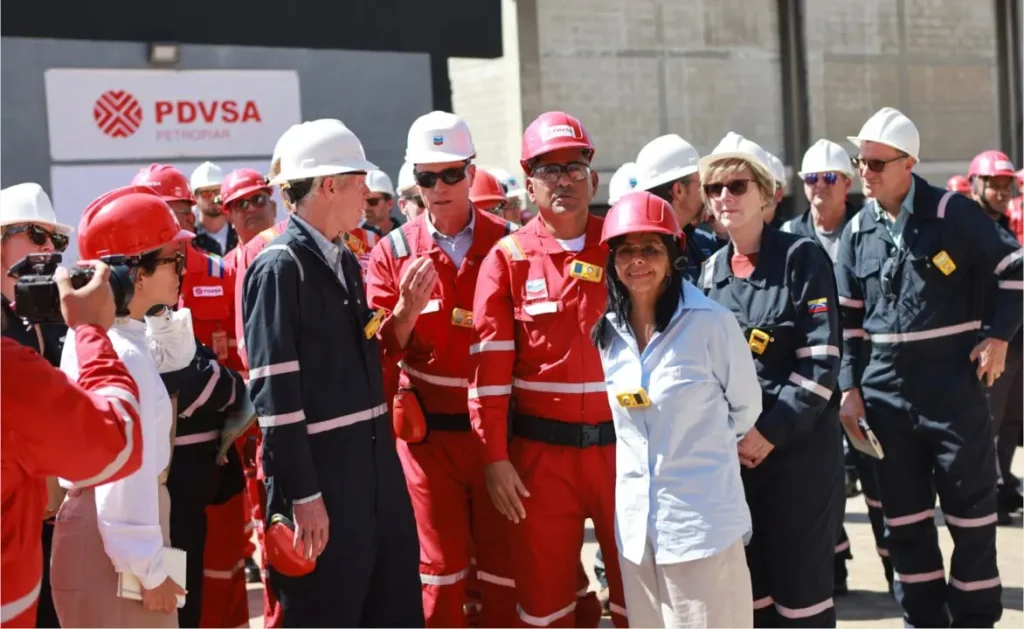
Venezuelan Acting President Delcy Rodríguez and US Energy Secretary Chris Wright tour the installations of the PDVSA-Chevron joint venture in the Orinoco Belt. Photo: Vice Presidency of Venezuela.
Venezuelan Acting President Delcy Rodríguez and US Energy Secretary Chris Wright tour the installations of the PDVSA-Chevron joint venture in the Orinoco Belt. Photo: Vice Presidency of Venezuela.
By William Serafino – Feb 17, 2026
The secretary of Energy of the Trump administration, Chris Wright, visited Venezuela last week, representing the most important visit by a high-ranking US official to Venezuela in years. During the trip, he held a meeting with Acting President Delcy Rodríguez at the Miraflores Palace, visited oil fields jointly operated by the US oil corporation Chevron and the Venezuelan state-owned PDVSA, and participated in a press conference with foreign journalists.
Wright’s presence in the country, just over a month after the US military aggression against Venezuela and the kidnapping of President Nicolás Maduro, was widely interpreted by various analysts as the factual embodiment of the thesis that Venezuela is now a Trumpist protectorate.
However, the institutional statements and events surrounding the visit offered clues contrary to that fashionable hypothesis that is generally supported by viewpoints that do not incorporate either nuances or details, precisely where the devil is supposed to be.
The analysis of the current complexity of Venezuela requires paying close attention to fine print and footnotes, as the elusive location of every unprecedented phenomenon lies there.
Suggestive declarations: reasons of the visit
Although Wright’s statements in Miraflores and from the Hugo Chávez Orinoco Oil Belt occupied a prominent place in the media coverage, his declarations in the press conference with foreign journalists, scarcely reported, were extremely revealing, clashing with the thesis of US tutelage over Venezuela.
According to the compilation by Venezuelan journalist Víctor Amaya, the US official indicated that the set of modifications introduced in the recent reform of the Organic Law of Hydrocarbons “was not broad and clear enough to encourage large capital flows, but the dialogue continues.”
Regarding the deliberate intention to exclude China from the equation of Venezuelan crude oil supply, Wright commented that it is “one of the topics to discuss. If they are legitimate trade agreements with China under legitimate trade conditions, that’s fine. China has already bought part of the crude oil sold by the American government.”
Both statements undermine the foundation of the tutelage thesis. On one hand, if it were true that the current authorities of Venezuela only take dictation from what is ordered by the White House, the Trump administration official would not have questioned the oil law reform, implying between the lines that reform is not attractive enough for US energy interests. On the other hand, the clarification regarding China can be interpreted as a readjustment very possibly associated with informal pressures from Beijing and Venezuela’s demand to maintain an autonomous administration of its international energy ties.
In practical terms, with these statements, the US official acknowledged the existence of a bilateral negotiation in which the coercive influence of the US is notable, but at the same time it is insufficient to completely undermine a Venezuelan regulatory framework where, despite its redesign to attract private capital, the state still plays a significant role in the operational, taxation, and contractual spheres.
The answer to why Wright was forced to embark on his Venezuela tour lies precisely in the meanders of his statements. Since the reform of the oil legislation was not as open as the White House wanted, the official had to visit Venezuela to inject confidence and credibility into Trump’s oil plan, in a desperate attempt to show that there are indeed favorable conditions for investment and profitability for US companies.
Fundamentally, Wright admitted a fact that had been becoming clearer as a trend in recent weeks: US pressure on the Venezuelan government has limits, and the cost of bringing the country to a state of precariousness in the style of Libya, in which oil companies would have unrestricted and cheap access to the resource, is too high. As Nathan Thompson correctly explains in a recent article in The American Prospect, “Trump, while certainly no anti-interventionist, has also shown disinterest in both the subtle, sustained regime change operations and the large-scale, blowback-prone wars born out of the neoconservative movement.”
Caracas, in an intelligent manner, is gauging these limits and frictions within the Trump administration as highlighted by Thompson, finding a balanced approach that prioritizes not exposing the country to a new attack or greater coercion, while simultaneously avoiding strategic concessions. Moreover, in a context where, according to recent data from Baker Hughes, active oil platforms in the US continue on their declining trend, the US government cannot afford to overestimate its influence to break the limits drawn by Venezuela.
Wright’s comment that the quarantine on Venezuelan crude “essentially ended” serves as a telling sign of an ongoing unequal negotiation, in which Caracas concedes but also demands under a programmatic premise of national self-determination.
Reading Between the Lines of OFAC General License 46 Regarding Venezuela
OFAC licenses: the labyrith of flexibilization of sanctions
Prior to the visit, the US Department of the Treasury, through its Office of Foreign Assets Control (OFAC), issued four licenses whose immediate effect corresponds to a substantial flexibilization of the sanctions regime against the Venezuelan oil industry. After Wright’s tour, two additional licenses were issued to authorize investments, contract signings, and operations of European energy companies.
Conducting an analytical review of these measures, Venezuelan opposition-aligned economist Francisco Rodríguez argued in a post on his X account that “General Licenses 46/46A, 47, 48, and 50 authorize the resale of Venezuelan oil, the sale of U.S.-origin diluents to Venezuela, the supply of certain items and oil and gas sector operations in Venezuela,” but that since “these licenses authorize contracts with the Venezuelan government or with PDVSA, they effectively require that the United States recognize the government under Delcy Rodríguez — whose appointees would be signing these contracts.”
Rodríguez’s prospective analysis is important, given that, without the official recognition of the Venezuelan government by the US, the scope of the licenses will be severely limited, negatively impacting the investment and production goals that Wright himself hinted at, by promising that Chevron would increase Venezuelan crude production in the short term.
Right now, Washington is facing the challenge of whether or not to openly recognize the Venezuelan government to steer its energy agenda before the dreadful midterms, in which a resounding defeat for Trump is projected.
Advancing in that direction would imply greater strength for Venezuela, as by the very act it would have achieved what it has been demanding for years, turning the act into a political and symbolic victory and a significant amount of autonomy, in addition to a potential accelerated growth in oil production, even if such recognition is carried out from an intermediate approach that maintains the coercive limits of the licenses.
On the flip side of such an action by the US, theoretically, Venezuelan funds and properties would be unblocked, the country would be readmitted into multilateral spaces, and the current US financial control over oil sales would be institutionally compromised, among other complementary effects of utmost importance in terms of financial and banking connectivity.
However, resistance to recognizing the Venezuelan government would mean maintaining the current levels of coercive influence at the risk of oil production not recovering quickly enough for Trump to exploit it for electoral purposes, within his central objective of keeping oil prices low.
For Washington, short-term action involves deciding between two strategic sacrifices, and in both cases, Caracas is trying to extract the maximum possible benefit while navigating unknown waters.
Translation: Orinoco Tribune
OT/SC

William Serafino in a Venezuelan political scientist, graduate of the Central University of Venezuela (UCV). Researcher, writer, and analyst specializing in geopolitics. Winner of Venezuela's Simón Bolívar National Journalism Prize, Research category (2019).