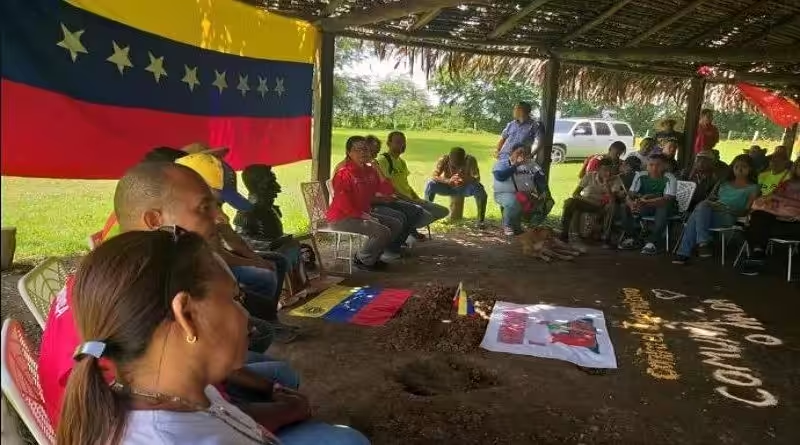
Socialist commune of El Maizal. File photo.
Socialist commune of El Maizal. File photo.
On January 3, 2026, the United States carried out a military aggression against Venezuela that included the bombing of the capital, Caracas, and the kidnapping of President Nicolás Maduro and his wife, National Assembly member Cilia Flores. Despite the significance of this event, it should not be seen in isolation from broader regional history. It is necessary to begin with a wider analysis of the current historical period in Latin America, more than two decades after the rise of leftist and progressive forces in many countries of the southern continent, with Venezuela at the forefront. Where do these forces stand today? Do they still represent a living link in the global struggle against capitalism and imperialism? How has the Bolivarian Revolution navigated its difficult path to achieve successive gains? Where does it stand now in light of recent developments, and where is it heading? How can the peoples of South America resist U.S. imperialism today amid this ongoing and dangerous escalation? These questions become even more pressing in light of major transformations underway in the world system: the rise of new Eurasian powers, the intensification of hybrid wars, sanctions, and blockades, the escalating imperialist and Zionist war against Palestine, Arab resistance movements, and Iran, and the continued militarization of the Caribbean and the Western Hemisphere.
Marxist theorist and militant Chris Gilbert has been involved in the Bolivarian Revolution for two decades. In this interview, conducted on February 22, 2026, he offers an analytical reading that situates the recent escalation within the broader history of confrontation between Venezuela and U.S. hegemony, and examines its implications for the country and the region. Gilbert also discusses the Venezuelan communes as one of the most significant expressions of popular power and a practical attempt to build a socialist alternative, along with the possibilities and questions this experience opens up for other societies, including Arab and Islamic societies. Gilbert is a professor at the Bolivarian University of Venezuela in Caracas and a contributing editor at Monthly Review. He is the author of numerous articles and books, most notably Commune or Nothing! Venezuela’s Communal Movement and Its Socialist Project(2023), and has also conducted extensive field research on the transition to socialism and the communes in Venezuela.
This interview first appeared in Arabic, in Al-Mustaqbal Al-Arabi Journal no. 565 (March 2026), published by the Center for Arab Unity Studies in Beirut.
Ibrahem Younes: On January 3 of this year, the United States carried out a heinous nighttime attack on Venezuela that included the bombing of Caracas and the surrounding area and the kidnapping of its president. We will discuss this attack and the response to it more fully later in the interview. However, let’s begin with a wider historical perspective on Latin America and specifically its epoch of progressive victories that is sometimes called the Pink Tide. That term denotes the wave of leftist governments in many Latin American countries that reordered state priorities toward social justice and national sovereignty—by expanding social protection, reclaiming certain public resources, and building mechanisms of regional integration. What is your understanding of the Pink Tide? How, in practical terms, does it function as a link in the chain of struggle against capitalism and imperialism? What do the recent attacks mean for this epoch of change?
Chris Gilbert: The mass media does in quotidian fashion what postmodern theory did in its books: destroy historical understanding. It does so partly by focusing on allegedly singular and special “events”—that is, semi-messianic occurrences that supposedly mark a sharp “before and after,” a complete rupture from what came before. In that spirit, what occurred on January 3 in Venezuela is systematically presented in the mass media as “an event” without much historical context. This results in a great deal of confusion, including on the part of the left. So, your directing the discussion first to the recent history of Latin America and asking about the context of the Pink Tide is relevant and even essential.
From the present, and in light of the attacks, I think it is important to look at the historical parameters of struggle in Latin America in the period following the fall of the Soviet Union. The 1990s were a period in which the United States enjoyed new levels of hegemony in the region. As evidence of their weakness, many of the counter-hegemonic movements in the 1990s in our continent explicitly turned away from the question of state power and focused instead on “social issues.” Hence there emerged a new focus of struggle: the “social movement,” which dominated much of the 1990s. It was called “movimentismo,” and expressed itself collectively in such spaces as the World Social Forum.
In Venezuela, at the dawn of the new century, Hugo Chávez took the struggle a step further in a groundbreaking way, demonstrating that it was possible, in Latin America, for popular left forces to take state power through mass mobilization and elections. This, in some sense, marked the birth of the wave of so-called Pink Tide governments, which could be described as the social forces of the 1990s entering or reentering power in countries such as Argentina, Venezuela, Ecuador, Nicaragua, El Salvador, Brazil, Honduras, Chile, Uruguay, and Paraguay by democratic and electoral means. In power, the Pink Tide governments exercised sovereignty over resources, expanded social programs, and sometimes took steps toward socialism. At the same time, the new progressive governments carried forward many of the participative forms that had developed from their origins in 1990s social movements, with an emphasis on popular power and grassroots democracy in their practices of governance.
The United States, since it is the epicenter of global reaction and the enemy of all peoples seeking self-determination, naturally began to move against such efforts. It used various methods. Sometimes it fostered old-style coups d’etat based on police and military forces. These could be unsuccessful (Venezuela 2002, 2019) or successful (Honduras 2009, Bolivia 2019). However, it also employed a relatively new parliamentary-lawfare kind of coup d’etat (Brazil, Paraguay, Peru). Additionally, it did not hesitate to apply unilateral coercive measures, or so-called sanctions. Even so, throughout this period U.S. strategy generally moved within the parameters of recognizing Latin American states as having some degree of (albeit limited) sovereignty. This meant that, with the exception of Colombia and Haiti, the United States mostly eschewed direct military intervention. Therefore, after the invasion of Panama in 1989 and excluding the United States’ kidnapping of Haiti’s president Jean-Bertrand Aristide in 2004, the coups that it carried out were done without overt U.S. military intervention and were, at least on the surface, about putting in power endogenous forces more favorable to U.S. interests. This overall imperialist modus operandi as a form of regional control reflected the United States’ condition as the more or less unquestioned hegemon of the western hemisphere. Conversely, because of the relative absence of direct military intervention (except in Colombia, where the United States continued to fund a state-led war against the Colombian people, and in Haiti, where it was masked as “humanitarian” or “security” assistance), the idea of armed anti-imperialist struggle was also more or less out of the picture.
Now, in the past year or so, this overall situation, which was the historical condition of the Pink Tide’s emergence, has changed significantly. With the United States clearly losing global hegemony, and perceiving threats even to its regional hegemony, it now pursues more risky and direct interventions. These include: the overt blackmail of Argentinian voters last October to influence the legislative elections; the multi-level intervention in the 2025 Honduran presidential elections; the new and unprecedented tightening of the cruel blockade on Cuba (itself essentially an act of war); the repeated threats of military intervention in Mexico and Colombia; and the January 3 bombing of Caracas followed by the kidnapping of President Maduro. With these actions that amount to an explicit and often military trampling of national sovereignty, it is almost inevitable that the Latin American countries will also have to prepare for military struggle—armed struggle of some kind—against U.S. imperialism in a new way to defend themselves against this more erratic, direct, and dangerous form of imperialist intervention.
All this is to say that as the epoch of uncontested U.S. hegemony comes to a close, its project of hemispheric domination has become more explicitly aggressive. In the medium or long term, countries and peoples of the region will have to re-learn and re-invent forms of armed struggle against U.S. imperialism to both defend themselves from the United States and also to take advantage of its decadence. Here there are important opportunities to learn from the glorious tradition of West Asian resistance to imperialism and Zionism, such as the struggles now being carried out by Hamas, Hizbollah, and Ansar Allah, as well as by the Islamic Republic of Iran. I think that the need to prepare more fully for armed struggle against imperialism in Latin America will remain even if the fascist-MAGA forces that now rule in the United States were to be removed from power through impeachment or in the next election. My reason for saying that is that the current shift in imperialist strategy responds to the needs of a decadent imperialist system. That means that the Democratic Party would henceforth apply similarly direct and aggressive forms of intervention.
IY: Venezuela, of course, appears to be a unique case in the Latin American continent. How would you describe the Bolivarian experience in Venezuela—from Chávez to Maduro—and in your view, has it, over more than two decades, managed to overcome some of the problems of building socialism that other countries faced?
CG: In the heyday of the Pink Tide described above, with relatively fewer direct U.S. military interventions and the at least nominal respect for Latin American nations’ sovereignty that defined the epoch, Venezuela indeed became a vanguard of progressive forces. However, Venezuela’s condition of being in the vanguard of change during this period never meant that it did not need the support of other countries and peoples in the region. In a general sense, any meaningful construction of an alternative in Latin America will have a regional character. The more diversified economies of Brazil, Argentina, and Mexico; the power, discipline, and communal vision of the continent’s Indigenous movements; and the scientific, educational, and cultural development of Cuba and the Caribbean more generally are all important components of the Latin American revolution. All of these strengths need to come together in a process of regional integration that respects the diversity of our peoples and their cultural traditions. I might add that our region’s proximity to the center of imperialism—whose attempts to convert it into a “backyard” has resulted in important, hard-earned learning processes—assigns it a special role in the world anti-imperialist revolution.
In our continent, socialism has been a longstanding aspiration. The ideas of the October Revolution and before that those of the Paris communards, were seized upon by the Latin American people. Communism is a living tradition—”theory is gray,” Goethe said, “but green is the tree of life”—and communism must be understood in the latter sense: as a living project. Here in Venezuela, as in much of Latin America, Indigenous and African belief systems and the emancipatory elements of Christianity have made communism stronger and ironically more orthodox than it would have been otherwise, and possibly more than it has been elsewhere in the world. There is no shortage of Latin Americans who consider Marx, Engels, and Lenin as the family gods, as Latin American forefathers! While some might consider Latin America’s messianic attitude toward communism to be a weakness—and no doubt it has contributed to left-errors and overreach—it can also be a strength, if it is combined with what Marta Harnecker called a “pedagogy of limitations” and a sober assessment that those very ambitious and profound communist aspirations need to have a material base, which may be long in construction.
The Venezuelan revolutionary experience contains many lessons for socialists in other parts of the world. One important lesson that has been learned in Venezuela is that the project of socialist construction requires a dialectical but complementary relation between transformed state power—state power that has had a revolutionary command center introduced into it—and processes of grassroots construction. It is in the second area, the grassroots, that a new social metabolism can be developed, though always under the tutelage and coordination of a strong state, which is needed both to foster the grassroots transformations and to protect the country, organizing the defense against imperialist aggressions. The state must also take charge of the heavier side of industrialization and technological progress that is necessary for sovereignty but, of course, is beyond the capacities of the communities.
IY: In your reading of Karl Marx, the “alternative” to capitalism is not reducible to nationalizations or an expanded welfare state, but to a shift in the logic of value—from a commodified and marketized “exchange value” to a direct “use value”—alongside a reorganization of production, consumption, politics, governance, and planning, all on a grassroot level, grounded in cooperative productive institutions that are self-managed by members of the local community. If we translate that today—as it appears in your writings and fieldwork—into a concrete institutional and economic design at the levels of ownership, distribution, and political administration, it seems to us that Venezuela’s anti-imperialist socialist communes, supported by the state, have already come a long way. In your view, how can we define the Venezuelan commune? What are its strengths and its problems? And how can commune members ensure a complete exit from market society and capitalist exchange within a regional and international environment that is capitalist and imperialist and hostile?
CG: No revolutionary process—or rather, no successful revolutionary process—is linear. A truly revolutionary moment, which is what existed here in Venezuela at the beginning of the 21st century, by definition mobilizes the mass of people and therefore unleashes their most profound aspirations for all-around emancipation. This represents what we could call the “utopian” moment of a revolution. It certainly occurred here in Venezuela. I experienced it in full force when I arrived to the country 20 years ago: it was a moment of euphoria, and there was often the sense that everything belonged to everyone, even internationally. A slogan that appeared on state-run shops, billboards, and t-shirts was “Venezuela es de todos” (Venezuela is everybody’s), and it was meant honestly, with foreigners and visitors being included among the “todos.” One felt—conditioned partly, of course, by the commodity supercycle that was occurring at the time—that the world of universal abundance was just around the corner.
The subsequent trajectory of the revolution has involved negotiating between, on the one hand, these very ambitious aspirations—a maximalist project that is essentially communist—and, on the other hand, the real-world obstacles and pressures that the revolution faces, including the pressing needs for technological development and defense, and the necessary alliances and compromises that must be made. One of the paradoxes and tensions in every revolution carried out in a world dominated by U.S. imperialism is that you proclaim total emancipation, a world free from oppression and exploitation, overcoming gender oppression and racial oppression, and you announce the goal of establishing a harmonious relation to nature, but your daily work will be to build an effective army and make very pragmatic decisions and compromises. Good revolutionary leadership, which Venezuela has had in President Chávez, President Maduro, and now has in acting President Delcy Rodríguez, is about managing this situation, never losing sight of both poles of it: the utopian-strategic and the practical. I think that so far it has been done very well, though of course in ways that are necessarily going to be imperfect and uneven.
The Venezuelan socialist commune certainly belongs to the most ambitious and maximalist side of this equation—it expresses the desire to overcome the world of exploitation and all oppressions. Its immediate history is in the project of building socialism that Chávez declared in 2006, then tried to legislate in 2007 with the unsuccessful constitutional reform, and then finally found a different approach, the commune, in 2009. However, it should be noted that at the same time as Chávez pursued this very radical, very ambitious project, he was also doing more pragmatic “developmentalist” projects—such as the Orinoco Belt heavy-oil project, which involved extensive international participation—and large-scale welfare programs like the Great Venezuelan Housing Mission. So, the pursuit of the “utopian” and strategic goal was always combined with hard-headed realism. Chávez, Maduro, and the people have tried—and continue trying—to “take the sky by storm,” as Marx said of the Paris Communards, but they have always kept their feet firmly on the ground. I think that is what it means to be a revolutionary, not merely a romantic “beautiful soul” (to use Hegel’s term).
It should be pointed out that the tension involved in negotiating between the most ambitious, socialist side of the Bolivarian Revolution, on the one hand, and the practical issues of survival in the world, on the other, also exists inside the communes, since the communes proclaim the highest socialist ideals, but quite often their daily work will consist in solving problems such as those related to plumbing or garbage collection. Here, too, of course, managing this tension requires revolutionary leadership and the social base’s ability to see the glorious future of all-around emancipation and meaningful abundance in the humblest daily activities, even if it is a distant goal. The coexistence of these two dimensions is part of any successful revolutionary project. To take two examples, it was embodied in the Chinese People’s Liberation Army, which fought fascism and the Japanese occupation while understanding its anti-fascist struggle as part of the broader communist project. It is also captured wonderfully in Fyodor Gladkov’s socialist-realist novel Cement (1925): the task of building the communist future is presented quite literally as figuring out how to get a cement factory running again—under gunfire from White Army forces and amid innumerable social and material difficulties.
All of this is to say that the “complete exit” from market society—not least because it will require defeating U.S. imperialism in a worldwide battle—is a distant goal. Getting there will not be an easy, short, or linear process. The challenge consists in holding the goal in sight, while building and experiencing parts of it in the present. That requires skillful and creative leadership, communicative skills, and human imagination. It is a challenge, but it can be done. We have examples of it in the past, as I was saying.
‘In Venezuela, the People Are Truly the Subject of the Revolution’: Interview With Thierry Deronne
IY: How, in your view, can Arab societies (most of which do not have political processes at the level seen in Latin America) benefit from the grassroots popular resistance—political, economic, and cultural—embodied in the Venezuelan commune experience?
CG: It is not for me to say, with regard to Arab societies, how they can benefit from the Venezuelan example of socialist communal construction, though I would point out that there has been a longstanding sharing of ideas between the Latin American region and the Arab countries, which goes on to this day. What I can say is that the strategic project of liberation from imperialism and initiating a march toward socialism has a universal character in our time, because the main enemy (the United States-led imperialist system) and many of the essential structures of domination are the same everywhere. This means that what is learned in one context is almost sure to have relevance in another—allowing, of course, for very important differences in terms of productive forces, history, political culture, traditions, and so on.
However, I would like to point out that cultural and societal differences should not be exaggerated in the way that postmodern, post-structuralist thought has encouraged us to do. Moreover, there have been serious errors due to the undialectical way the same body of thought has encouraged us to conceive our differences. Recognizing the existence of difference does not negate the universal but rather confirms and expresses its validity. (Put another way: The universal does not express itself through the negation of difference—to think so is to confuse the universal with the general or the homogeneous—but rather it expresses itself through the particular and individual phenomenon with its differences). For example, acknowledging the particularity of our past and living Indigenous societies in Latin America, which often embody already-existing socialist practices, does not negate but rather confirms the validity of Marx’s discoveries about the possibility of overcoming value production through free association of laborers and social property. In effect, we become more Marxist, more communist, not less Marxist and less communist, by recognizing and respecting the specific character of an Indigenous society. This is what the great Latin American Marxist thinker José Carlos Mariátegui demonstrated, who showed how analyzing what was then called “the Indigenous question” on the bases established by Indigenous peoples themselves would lead us to the most Marxist issue of all: the problem of the land (i.e. property relations). He also showed how the coming together of the modern socialist movement and the Indigenous peoples’ struggle to maintain their de facto socialist land-use in Peru could make both movements stronger on their own respective terms.
I would like to point out that the commune should not be converted into a fetish and a kind of socialist panacea for peoples and nations everywhere. In places where communal traditions exist it may be relevant. However, there are many communal projects that proclaim socialist ideals or claim to be leftist but are neither useful for socialism nor are they anti-imperialist, which is the sine qua non of any valuable undertaking today. (The most explicit example of the communal form serving the nefarious purposes of imperialism and Zionism is the Israeli kibbutz, which is an instrument for robbing Palestinians of their land, but there are other examples of communal projects that are functional to imperialism in other parts of the world.) Marx indeed saw value in many communal undertakings, but if you read Marx with any degree of rigor, you will be brought face to face with the fact that Marx did not “defend the commune in general” without considerations of context and content, neither the Paris Commune nor the Russian rural commune. He realized that, to be viable, the communes needed to be part of a wider context, a revolution of national emancipation. In our time, that wider context is an anti-imperialist (and anti-Zionist) revolution of national liberation that will be conducted by a vanguard party or other class-based organization. The need to be part of that larger revolutionary project is what Marxism teaches us, and it is reflected in Chávez’s thought. Chávez said, “The isolated commune is counterrevolutionary” and “The commune is a cell, but a cell needs a body.” He also insisted on the need to build a National Communal System. (For more exploration of these ideas, see my recent article, “Socialist Communes and Anti-Imperialism: The Marxist Approach,” published in Monthly Review this summer.)
Since I mentioned above the contribution of the emancipatory elements in Christianity to the Latin American revolutionary project, I want to say something about Islam, which is the dominant religion in the Arab countries. Of course, Islam like most other religions also has many emancipatory and humanly valuable elements, but its relevance to the revolutionary project of our times goes beyond these specific features. The most important thing is that, for the past few centuries, most Muslim-majority peoples have lived under forms of colonial or imperialist domination by Northern powers. As a result of this experience, the culture of Islam tends historically toward anticolonial and anti-imperialist positions. An indirect confirmation of this is that when Islam becomes the official religion of a pro-colonial, pro-imperialist state such as Saudi Arabia, it produces numerous fractures, contradictions, and dissident movements. This reminds us that, because of basic historical and geographical trajectories, Islam is fundamentally a religion of the oppressed and dominated.
Now, it would be profoundly absurd—and in fact contrary to every sociological and historical principle consistent with Marxism—to imagine that the culture and belief systems of the oppressed of the world are not revolutionary assets. Indeed, the two billion Muslims of the world are one of the main pillars of the global anti-imperialist struggle that defines our epoch.
IY: Beginning in the summer of 2025, the U.S. carried out a massive military deployment in the Caribbean. There have been drone and missile attacks on fishing boats, involving the extrajudicial killing of more than 130 people, and multiple violent seizures of oil tankers carrying Venezuelan crude. These actions culminated in the bombing of Caracas on January 3 of this year and the illegal kidnapping of President Maduro and his wife the national assembly member Cilia Flores. How do you understand these unprecedented attacks, and what do you think their medium- and long-term impact will be? You have mentioned the probable return of armed struggle as a form of resistance to this new kind of imperialist intervention. Beyond that, what other challenges do Venezuela and the countries in the region face in this new scenario?
CG: I began this interview pointing out the importance of considering January 3 within the historical continuum. In that same spirit, I want to point out that a correct, materialist perspective on the events of that day will recognize the heavy conditioning of U.S. imperialism’s actions both before and after it took the decision to do a Blitzkrieg attack on Venezuela and illegally kidnap President Nicolás Maduro and first combatant Cilia Flores. On the one hand, the unity of the revolutionary bloc within Venezuela, the unbroken loyalty of the military, and the armed character of the people put real limits on what imperialism could do in this context. It meant that the United States was unable to do a classic ground invasion and also unable to do regime change through a coup d’etat. For all of those reasons, the United States opted for a tightening of the blockade, by preventing oil tankers carrying Venezuelan crude from leaving the country, and it decided to kidnap the President.
In fact, the closest historical precedent for the illegal kidnapping of President Maduro and Cilia Flores on January 3 is the operation that murdered FARC leader Alfonso Cano in 2011 at the dawn of peace negotiations in Colombia, which left Timochenko (Rodrigo Londoño) at the head of that anti-imperialist guerrilla movement to complete a negotiation process that was already under way. In that sense—and looking once more at historical continuities—it is worth pointing out that acting President Delcy Rodríguez’s decisions after the January 3rd attack essentially follow the lines of the negotiation plan already laid out by Nicolás Maduro. Prior to his kidnapping, Maduro had already foreseen a possible revision of the Hydrocarbon Law and a controlled opening to U.S. oil interests. Notably, most oil experts do not predict a great change in the amount of oil being produced in Venezuela over the upcoming years, since investors are not enthusiastic. As a result, promises of a “new boom” that greatly benefits either the United States or Venezuela is very unlikely.
It is important to recognize that the new scenario following January 3 does involve a tactical retreat and significant challenges for the Bolivarian Revolution as well as for progressive forces in the region, most especially Cuba (whose revolution has been a socialist example and beacon of hope for revolutionaries around the world). The fact that the United States will control Venezuela’s oil sales in the near future indeed represents a blow to Venezuela’s sovereignty in one specific area. What the Venezuelan government has done, I must emphasize again, should be considered a tactical retreat. It was wise to do so. Controlled retreats and compromises are an important part of any revolutionary playbook. However, it will be important for the Venezuelan revolution—if it wishes to keep the retreat as a merely tactical one—to continue its anti-imperialist political stance and assert sovereignty in other areas, while it prepares to recover full control of its oil production and commercialization at a future date.
To maintain its strategic project in the difficult time that lies ahead, the Venezuelan revolution has some important assets. These include: (1) a powerful political party, the PSUV; (2) a loyal military that is allied with the people in what Chávez called “the civic-military alliance”; and (3) improved control over the financial sector, which developed in response to the United States blockade over the past decade. Over and above these three elements, Venezuela’s most decisive revolutionary “asset”—in fact, the very essence of the revolution—is the alliance between popular power and the revolutionary government. This must be maintained at all costs. Moreover, in the upcoming period, it will be the task of popular power, particularly as expressed in the communes, to maintain the highest socialist and anti-imperialist ideals of the revolution, just as the communal movement did during the blockade-induced crisis we experienced during the last decade. It will also fall upon this movement to attempt to maintain some of the more revolutionary international connections on a people-to-people, South-South basis that may not be so easy for the State to do now through overt diplomatic relations.
In fact, this has already been happening, inasmuch as communal forces have been working diligently on campaigns for the return of President Maduro and have been working to maintain some of the internationalist ties, such as that with the revolutionary forces among the Colombian people. In the difficult time we face in the future, it is important to maintain the impressive unity of Venezuela’s revolutionary forces, demonstrated both over the last decade and in the immediate responses to the January 3rd attack. That being said, within the unified revolutionary bloc in Venezuela, there have always coexisted tendencies that are more middle-class and technocratic, on the one hand, and others that are more working class and connected with the communes, on the other. The former have been strengthened over the past decade, because of policy decisions that were necessary to survive the imperialist blockade. Therefore, it will be important that the socialist-leaning forces of the revolution, especially those involved in the communes, demonstrate, by way of example—as they did in the last decade—their capacity and robustness in the economic, political, and cultural spheres. To be clear, this should not take the form of chest-beating and “critical” discourses, but patient concrete work of commune-building and ideological and practical formation of the masses: that is, a range of efforts that show by way of example that the communal sector is the most solid, most trustworthy and disciplined, and most antiimperialist pillar of the revolution.
One final observation. Fascism has advanced in the United States and actually seized power there, in a way that has become very explicit with Trump’s second presidency. Meanwhile, a fascist and more explicitly colonialist imperialism—MAGA imperialism—has scored some real victories in the Latin American region through its recourse to more violent actions and open intervention. This can provoke despair in the left, particularly since the response from the anti-imperialist, anti-fascist forces in the region has so far been slow, disorganized, and not decisive enough. However, people on the left should be patient. Fascism typically wins the first battles, while the response of the most profound anti-fascist forces is necessarily slower to take shape. This is partly because anti-fascism must mobilize the peace-loving majorities of the world and partly because its methods of internal organization are more democratic. However, once this force awakens, its power and creativity are immense, and its capacity to crush the enemies of social progress and human emancipation is resounding.
Ibrahem Younes is an Egyptian researcher and translator whose core interests include sociology, Marxism, and world-systems analysis. He regularly writes on Latin American affairs for the Al Mayadeen Network website and the Lebanese newspaper Al-Akhbar.
(MRonline) by Ibrahem Younes