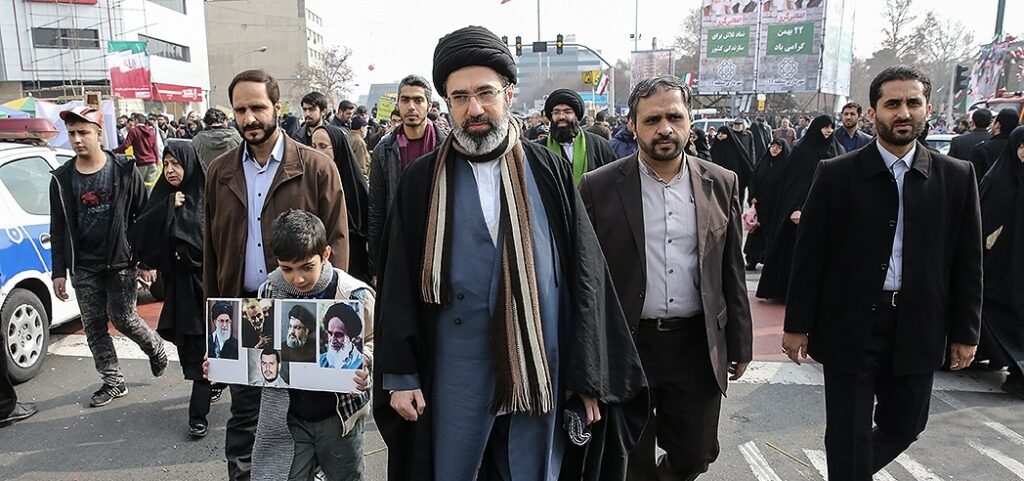
Mojtaba Khamenei with his children at a march in 2017. Photo: Wikimedia Commons.
Mojtaba Khamenei with his children at a march in 2017. Photo: Wikimedia Commons.
By Aseel Saleh – Mar 11, 2026
The appointment of Supreme Leader Mojtaba Khamenei underscores Iran’s political cohesion during the time of war, and its intention to continue military confrontation with Israel and the US.
Iran’s Assembly of Experts announced on Sunday, March 8, the appointment of Ayatollah Seyed Mojtaba Khamenei (56) as the third supreme leader of the Islamic Republic.
The announcement came several days after his predecessor and father, Ayatollah Seyed Ali Khamenei, was assassinated in a US-Israeli airstrike that targeted his office in the Iranian capital of Tehran.
For many, the swift selection of Mojtaba Khamenei implies the Iranian political leadership’s resilience in the face of attacks, the high-level of elite cohesion, and its ability to maintain consensus amid an existential crisis caused by the ongoing aggression against the Islamic Republic.
Iran’s complex decentralized power structure complicates US plans for “regime change”
Although the US has, for decades, attempted to topple the Islamic Republic’s leadership, the country’s complex power structure has made its dismantling far from attainable.
While the supreme leader represents the highest political and religious authority, power-sharing and decision-making is also distributed through different decentralized government institutions and actors.
The structure includes the judiciary, whose head is appointed by the supreme leader, alongside the parliament and the president, who are elected but vetted by the Guardian Council, which also vetoes unconstitutional legislation passed by the parliament.
Meanwhile, the Expediency Council provides advice to the supreme leader and settles disputes between the Guardian Council and the parliament.
There is also the Assembly of Experts that comprise 88 clerics, with the role of overseeing the supreme leader, and selecting a new supreme leader in case of death, dismissal or resignation.
Moreover, a mechanism has been implemented to recalibrate the supreme leader’s absence until his successor is selected, by allowing a group of three persons to fill his place. These persons include the president, the head of the parliament and a member of the Guardian Council, who should be chosen by the Expediency Council.
The Iranian Armed Forces, the Iranian Revolutionary Guards Corps (IRGC), the Supreme National Security Council, and the Ministry of Intelligence and Security (MOIS) are part of this power structure as well.
Who is Mojtaba Khamenei?
According to media reports, Mojtaba is the second son of the late supreme leader, who despite never running for office or elections, has considerable political clout and well-established experience in military and security-related matters, in addition to being a religious cleric.
He gained ample knowledge on major administrative matters and policy decisions in his role as the key aide to the late supreme leader for several years.
Even though he has always sought to keep a low profile, it is said that the new supreme leader has had strong ties with the IRGC, since he served in its 27th Division in the Iran-Iraq war (1980-1988).
Many of Mojtaba’s comrades in arms have held senior positions in the security and intelligence apparatus ever since, which may further consolidate his influence.
The IRGC is known as a hardline, premier military, political, and economic force, with a deeply entrenched anti-western and anti-imperialist ideology.
This in turn foreshadows a minimal likelihood that Iran would again seek negotiations with the US to end the war, at least in the immediate-term, under Mojtaba’s rule.
Under Fire, Not Divided: Why Iran’s Ethnic Front Has Not Cracked
US officials “disappointed” by selection of new Supreme Leader
US President Donald Trump expressed his disappointment about the selection of Mojtaba Khamenei as Iran’s new supreme leader during a press conference on Monday, March 9.
“I don’t want to say that, but you know, but I was disappointed because we think it is going to lead to just more of the same problem for the country, so I was disappointed to see their choice.”
Trump had declared his rejection to Mojtaba becoming his father’s successor even before his official appointment was announced.
“I’m not going through this to end up with another Khamenei,” the US president told Time Magazine last Wednesday.
United States Senator and Iran war hawk Lindsey Graham also slammed the selection of Mojtaba Khamenei in a social media post, threatening that he will “meet the same fate as… his father”.
“When it comes to the future of the region and that of the Iranian people, the son of the late murderous ayatollah is not the change we’re looking for. He has lived large as the Iranian people have suffered and he’s been on the front lines of pushing hate because he too is a religious Nazi. I believe it’s just a matter of time before he meets the same fate as that of his father – one of the most evil men on the planet,” Graham wrote.
Israel threatens to assassinate Mojtaba before his appointment was announced
The Israeli Occupation Forces (IOF) warned Iran’s Assembly of Experts on Sunday, that it will pursue every person involved in selecting the new supreme leader, before its members convened to appoint a successor for Ayatollah Ali Khamenei later that day.
“Iran’s Assembly of Experts, which has not convened for decades, will soon gather in the city of Qom. We want to tell you that the hand of the State of Israel will continue to pursue every successor and every person who seeks to appoint a successor,” the IOF said on X.
The IOF’s spokesperson, Ella Waweya, also threatened on X, that Israel will target the successor himself.
“Israel’s long arm has not and will not stop. Everyone who tries to inherit the throne of terror, and everyone who participates in installing a successor to a regime that ignited wars and destruction in the region will know that the reckoning is not over yet.”