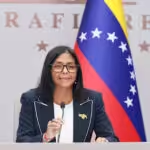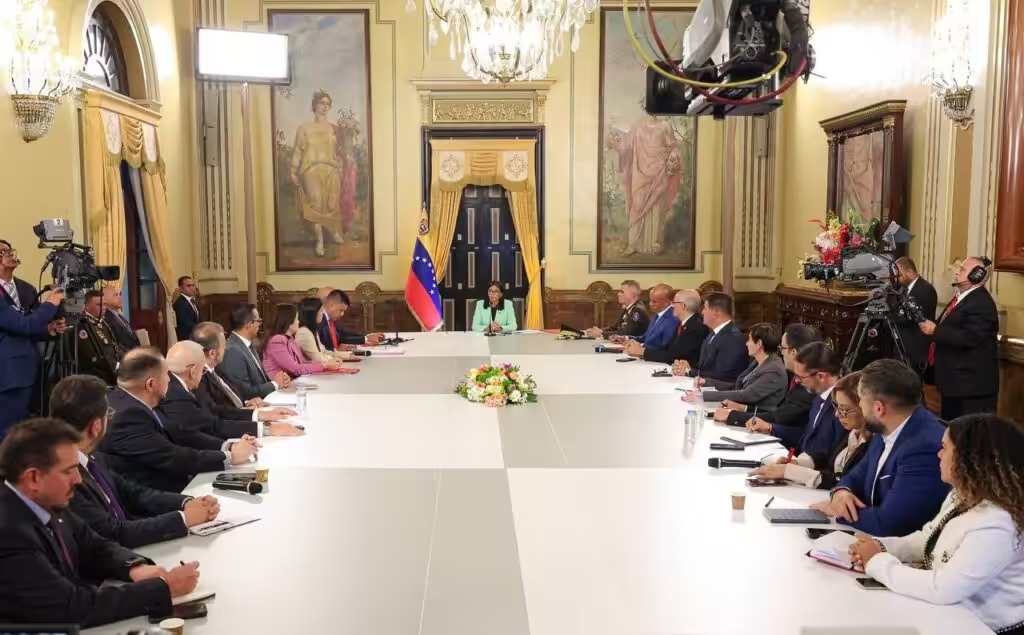
Venezuela's Acting President Delcy Rodríguez at the start of the 2026–2031 legislative constitutional term, during a ceremony at the Simón Bolívar Hall of Miraflores Palace in Caracas, January 7, 2026. Photo: Venezuelan Presidential Press.
Venezuela's Acting President Delcy Rodríguez at the start of the 2026–2031 legislative constitutional term, during a ceremony at the Simón Bolívar Hall of Miraflores Palace in Caracas, January 7, 2026. Photo: Venezuelan Presidential Press.
Caracas (OrinocoTribune.com)—Venezuela’s Acting President Delcy Rodríguez has reaffirmed that Venezuela’s energy relations will continue to be diversified, despite the latest colonial attacks attempting to appropriate the sovereign nation’s resources.
In a national television broadcast this Wednesday, January 7, she once again condemned the intentions of the US empire to steal the oil wealth and natural resources that the Venezuelan nation possesses, which she identified as the real reason behind US military attacks against Venezuela last Saturday.
“We have had a very clear position here, that Venezuela is open to energy relations where all parties benefit, where economic cooperation is very well defined in commercial contracts,” she stated firmly at the start of the 2026–2031 legislative constitutional term, during a ceremony at the Simón Bolívar Hall of Miraflores Palace in Caracas, accompanied by the ministerial team and the leadership of the National Assembly, including members of the opposition.
Rodríguez’s statements come in a context where US spokespeople, supported by their international media machine, are attempting to impose the narrative that they allegedly control Venezuela and its oil industry, and where Donald Trump and his administration continue to publicly admit to the world their desire to steal Venezuela’s oil wealth and other natural resources, while threatening to kill the Chavista leadership.
The acting president emphasized that Venezuela is going through a complex political moment after the US colonial violation of Venezuela’s sovereignty, an event she described as “a stain on our relations that had never existed in our history.”
“The relationship between the two countries is neither extraordinary nor regular,” she explained. “However, 71% of Venezuelan exports are concentrated in eight countries, and of that 71%, 27% are destined for the US.”
“Those who have excluded themselves from relations with Venezuela are the ones who have lent themselves to attacking our country,” Rodríguez continued. “It hasn’t been Venezuela. That’s why I’ve said that Venezuela is not at war. Venezuela is a peaceful country that was attacked by a nuclear power,” she added, while reiterating that the nation’s hands remain extended for economic, commercial, and energy cooperation with all nations that respect its sovereignty.
During the ceremony, the acting president directed several calls to opposition deputies present to understand the extraordinary times Venezuela is living through, in order to unite to achieve peace, harmony, and economic growth. She also expressed the willingness of the government to work in that direction, clarifying that recent unprecedented events are the result of actions taken by the far-right opposition.
Legislative agenda
During the ceremony, the president of the National Assembly, Jorge Rodríguez, announced a comprehensive reform of the Venezuelan legal system, which includes the creation of eight major specialized codes to simplify the country’s legal framework.
Analysts suggest these codes may represent a partial, pragmatic translation into reality of the constitutional reform proposed by Chavista legislators last year, now adjusted under current extraordinary circumstances.
“I believe it is time to bring order to the current Venezuelan legislative tree,” Rodríguez stated, proposing that existing laws be consolidated into modern instruments.
The legislative agenda for the new period will focus on six central axes: peace, economic growth, people’s power, new economic modalities (entrepreneurship), the defense of life, and the security of Venezuelans. These are summarized in the following proposed instruments:
• Popular Penal Code, and renewed Civil Code.
• Venezuelan Social Code, to group guarantees and protection programs.
• Economic and Productive Trade Code, adapted to the “new reality of the economy.”
• Electoral Code, to unify all laws on the matter.
• Code of Direct Democracy.
• Environmental Ecological Code.
• Comprehensive Protection Code, for vulnerable people.
Jorge Arreaza at Massive Chavista Demonstration: US Attacks ‘Deepen the Bolivarian Revolution’
Legislative proposals
The agreed legislative agenda prioritizes a shift toward a non-rentier economy, strengthening the capabilities of strategic sectors. The key legislative proposals presented by Jorge Rodríguez include:
• Reform to the Mining Law: Aimed at attracting investments that allow the development of gold, bauxite, diamond, and rare earth reserves, strictly for the benefit of the people.
• Export and Import Committee (COMEX) Law: With the objective of diversifying non-oil exports and limiting imports to what is strictly necessary.
• Law on Socioeconomic Rights: An advance in the system of agreed prices to combat speculation and protect workers’ income.
• Update to the Industrial Property Law: To encourage invention and national technological development, recognizing the fundamental role of the working class in the resistance against the blockade.
• Artificial Intelligence and Natural Medicine: As a reminder that “science is not for making nuclear bombs and destroying entire peoples.”
• Digital Rights and Cybersecurity: As social media platforms are a “deadly weapon against humanity, and must be a space where we can preserve the sovereignty, security, and lives of Venezuelans.”
• Energy and Electricity: Given the attacks Venezuela has suffered due to the “energy voracity of the North.” He stated there will be upgrades and improvements to the generation, transmission, and distribution of the National Electric System. “This is one of the sectors where the blockade has done the most damage, and we have made progress in the recovery of the Electric System,” he explained, “but the Venezuela we aspire to requires growth and demand from its electrical system.”
• Telecommunications: To update Telecommunications Law to current technological standards.
• Law of Peace and Coexistence: “Just as a parliament serving foreign powers cannot be permitted,” he explained, “neither can extremist and fascist social, political, or economic expressions, because they have led to very dangerous situations for the life of this Republic.” He added that the rise of extremism has led to certain groups that, on their knees, “offer up our country, our riches, and compromise our national sovereignty.”
Jorge Rodríguez recalled that the January 3rd attack was instigated, requested, supported, and backed by Venezuelan extremism and fascism. “This cannot be allowed,” he reiterated.
Special for Orinoco Tribune by staff
OT/JRE/AU