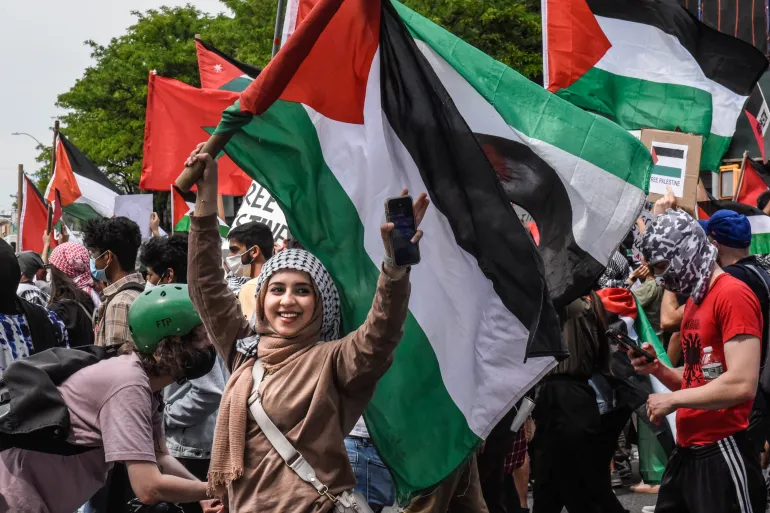
People participate in a pro-Palestinian rally calling for an end to the Israeli occupation in the Queens borough of New York City, US. Photo: Stephanie Keith/Getty Images/AFP.
People participate in a pro-Palestinian rally calling for an end to the Israeli occupation in the Queens borough of New York City, US. Photo: Stephanie Keith/Getty Images/AFP.
The Asia-Pacific News Update expands on the Afghanistan News Update, providing updates, resources, and analysis on U.S. imperialism across the regions—from the Philippines, Korea, Kanaky and Hawai’i to Palestine, Iran and Afghanistan. With each edition, we aim to strengthen the public’s awareness and understanding of U.S.-led militarization across Asia and the Pacific, while mobilizing support for regional struggles against the U.S./EU/NATO Axis of Domination.
In this edition of the Asia-Pacific News Update, BAP’s Asia-Pacific team interviews members of Tariq el-Tahrir, an emerging international network of Palestinian, Arab, and internationalist youth, students, and organizations contributing to the movement for Palestinian liberation. We discuss Tariq el-Tahrir’s organizational activities, connections between the liberation of Palestine and the liberation of oppressed peoples within the U.S., and contradictions within the Palestine movement in the U.S.
Asia-Pacific News Update: What is Tariq el-Tahrir? Can you tell us about the motivation behind forming this new network, as well as its political outlook and some of the work you’re doing?
Tariq el-Tahrir: The Tariq el Tahrir Youth and Student Network was founded at the fourth annual conference of the Masar Badil (Palestinian Alternative Revolutionary Path Movement), which brought together activists from around the world, including youth and students, Palestinians, diaspora Arabs, and internationalists. Throughout the conference, we conducted several discussions on the diverse needs, challenges, and experiences specific to each of our local circumstances after the rise and repression of the first wave of the student intifada in the Spring and Summer of 2024. Through these discussions, we came to understand that the Palestinian Revolution today is at a critical juncture. Our motivation for forming this network stemmed from an understanding that the project of the Oslo Accords and its successive political implementations systematically dismantled the vital organizational structures of the Palestinian national movement and sidelined the Palestinian diaspora. In the years following Oslo, the institutions of the revolution that had once connected the homeland with our brothers and sisters in the diaspora were intentionally liquidated. We aim to rebuild those structures, to reconnect the forces of return, resistance, and exile, and to re-activate the Palestinian diaspora, formerly isolated by Oslo’s logic of confinement, so that they may assume once again their rightful place in the struggle for national liberation.
Our political outlook is rooted in the Palestinian cause for return and liberation, in the Arab dimension of that cause, and in a broader internationalist horizon. We affirm the centrality of Palestine, from the river to the sea, as an Arab question and as an emancipatory issue for humanity at large. We believe that the Palestinian people, the Arab people, and the international anti-colonial movement must stand together in solidarity and common purpose. The Tariq el Tahrir Network, therefore, seeks to link the Palestinians within occupied Palestine and those in exile so that the diaspora becomes an active force in the larger camp of resistance, not a passive bystander.
In this spirit, we reject the normalization, fragmentation, and compartmentalization imposed by the occupation and the traitorous Palestinian Authority protecting it. We commit ourselves to forging an alternative path towards liberation, an alternative not to the resistance, but to Oslo and its path of capitulation.
Asia-Pacific News Update: The Masar Badil has stated that the Al-Aqsa Flood “disrupted the calculations of the forces of normalization.” Within the imperial core of the United States and Western Europe, how can the fight for a liberated Palestine and an end to U.S. imperialism maintain and escalate this disruption in light of the “ceasefire” agreement that the zionist entity continues to violate?
Tariq el-Tahrir: The Palestinian revolution does not need sympathy; it needs comrades. Our task is to transform solidarity into organized struggle—reactivating the diaspora and all internationalist strugglers back into the Palestinian Revolution. As we have stated in our introduction co-written with BDS Providence to a republication of the Palestinian National Charter, we must meet the needs of this moment to escalate by not only “rhetorically supporting the resistance, but also developing a strategy – through trial and error – to escalate the struggle within imperialist countries to higher levels of militancy. Although peaceful protest and legislative work can play an important support role within such a strategy, excessive reliance on these tactics has failed to halt Zionism-imperialism’s genocide and cannot substitute for the more militant forms of action necessary to contribute meaningfully to the liberation of Palestine.”
All of the acts of resistance in the diaspora of the last 2 years are justified and must continue if we are to meet our responsibilities to be true partners to the Palestinian and regional resistance, and begin to meet our own obligation to join them in a global camp of resistance. Everywhere, we must enable the masses to participate in their own liberation movement and in the defeat of both the zionist movement outside of Palestine and imperialism.
We must also continue to build Palestinian, Arab and Internationalist popular institutions and organizations that can concretely sustain our bridges to the resistance. This includes withstanding and pushing back against the countless racist, anti-migrant and counterinsurgency laws. This involves building together with, rather than in isolation from, the Palestinian, Arab-Iranian and international revolutionary forces outside of the imperial core; whether they be journalists affiliated with the factions or freed prisoners or resistance leaders. We can only work out an effective strategy together because we are ultimately one movement.
Asia-Pacific News Update: Despite the upsurge in the movement for a liberated Palestine in the imperialist countries, it’s also clear that this movement is weakened by internal contradictions. Demilitarize Brooklyn Navy Yard recently published an open letter with their own analysis of these contradictions; for example, the excessive focus on mass mobilizations at the expense of longer term organizing campaigns or the material disruption of military supply chains. To their list we could add the limited public support for political prisoners like Elias Rodriguezand Casey Goonan. What do you see as some of the principal contradictions within our movement today, and how can we struggle to overcome those contradictions?
Tariq el-Tahrir: The growing wave of solidarity for Palestine across the imperial centers and the world at large in light of the Al-Aqsa Flood Operation launched on 7 October reflects a deepening global crisis of legitimacy for imperialism—but from our position within the Palestinian revolutionary movement, it also reveals urgent contradictions that must be confronted.
The first contradiction is the dominance of symbolic activism over material confrontation. Marches and statements are useful tools, but they cannot dismantle imperialism’s infrastructure alone. Real solidarity must strike at the heart of the system—disrupting weapons production, Zionist capital, and normalization projects. Additionally there is the schism between Palestine organizations that distance themselves from the resistance in the region and those which see their role as being a popular cradle for the regional resistance.
The second contradiction is the isolation of Palestine from the wider anti-imperialist front. Many Palestine organizations in the imperial core speak of “human rights” while refusing to name U.S. militarism, NATO intervention, and the comprador regimes that sustain occupation. On the other hand, some anti-imperialist, migrant and left organizations use repression as an excuse to boycott Palestine organizations–splintering the forces against our shared enemy.
A third contradiction manifests in the neglect of political prisoners and revolutionary strugglers such as Elias Rodriguez and Casey Goonan. To abandon those who sacrifice for the cause is to abandon the cause itself. Likewise, NGO-ization was no accident, born from the Oslo process—it was engineered to strip the movement of its revolutionary teeth. Resistance became a buzzword, militants were turned into administrators, and the fight for liberation was transformed into a career path managed by the same powers that sustain colonialism. An important corrective to this trend was issued by Samidoun in its zine “What to do when you too become a terrorist.”
We overcome these contradictions by re-centering the Palestinian revolution as the backbone of a renewed internationalist movement—by rebuilding the diaspora as an active revolutionary front, linking struggles from the Black and Indigenous liberation movements to Latin America and the Philippines, while standing in loyalty to our prisoners, martyrs, and fighters. The struggle for Palestine is not a moral appeal; it is our revolutionary duty. To stand with Palestine means to fight the empire that sustains its colonizer.
US Imperialism in Crisis: Opportunities and Challenges to a Global Community With a Shared Future
Asia-Pacific News Update: U.S. militarism in West Asia has cemented itself via U.S. Central Command (CENTCOM), which oversees an estimated 58 U.S. military bases and installations across 10 countries. Tariq el-Tahrir’s foundations of struggle make clear that the Palestinian peoples’ fight against zionism is inherently an anti-imperialist struggle. What role does the Palestinian liberation movement play in the global struggle against U.S.-led imperialism?
Tariq el-Tahrir: U.S. militarism in West Asia, entrenched through CENTCOM and its network of bases, represents the core of imperialist domination over the region. These bases secure reactionary regimes, enforce dependency, and protect Zionist colonization. Yet beyond these installations stands the most powerful and strategic U.S. military base of all: the Zionist entity itself, serving as an armed colonial fortress which was created on behalf of and continues to exist in service of the interests of Western capital – imposing imperial control, regional fragmentation, and the suppression of Arab liberation.
The Palestinian struggle, grounded in the liberation of all of Palestine, from the river to the sea, is a revolutionary struggle against this very system of imperialism. It directly confronts the nexus of U.S. military power, global capitalism, and settler-colonial Zionism. Each act of resistance—whether in Gaza, Jenin, or the refugee camps—shatters the illusion of imperial permanence and exposes the vulnerability of the empire’s project. The steadfastness of the Palestinian people demonstrates that liberation is not only possible but inevitable when rooted in popular struggle and revolutionary organization.
The Palestinian liberation movement occupies a vanguard position in the global anti-imperialist front. It is not an isolated cause but a unifying struggle that connects all peoples confronting domination—from Latin America to Africa, from the Philippines to the Arab homeland. To stand with Palestine is to stand against U.S. imperialism, against the comprador classes that serve it, and against the global system of exploitation that sustains it.
Asia-Pacific News Update:In the two years since the Al-Aqsa Flood, we’ve seen a massive rise in popular consciousness around the history and current realities of the Palestinian national liberation struggle. Are there any political education resources you’d recommend to strengthen our ideological clarity? Finally, how can individuals and organizations support, collaborate with, or join the work of your organization?
Tariq el-Tahrir: One of the blessings of the Flood is that the leadership of the Palestinian Revolution has never been clearer for the diaspora. It is the honorable and steadfast movements of Hamas, along with Palestinian Islamic Jihad and other forces of the Islamic national resistance in the region, such as AnsarAllah and Hezbollah, who are morally, politically, militarily, and ideologically leading the way. There are many exciting projects initiated primarily by unpaid volunteers on social media to translate the work of the media offices of these resistance movements into English and Spanish, including contributions by our comrades at Samidoun: Palestinian Prisoner Solidarity Network and the Dismantle Damon and free Palestinian Students campaigns.
The Masar Badil and Tariq El-Tahrir are also informed by the total historical experiences of the Palestinian and Arab people, including of course the nationalist and revolutionary left currents whose historical documents are readily available for study. In particular, the analysis of the friends and enemies of the Palestinian Revolution laid down by the Popular Front’s Strategy for the Liberation of Palestine in 1969 and Ghassan Kanafani’s writings are our faithful guides. Additionally, we recommend our series of media interviewswith resistance leaders directly involved in the liberation struggle. And of course alongside millions of others, we follow and eagerly await the speeches, or what we call the “weekly report”, that Sayyed Abdul-Malik Badr Al-Din Al-Houthi presents to the free people of the world. We would love to connect with interested organizations and individuals. Please send us your links, news, and calls to action, proposals for events, and more. We welcome new folks who would like to work with us, invitations to speak, or ideas for new actions, delegations or events. Use the form on our website to contact us or email us at info@tariqeltahrir.org.