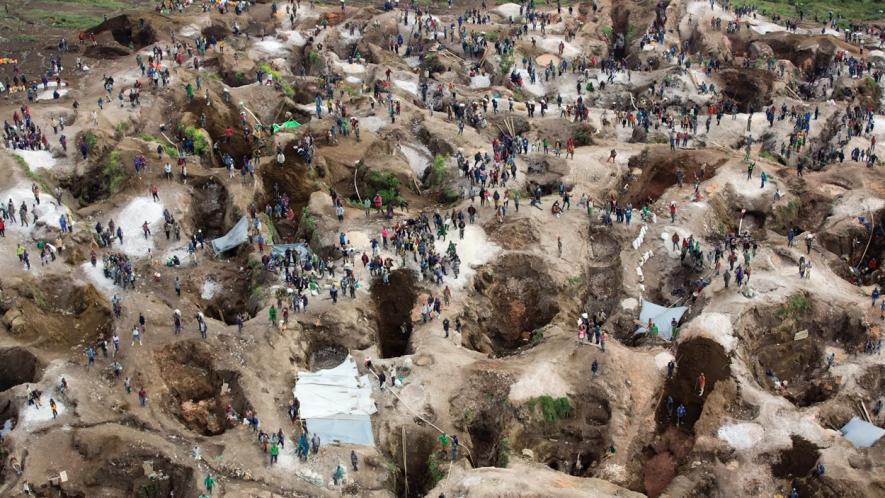
Luwowo Coltan mine near Rubaya, North Kivu. At the time the photo was taken in 2014, the Luwowo mine was believed to be conflict free. Photo: Sylvain Liechti/MONUSCO.
Luwowo Coltan mine near Rubaya, North Kivu. At the time the photo was taken in 2014, the Luwowo mine was believed to be conflict free. Photo: Sylvain Liechti/MONUSCO.
By Nicholas Mwangi – Apr 21 2025
Kinshasa’s pivot towards the US for security in exchange for minerals has alarmed activists who say that the US is responsible for the ongoing violence in the country’s east.
The Democratic Republic of the Congo (DRC), a country endowed with some of the world’s most coveted minerals, continues to be at the heart of global geopolitical interests. And this time, the stakes are higher.
As M23 rebels continue to gain ground in the eastern provinces of the DRC, the embattled government of President Felix Tshisekedi, facing rising unpopularity and legitimacy questions, appears to be inching closer to a controversial deal with the United States: security assistance in exchange for strategic mineral access. The details of the deal, timelines, and key points have yet to be announced, but officials from the Trump administration have told the press that negotiations continue.
At the center of these unfolding negotiations is Erik Prince, founder of the notorious private military company Blackwater and a close ally of US President Donald Trump. According to a report published by Reuters on April 17, Prince is brokering an agreement that would position him to oversee the security and taxation of mineral extraction in the mineral-rich nation.
Given Blackwater’s infamous record of violence and impunity during the Iraq War, along with the company’s subsequent rebranding, Prince’s involvement signals a troubling turn. Instead of the DRC moving in a sovereign path, Tshisekedi appears to be opening the doors to the US and its private companies to operate in the country and have access to the DRC’s sovereign wealth.
The deal that wasn’t debated
What’s alarming is not merely the substance of the potential deal between Washington and Kinshasa, but also the process. Or rather, the absence of it. The announcement of the deal did not come from Parliament or the National Assembly, it was revealed through the press. As Kambale Musavuli, a Congolese analyst pointed out to Peoples Dispatch, “Can you imagine that a whole country is making a decision on a mineral deal, and Parliament never discussed it?”
The Congolese constitution nominally vests ownership of the country’s land and resources in the state, but the lack of popular or parliamentary oversight raises profound questions. “The contradictions of the Congolese Constitution are being exposed,” said Musavuli. “Legal experts are now debating whether the president even has the authority to make such sweeping deals unilaterally.”
What’s at stake is not merely legality, but also legitimacy.
A crisis of sovereignty
The larger backdrop to this unfolding deal is the resurgence of M23, a rebel group long accused of operating with the backing of neighboring Rwanda and Uganda both of whom have enjoyed US military and political support over the years. In Musavuli’s view, this casts an ominous light on any purported US military assistance: “Why should the DRC go to the US when, for all intents and purposes, they are the ones arming, training, and equipping the Rwandan and Ugandan militaries?”
Civil society actors, particularly from mineral-rich Katanga province, have issued statements condemning any mineral-for-security arrangements that bypass the Congolese people. Yet their voices have been conspicuously absent from international headlines. Which denies its right as a sovereign nation with its own people, political will and agency.
Stewart Muhindo, a member of the civil society movement LUCHA, echoes this sentiment. “Congolese are not enthusiastic about this deal. We are pessimistic. Foreign interventions have done nothing for years. We don’t think solutions for our problems can come from other countries. We need to build our country ourselves.”
Sovereignty undermined
The geopolitical tensions and interests vying for control over critical minerals only intensify the internal contradictions of the DRC. As Musavuli explains, the crisis is not just external: “We also have our local comprador class, who are in bed with the West. These leaders do not serve the interests of the Congolese people. The future is being sold without their consent.”
This dual crisis, external intervention and internal collaborationism, mirrors the dilemmas that haunted Congo’s post-independence era. Patrice Lumumba’s assassination in 1961 at the hands of Western-backed conspirators marked the beginning of decades of resource extraction at the expense of national sovereignty. Today, in 2025, the echoes of Lumumba’s dream still haunt the Congo, that its land belongs to its people not to corporations, multinationals, or foreign armies.
Looking at the Sahel’s fight for Sovereignty
In stark contrast, the Sahel region is witnessing a resurgence of popular anti-imperialist politics. Countries like Mali, Burkina Faso, and Niger have rejected French and Western military partnerships, opting instead to nationalize resource control and assert regional autonomy. “They are following Nkrumah’s ideas,” said Musavuli. “They are saying the resources should benefit the people.”
Yet in Kinshasa, the direction appears reversed. The leadership’s desperation to stay in power, amid mounting insecurity and waning legitimacy, has pushed them toward the very powers that have long destabilized the country. If the reported deal with Washington goes through, it will not represent Congolese empowerment, but Congolese submission for its minerals.