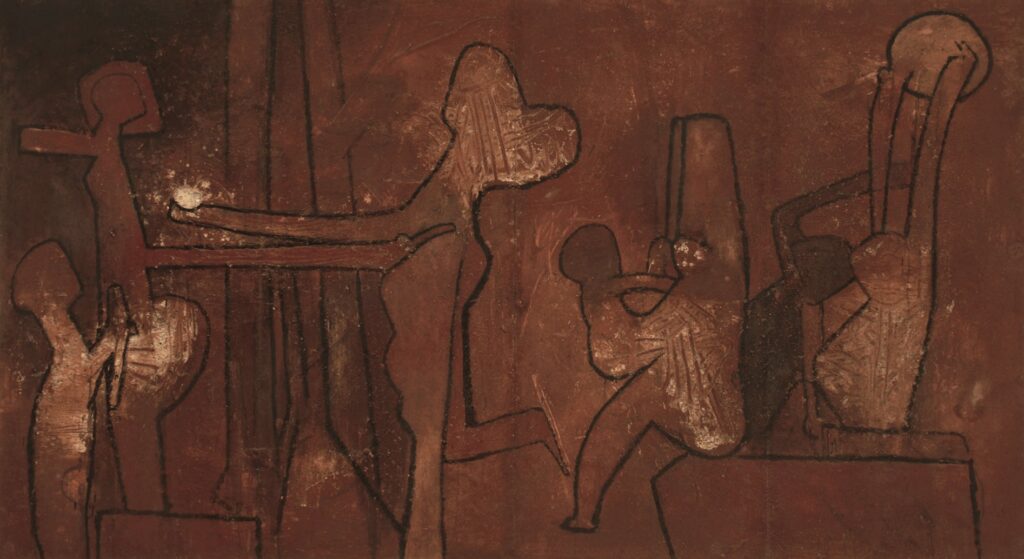
Cuba es la capital ("Cuba is the capital), soil and plaster on Masonite (mural) (1963), by Roberto Matta (Chile). Located at the entrance to Casa de las Américas, in Havana, Cuba.

Orinoco Tribune – News and opinion pieces about Venezuela and beyond
From Venezuela and made by Venezuelan Chavistas
Cuba es la capital ("Cuba is the capital), soil and plaster on Masonite (mural) (1963), by Roberto Matta (Chile). Located at the entrance to Casa de las Américas, in Havana, Cuba.
By Vijay Prasad – Mar 19, 2026
On 13 March 2026, President Miguel Díaz-Canel Bermúdez gave a press conference in Havana, Cuba. The country has been wracked by a worsening fuel and electricity crisis produced by the long-standing illegal US blockade, which the Trump administration tightened further in early 2026 by effectively cutting off oil shipments to the island. On 29 January, Trump issued an executive order filled with the bluster of falsehoods – including the claim that Cuba ‘welcomes transnational terrorist groups, such as Hezbollah and Hamas’ – and threatened tariffs against any country that tried to send oil to Cuba.
Cuba produces about a 40% of the fuel it needs and imports the rest – mostly from Mexico and Venezuela. After the kidnapping of Venezuelan President Nicolás Maduro, Venezuela was forced to stop shipments to Cuba, while Mexico halted shipments under the threat of US tariffs. Cuba has not received oil since the first week of January. In early February, Deputy Prime Minister Oscar Pérez-Oliva Fraga said that the Cuban government would direct the remaining fuel to essential services – education, healthcare, and the supply of water and food. It was in this context that Díaz-Canel announced that Cuba and the United States had begun ‘a very sensitive process’ of talks aimed at addressing bilateral problems and taking ‘concrete actions for the benefit of the people of both countries’.
A few days before the press conference, a delegation from the International Peoples’ Assembly met with Díaz-Canel, who told us that the situation in Cuba is very difficult but that his government is doing everything it can to alleviate the hardship faced by the Cuban people. At the same time, he said, the revolution would not abandon its socialist principles of sovereignty and dignity. The quiet conviction with which Díaz-Canel spoke comforted us, and his words reflected what we heard from the people we spoke to across Havana (we could not travel beyond the capital because of the fuel crisis created by the oil blockade).
Trump’s latest assault on Cuba is a continuation of the illegal US blockade that began on 7 February 1962, when US President John F. Kennedy signed Proclamation 3447 under Section 620(a) of the 1961 Foreign Assistance Act, and was later consolidated in July 1963 under the authority of the 1917 Trading with the Enemy Act. Kennedy’s move expanded the earlier trade restrictions imposed in 1960 and transformed them into a comprehensive ban on nearly all commercial and financial relations between the United States and Cuba. The blockade’s extraterritorial reach deepened over time, especially after 1991: the 1992 Torricelli Act barred foreign subsidiaries of US companies from trading with Cuba and imposed a 180-day restriction on vessels involved in trade with the island, and the 1996 Helms-Burton Act further – and illegally – extended the blockade’s reach to third countries and foreign companies.
The policy, then as now, is explicitly designed to weaken a Cuba that had sought to chart a sovereign path out of subordination, first to Europe and then, after 1898, to the United States. The United States used the blockade to punish Cuba for its defiance of US control and for the example that Cuba had begun to represent for other countries of the Third World. From the outset, the blockade’s intent went beyond diplomacy: internal US government documents reveal a strategy explicitly aimed at generating ‘economic dissatisfaction and hardship’ in Cuba to provoke political change. The blockade grew more complex and punitive over time. Rather than easing pressure during Cuba’s Special Period, which followed the fall of the Soviet Union when the island had lost its principal trading partner, the United States tightened its policy still further. Such extraterritorial enforcement directly conflicts with international trade norms and the sovereign rights of other states.
The US blockade of Cuba is widely accepted to be illegal under international law because it violates core principles of state sovereignty, non-intervention, and the right of other states to engage in lawful trade. These principles are enshrined in the United Nations system and, most importantly, in the 1945 Charter of the United Nations, which affirms the sovereign equality of states, prohibits the threat or use of force against their territorial integrity or political independence, and forbids intervention in matters essentially within their domestic jurisdiction. For the sake of clarity, it is worth referring to the main legal principles and instruments that the United States has flouted since 1962:
Apart from these explicit treaties in the United Nations system, there is also an older tradition of customary international law that protects freedom of international trade and that prohibits extraterritorial jurisdiction over third states. The blockade violates the principles of sovereign equality by attempting to dictate Cuba’s internal political and economic system. Its explicit intent to cause economic hardship constitutes unlawful intervention and coercion. The extraterritorial enforcement of US sanctions unlawfully interferes with the sovereign rights of third countries and their nationals. The absence of any United Nations Security Council authorisation further underscores the unilateral and coercive character of the blockade.
‘This Is Our Moncada, Our Bay of Pigs,’ Says Young Cuban Communist Leader
Every year since 1992 (except for 2020 when Covid prevented a vote), the United Nations General Assembly has overwhelmingly voted to condemn the blockade of Cuba, describing it as contrary to international law and the UN Charter. These resolutions emphasise that the policy violates Cuba’s right to self-determination and obstructs normal economic relations between states.
While General Assembly resolutions are not legally binding, their consistency and near-universal support demonstrate a strong international consensus on the illegality of the measure. When the General Assembly held its most recent vote in October 2025, 165 out of 193 member states voted to end the blockade. Among them were some of the world’s most populous countries, such as Brazil, China, Nigeria, India, Indonesia, and Pakistan. Taken together, the countries that voted in favour represent approximately 92% of the world’s population. By any measure, the bulk of the world’s peoples oppose this illegal blockade.
A nurse at the Institute of Neurology and Neurosurgery in Havana told me that it takes her over two hours to get to work from her home, but that she sees this inconvenience as part of her mission within the Cuban Revolution. It made me want to cry to hear the staff at the hospital talk about their commitment to their patients and to the Cuban revolutionary process. Because of the oil blockade and the resulting power fluctuations, the surgeons and nurses worry about performing delicate brain surgery. Their patients – some suffering from epilepsy or brain tumours – simply must wait.
Dr. Orestes López Piloto, the director of the hospital, walks me through the main ward. “I come from the southern part of Oriente [in eastern Cuba]. My family are workers and farmers, Black people who worked the soil,” he told me. “I am a doctor and a surgeon because of the revolution. And because of it, I am at one of the main medical centres of the country.” He looked directly into my eyes and said, “There are people who are against the revolution. But there are many more of us who are for it. And we are not afraid.”
Vijay Prashad is an Indian historian, editor, and journalist. He is a writing fellow and chief correspondent at Globetrotter, a project of the Independent Media Institute. He is the chief editor of LeftWord Books and the director of Tricontinental: Institute for Social Research. He has written more than 20 books, including The Darker Nations: A People’s History of the Third World (The New Press, 2007), The Poorer Nations: A Possible History of the Global South (Verso, 2013), The Death of the Nation and the Future of the Arab Revolution(University of California Press, 2016), and Red Star Over the Third World (LeftWord, 2017). He writes regularly for Frontline, the Hindu, Newsclick, AlterNet and BirGün.