Dorothy Granada: ‘The Dearest Thing to my Heart is the Revolution’
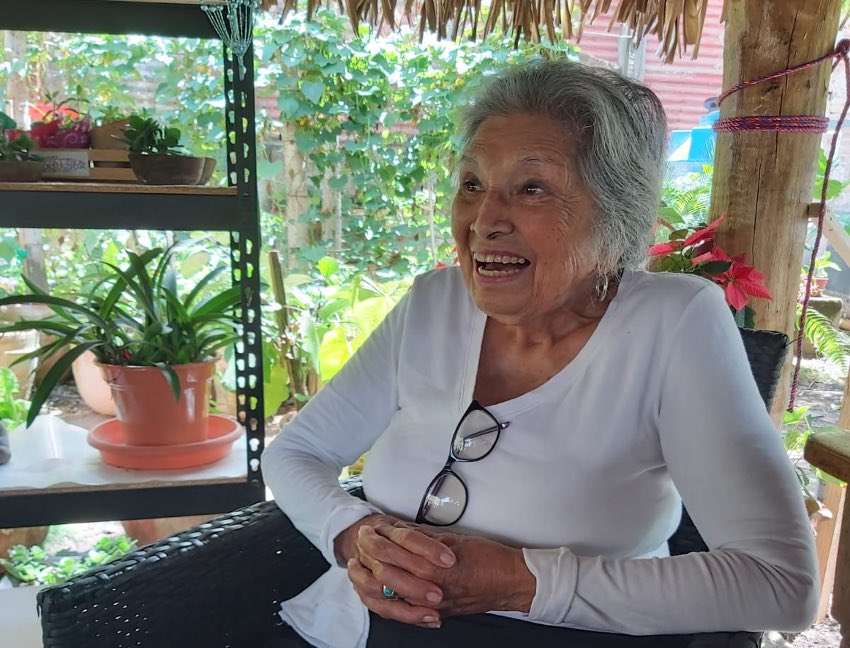
Dorothy Granada. File photo.

Orinoco Tribune – News and opinion pieces about Venezuela and beyond
From Venezuela and made by Venezuelan Chavistas
Dorothy Granada. File photo.
By Becca Mohally Renk – Mar 31, 2022
Becca lives with her husband Paul and their two children in Ciudad Sandino, and since 2001 has worked with the Jubilee House Community and its project the Center for Development in Central America.
When we arrive at her home near the cemetery in Nicaragua’s northern city of Matagalpa, 91 year-old Dorothy Granada is already standing in her doorway, calling out parking instructions and guiding us down the steep hillside where her house is perched.
“I fell and broke a rib recently,” she tells us. “It still hurts!” A friend has brought my husband Paul and me to meet Dorothy, a leader in peace and justice work and a legend in Nicaraguan solidarity. Dorothy bustles us into her house, which also serves as the office for Skills to Save Lives, a non-profit she founded to train lay midwives and work on violence prevention. Dorothy introduces us to the organization’s president, who is working at a computer a few feet from Dorothy’s bedroom. We meet three more members of the organization in the combined front room and kitchen, make a quick stop at the curtained bathroom, and then climb a steep set of stairs to Dorothy’s backyard garden.
Dressed in bright white with her salt-and-pepper hair pulled loosely back, Dorothy is a picture of elegance with a natural grace that belies her years. Settling back comfortably under a thatched roof in the garden, surrounded by her edible plants, Dorothy tells us her story, and why she has dedicated the past nearly 40 years to Nicaragua.
“The dearest thing to my heart is the Revolution: giving people a better life,” she explains.
RELATED CONTENT: The Gains of Nicaraguan Women During the Second Sandinista Government
A nurse since the age of 24, Dorothy became involved in the peace movement in the U.S. with her husband, carpenter Charles Gray; including starting the Nuremburg actions with S. Brian Willson and others to block trains transporting weapons to supply the U.S.-funded Nicaraguan Contras. In 1985, Dorothy and Charles had gone to Nicaragua as long term volunteers with Witness for Peace.
“Our job was to document the war and prove that it wasn’t a war between two belligerent forces, but that it was a war to destroy the infrastructure of the Sandinista Revolution. So we lived in the war zones,” Dorothy explains. After finishing their time with Witness for Peace, they moved to Nueva Segovia where Dorothy worked as a nurse with tuberculosis patients.
“Mid-war, healthcare was fantastic!” She exclaims. “[The Ministry of Health] did a wonderful job, they would give women pills for contraception; but there was no examination, there was no pap. Women never told them if they had discomfort…because women thought that’s to be ashamed of.” In her work, Dorothy had the opportunity to talk with patients one-on-one, and women continually came to her with gynecological issues.
“I thought I’d try to find a place for myself in the Revolutionary process. So I decided that what I really should do was establish a clinic for women in the campo. Safe, so women could be examined, and feel comfortable.”
Dorothy traveled the country looking for a group of organized women who wanted a health center. “We finally found one in Mulukukú, a cooperative of women had formed recently after Hurricane Joan.” The women of the Maria Luisa Ortiz Cooperative had lost everything in the hurricane, but they were rebuilding their homes with Habitat for Humanity. When Dorothy asked the cooperative what kind of health care they needed most, they answered, “contraception and natural medicine.” Together, they built a small clinic and began treating patients. The clinic grew as women began bringing their children and husbands to the clinic as well.
“In Nicaragua you never need a telephone,” laughs Dorothy, “word of mouth is much faster.”
The clinic developed a support network in the U.S. that raised money and brought volunteer medical workers several times a year, but it was impossible to hire full time medical staff.
“The Contras were killing nurses and doctors and a lot of people didn’t find that very attractive,” Dorothy shrugs. “So I, who was mostly an organizer all my life…ended up being a practitioner. I had five [reference] open books on my desk at all times, because I was pretty ignorant.” The co-op started a small laboratory to diagnose infections and continued to give preference to women, whose main demand was for family planning. Dorothy only remembers ever treating one woman who refused family planning.
“She was about 40 years old, she had about 10 children. I said, ‘Perhaps you would like to limit your family?’” The patient replied, “‘Oh no, I want all the babies that God sends me.’” Dorothy holds up one finger. “This was onewoman out of thousands. Now, she had a loving relationship with her husband, they had a farm, they had resources, all her children were healthy, she was healthy…so she had babies until she couldn’t have them anymore. And I’m sure God was pleased,” Dorothy smiles.
Mulukukú was a frontier town; for many years it was literally the end of the road to the North Caribbean Autonomous Region. In 1990, when the U.S.-funded neoliberal candidate won the Presidential elections, the war officially ended and Mulukukú became a designated resettlement area for former Contra fighters.
“So the Contra came in and just took over. My name appeared on death lists,” Dorothy remembers matter-of-factly. “The war didn’t really stop in Mulukukú until 1998. We had groups that really turned into bandits. So part of the time they killed Sandinistas, and part of the time they just robbed and took people hostage,” Dorothy shakes her head sadly. “All they had been taught to do was to put a gun at the end of their arm…Their spirits were destroyed.”
When public health care was effectively privatized in the neoliberal era, Dorothy’s clinic picked up the slack for the poor majority who couldn’t afford to pay. With another nurse and six lay workers, Dorothy provided care for 25,000 people in and around Mulukukú, always prioritizing women’s health, which included attending births and treating cancer.
By 2000, their efforts had gained the unwelcome notice of the neoliberal government of President Arnoldo Alemán, notorious for embezzling millions of dollars donated for Hurricane Mitch relief, at a time when much of Nicaragua was suffering extreme poverty. Ten years after losing the Presidential elections, the Sandinistas were making a comeback by winning local elections, including in Managua. “Critics say Alemán is still smarting from that setback,” reported Women’s eNews that year, “and venting his fury upon relief organizations and activists…whom he accuses of backing the Sandinistas.”
On Dorothy’s 70th birthday, December 8, 2000, a dozen heavily armed police arrived at her door in Mulukukú at dawn to arrest her, but found she wasn’t home. Friends had alerted her by radio and Dorothy had gone into hiding.
“The next thing I knew Arnoldo Aleman was trying to get me out of the country,” Dorothy recalls more than 20 years later. “He was attacking women’s groups. He didn’t think women should wear shoes or do family planning or learn how to read and write. So he was attacking women’s clinics. He learned about us and ‘Oh, there is a gringa there, she’s the reason, we have to get rid of her.’ So he went after me.”
Dorothy was accused of performing illegal abortions, refusing to treat Contras, and arming Sandinista groups. Dorothy denied the charges and the Nicaraguan government itself eventually found no evidence of these allegations in its own investigation.
“[Alemán] accused me of helping a renegade Sandinista group that was killing off the Contra killers who were stealing farms. [He said] I brought them guns. I said, ‘I’m a pacifist, I have nothing to do with guns.’ I don’t know how much he believed that, but I wouldn’t even know the right end of a gun! And I certainly wouldn’t be carrying guns to people.”
Dorothy’s response was to sue the government. “It wasn’t that I was so important,” she says, “just that I was an example of someone who wouldn’t take it. He was violating laws, by just picking me up and taking me out. I should have had an audience, a way of defending myself. But that wasn’t his way. He hated my guts, but I didn’t have anything against him,” she shrugs and smiles her brilliant smile. After three months underground, Dorothy won her court case.
“That, I have been told by various people, was the beginning of the end for Arnoldo Aleman, which I think I should be a little bit proud of!” She exclaims. It was, Dorothy explains, a moment Nicaraguans understood that their President was not acting in the best interests of the people – ten thousand people marched to support Dorothy.
“Because what [Alemán] was saying to the population was, ‘You cannot organize to meet your own needs.’ Well, the you-know-what hit the fan when the people got that message!”
Dorothy shakes her head at how Alemán could have misread the situation so thoroughly. “I know there are smart people on the right, but he didn’t have them as advisors.”
After Dorothy won her case, she came out of hiding and returned to Mulukukú to re-open the clinic and run it for another ten years. Today, the women in Mulukukú continue their work, now as a private clinic.
Public health care in Nicaragua is free and expanding rapidly – in Mulukukú there is a new hospital and a new regional hospital in Matiguás [a municipality on the road to Mulukukú] was inaugurated last year in Dorothy’s honor: Hospital Regional Dorotea Granada.
At the request of the Ministry of Health, in 2011 Dorothy began training midwives in remote areas for emergencies and founded Skills to Save Lives.
“Our midwives are not afraid of anything. I go in and look at a patient and I say, ‘Eek!’ They go in and they say, ‘Well, we do one-two-three.’ They’re wonderful, I love them.”
Skills to Save Lives also works in prevention of violence and accompanies families experiencing violence – an issue that is obviously close to Dorothy’s heart.
“The first time I took an abused woman to the policeman in Mulukukú, he said, ‘What did you do to deserve this?’ I almost killed him – and I’m a pacifist! So I told him it was against the law, and I said, ‘We want you to go and find this man and put him in jail because he’s gonna kill this woman.’”
Due to heart problems, Dorothy is no longer involved in the day-to-day work of the organization that is run out of her living room, but she still speaks about the work passionately.
“If I go to you and you are beaten black and blue for the last 20 years and I say, ‘Are you hurting?’ You say, ‘Yes, I’m hurting!’ I’ve never had anybody say, ‘No, I’m not hurting.’ Women do not deny it…All they need is a glimmer of hope, and they grab onto it.”
Dorothy says that although their organization is seeing an increased number of cases of violence, she doesn’t believe the incidence of violence has gone up, but rather that victims are reporting it more than they used to.
“They heard that they don’t have to take it…word is getting out. I think the numbers may have always been there, but now they are coming out. We help the person put in a complaint. We get the guy in jail – I hate jails, but we don’t have an alternative. And we walk the family thought the process. If the family is hungry, we find a way to get them food; to get them a loan so they can raise their own food; we get them in school; we get the women to have paps.”
Despite the difficult circumstances, Dorothy is an optimist. “I have tremendous hope for the future,” she says, “in what I see every day – the change in women’s and children’s lives, justice being done…Campesina women are a breed apart – they’re just so strong! Even if they don’t know how to read and write, they are so eloquent once they feel their power, once somebody tells them, ‘It’s ok to be powerful.’”
As our conversation winds up, Dorothy exclaims, “Do you like eggplant? We must send you with some!” She scurries from plant to plant, picking a dozen long eggplants while she explains that her housemate as finally admitted she just doesn’t like the vegetable. “Now I don’t know what to do with all this eggplant!”
Dorothy’s prolific garden grows in clay pots which she has transported with her in each move from house to house. Dorothy has nurtured and watered her plants, and shared her produce; just as she has nurtured and watered her social justice projects and offered the fruits of those labors to Nicaragua over the decades.
“The first thing that’s closest to my heart are all the young people who gave their lives,” she says. “We’re living out the Sandinista dream now, but this country has been baptized with their blood, and their blood is sacred. You know, there’s been so much love that has gone into this Revolution. And I choose to believe that none of it is wasted. I choose to believe that no sacrifice is wasted if it’s given in love.”
Featured image: Dorothy Granada. File photo.