By Aaron Maté – Mar 20, 2021
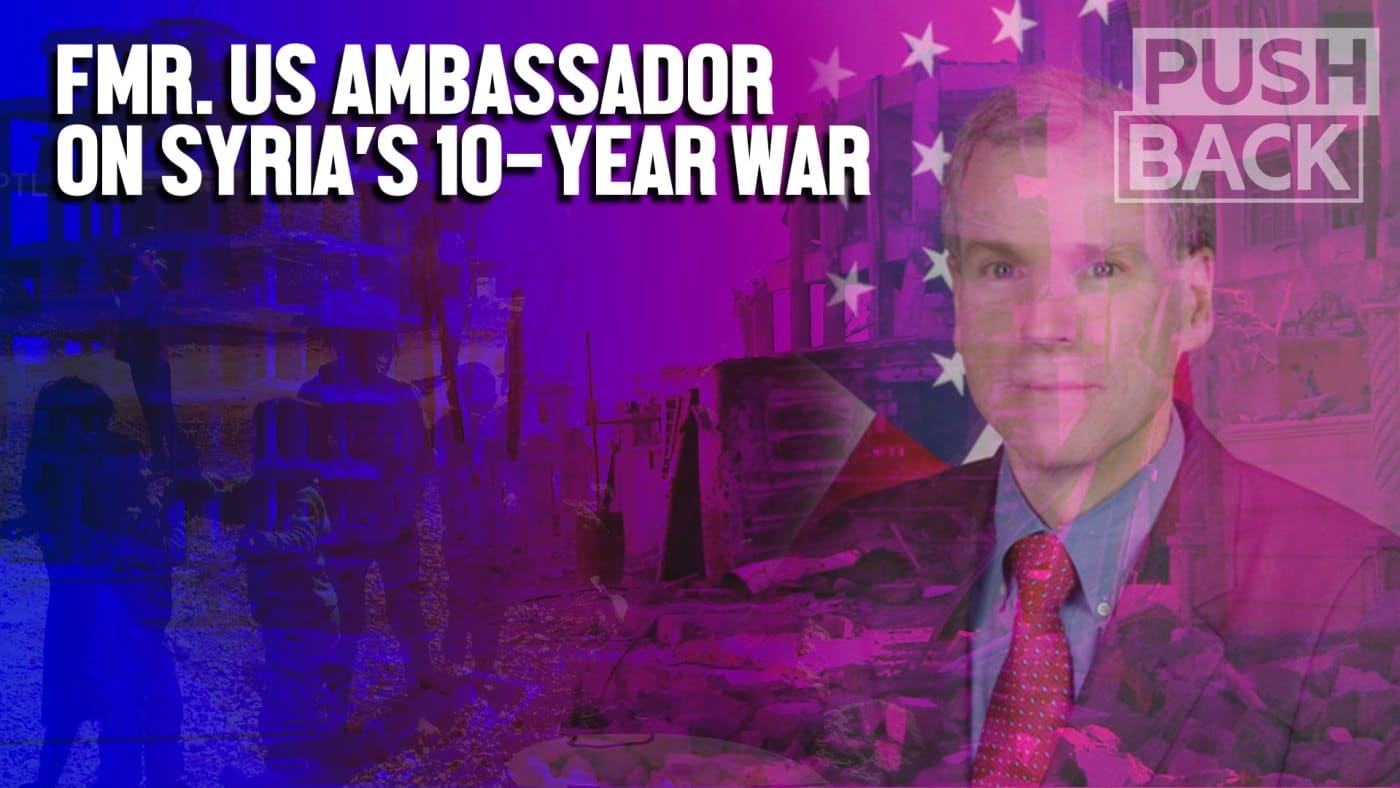
Former US Ambassador to Syria Robert Ford speaks to Aaron Maté about the 10th anniversary of the Syrian war, the US role in the conflict, and why he now supports the withdrawal of US forces.
Robert Ford served as US Ambassador to Syria from 2011 to 2014. On the tenth anniversary of the Syrian war, Ford speaks to Aaron Maté about the roots of the conflict; the US role; the current US sanctions that target Syria’s reconstruction; chemical weapons allegations against the Syrian government; and why he now supports the withdrawal of US forces.
Guest: Robert Ford, retired US diplomat who served as US Ambassador to Syria from 2011 to 2014.
TRANSCRIPT
AARON MATÉ: Welcome to Pushback, I’m Aaron Maté. This month marks the 10th anniversary of the war in Syria. After a decade, hundreds of thousands have been killed, millions displaced, and the country is still in crisis. The UN says that sixty percent of Syrians are at risk of famine in the coming year.
Well, joining me is Robert Ford. He is a retired US diplomat who served as the US Ambassador to Syria from 2011 to 2014. Robert Ford, welcome to Pushback.
ROBERT FORD: Nice to be with you.
AARON MATÉ: I want to get into your recollections and reflections on the 10-year anniversary of the war. But before we get into the past, I want to talk about the present.
The current US strategy in Syria is one of a military occupation in about a third of Syria, and, also, crippling sanctions that are preventing Syria from rebuilding. You recently wrote a piece in Foreign Policy called, “US Strategy in Syria Has Failed.” How would you describe the US strategy in Syria today, and what do you make of it?
ROBERT FORD: I think since 2015, and the importance of ISIS to the United States, the US has had to two key interests in Syria. One—and most important—was destroying the Islamic State of Iraq and Syria, ISIS. And there was a second but less important goal, which was to try to pressure the Assad government in Damascus to make enough reforms to make a political solution to the broader Syrian civil war possible.
The Americans actually did pretty well on goal number one. ISIS has been pretty much defeated. It upholds new territory and has many fewer fighters. As of February 2021, a Pentagon report says that it’s no longer able to attack from Syria to outside of Syria, to places like Western Europe or the United States. So, that’s all very good. But on the second goal of helping to resolve the Syrian civil war to promote a political settlement, there I think the Americans have failed and failed badly.
AARON MATÉ: How so?
ROBERT FORD: Well, in short, there has been a United Nations-led negotiation about a new Syrian constitution. That started in 2018, and for three years has made no progress of any … nothing significant. Essentially, the Syrian government has refused to negotiate, it simply kind of stalled, refused to write, take notes on areas of agreement or disagreement, which was the UN mediators’ latest suggestion rejected by the Syrian government delegation. In the end, Bashar al-Assad really does not want to introduce political reforms under outside pressure. I’m not sure he’ll ever introduce political reforms; that’s a different question. But, certainly, under outside pressure, and the Americans, despite occupying about a quarter of the country, using different kinds of economic pressure, withholding oil revenues, economic sanctions, and other things, has not succeeded in extracting concessions from Assad, either. And I think, therefore, we really do need to have a rethink about what we’re doing in Syria.
AARON MATÉ: So, do you think that the US should be occupying Syria still and imposing these sanctions that prevent reconstruction?
ROBERT FORD: I’m mostly concerned about the American military forces because we’ve already lost a few. I’m happy to say only a few, about half a dozen. But that’s still half-a-dozen soldiers lost, for what, exactly? It’s not clear to me.
I think it’s important for your listeners to understand that the American troops were sent into Syria originally to fight ISIS. Now that that job is more-or-less finished, we have a sort of mission creep where now the American forces are there not to defeat ISIS—ISIS is already defeated. As I said, the Pentagon report itself, February 5, 2021, said it’s defeated, can’t threaten outside of Syria, which is the most important thing. But now, so what are the Americans doing? Well, now they sort of changed the mission to putting pressure on Damascus, the Assad government, trying to get the Iranians out, trying to limit the Russian influence.
The military force, to my mind, is no longer serving a useful purpose. It costs about two-and-a-half to $3 billion a year. I’d much rather see that funding used for higher priority needs elsewhere. So, I think the military forces should leave; they probably need to leave in such a way as to not cause confusion, the way that Donald Trump’s idea of withdrawal did. There needs to be close consultation with the Syrian Kurdish militia with which we partnered against ISIS. We need to talk with the Russians about it, how they would come in to help chase the remaining pockets of ISIS here and there. But it’s not something the Americans need to do.
Sanctions is a different question, Aaron. I think a lot of it is emotional here in the United States. There’s a desperate desire for justice after all the war crimes committed in Syria. And I think getting rid of the sanctions is going to be a much harder battle to fight in the Congress. So, the sanctions have very strong approval in Congress. And I think the first step of that is to say, what are the sanctions actually achieving?
AARON MATÉ: Well, one thing the sanctions are achieving is, you know, starving the Syrian people after all the suffering they’ve already gone through. And I’m wondering if you think we have any right at this point to be sanctioning a country that we helped immiserate. This was a war that we were involved in through the CIA Timber Sycamore program, the proxy war. I mean, do we have a responsibility actually for the chaos that happened in Syria, and then, accordingly, what right do we have to sanction a suffering country?
ROBERT FORD: I think it’s important. Two things there. Number one, Syria’s economy was suffering well before the civil war, and it was suffering—it’s one of the reasons the civil war broke out, as there are large segments of Syrian society that were not benefiting from the Syrian economy. And so, they joined into the protest marches way back when this started 10 years ago. Let’s not forget that the Syrian economy has been mismanaged for decades. With respect to what the sanctions are doing, yeah, I think the sanctions are adding to the problems of the Syrian economy, and they’re adding to the problems of regular Syrians.
Look, the sanctions are designed to cut back on foreign currency inflows into Syria. The Syrian exchange rate has plummeted now. It’s largely wiped out whatever was left of the Syrian middle class. It’s reduced the amount of investment coming into Syria. That means fewer jobs, which then has an impact on the Syrian labor market in terms of unemployment and wages. I think it would be foolish for an American official to say that the sanctions don’t have any impact on a regular Syrian.
I was in Iraq after the American invasion there. I went in a few months after our soldiers did. And there was no Iraqi middle class to speak of by then. Sanctions over a period of years against the Saddam Hussein government had wiped out the Iraqi middle class, and I think our sanctions are doing the same in Syria. But that does not relieve responsibility with the Bashar al-Assad government, both for militarizing the entire uprising that dates back to 2011 and does not absolve the Assad government of the economic mismanagement and corruption which afflict Syria to this day.
AARON MATÉ: Well, it’s true there is corruption. It’s true there’s corruption in many states, but not every state has massive amounts of death and refugees. And I see that as a consequence of war. And on that front, in terms of the militarization of the conflict, let me ask you about that. Initially 10 years ago, there were protests, especially in Damascus, opposing the restriction of freedoms, calling for the release of political prisoners. But there also was, as I understand it—I wasn’t there—but from what I’ve read, there were violent attacks on the Syrian Army as well. I’m wondering, you being on the ground back then, when you first started to see the protests becoming militarized, and this turning from some protests against an autocratic regime into an armed militarized war?
ROBERT FORD: Yeah, it’s a fair question.
So, I was on the ground, and I led a team of American diplomats, several of whom, like me, speak Arabic. And we also worked closely with a number of other embassies, including the Japanese embassy, the Danish embassy, the British and French Embassies. And this is what we saw, Aaron.
In March and April, May into June, the protests were almost entirely peaceful. I, myself, went to Hama where there were huge demonstrations in June. The Syrian government was furious. I didn’t join in the marches, but I watched them. And there was no violence. In fact, we drove around the city of Hama—it’s a pretty big city, there’s about a million people—and there was no damage anywhere. I distinctly remember driving by the city’s police headquarters, and there were two policemen sitting out in white plastic chairs under the trees—this was June, it was hot—just sitting in the shade of the trees drinking tea. It’s not like there was a war going on, and they weren’t worried about getting sniped at or anything. They were sitting out on the sidewalk in the shade of some trees drinking tea. So, let’s keep that in mind.
That’s not to say there was no violence. In the first protest, for example, in Daraa [March 20, 2011], in which we’re now coming up on the 10-year anniversary, yeah, the protesters did attack the telephone office [Syriatel] that’s owned by Bashar al-Assad’s cousin, Rami Makhlouf. They did attack a court building. They were demanding, actually, not so much free speech—that wasn’t the issue—it was police brutality. They were demanding that the police chief at Daraa be sacked because he had arrested and beaten up some kids. And when the protests spread to Damascus and Homs, and to cities on the Mediterranean coast like Baniyas, Tartus, and then out east, to Deir ez-Zor, it was police brutality and the security services’ unaccountability that was really the focus of the protesters’ ire. And to be honest, the fighting didn’t really start in earnest until August. There had been a few gun battles here and there, but nothing big. But in August it got serious. And that’s when the Syrian Army went in and physically occupied Hama, the city that I had visited in June. They physically occupied the city of Deir ez-Zor; smashed up the town mosque. I can still remember watching the video and thinking, my, if the Americans did that in Iraq, it would just be horrific.
But that came in August. The Free Syrian Army, your listeners might be interested to know, where did it come from? They were originally deserters from the Syrian Army, young men who left the ranks and took their weapons with them and joined protest marches and were sent up to rooftops. And their job—now I’m talking about July and August—their job from rooftops was to watch the protests down below, and when the Syrian security forces came in, say, from left, they would shout down to the protesters, ‘Run away to the right!’, and they would shoot at the Syrian security forces coming at the protests, and they would shoot at them in order to give time for the protesters to run away. Being arrested at that time was a very bad thing because the Syrian security forces are, to this day, infamous for their torture and their mistreatment and abuse of detainees.
AARON MATÉ: In terms of your timeline—again, I wasn’t there—but from what I’ve read, Anthony Shadid of The New York Times, the now deceased New York Times correspondent, he was reporting in May of 2011 that even US officials, possibly yourself, we’re acknowledging that the protesters were armed. And then in June, you have the mass killing in Jisr al-Shughur of more than a hundred Syrian soldiers, which it was later confirmed, committed by the opposition. So, the picture that I drew from all this is that, earlier on, in parallel with the protest for reforms, there was actually an armed rebellion earlier on.
ROBERT FORD: So, it’s interesting you raise the Jisr al-Shughur incident, since the Syrian government asked for our help on that. And Jisr al-Shughur is a little place up near the Turkish border, and the fight started there because the police arrested some people, and the people said, ‘Let them go.’ And it escalated into shooting between the two sides. And in this case, the people with guns outnumbered the security forces, and the security forces were overrun. And it took a little while for the Syrian government to send in enough forces to take the town back. But Jisr al-Shughur was not a big place; it’s kind of out of the way, it’s kind of hard to reach, actually. You have to drive up to Aleppo, you have to take a long detour to get to it.
In the principal places, Aaron, where the protest movement was big and where it was politically important—Damascus, Homs, Hama, Baniyas, Tartus, Deir ez-Zor, Daraa—for the most part there really was not any big fighting. There was shooting and there was killing on the side of the Syrian government, and we saw that with our own eyes. We had American diplomats that saw the Syrian troops fire into crowds. So, we didn’t see a lot of shooting back in the other direction. Were there arms? Yeah, absolutely. Syria, like Iraq, has a lot of arms. So, but it’s one thing to have them, and it’s another thing to be organized to use them.
RELATED CONTENT: US Bombs Syria and Ridiculously Claims Self Defense
AARON MATÉ: Right. Okay. So, at whatever point this conflict became militarized—I think we’ll disagree on the dates—how did you feel about Saudi Arabia, Qatar, Turkey, arming what turned out to be Salafi jihadists, mostly benefiting groups like al-Qaeda and their allies? And then you had proposals earlier that were initially rejected, I believe, by Obama, but later on approved to arm these same factions. What did you think about this tact of arming the militants fighting the Syrian government?
ROBERT FORD: So, a couple of points on that. Number one, those countries did send in weapons before the Americans. They didn’t ask for American permission. In some cases, they informed the Americans, but they weren’t asking for permission. And I think that’s especially important. Look at how Turkey is today and how many problems we have with the Turkish acquisition of the Russian [S-400] surface-to-air missiles, the way the Turks react with our working with the Syrian Kurdish militia. Turkey doesn’t take orders from the United States. And they weren’t asking for permission.
Were the Americans enthusiastic about it? No. And if you go back and look at our statements from 2011, 2012, and even 2013, 2014, we were always demanding that there be a political solution. We used to say over and over again, ‘There is no military solution in Syria.’ [inaudible] We wanted a negotiation.
This, I would say, Aaron, comes from the Obama administration’s trying to learn the lessons of the disastrous 2003 invasion of Iraq. Nobody wanted to rush in and overthrow Bashar al-Assad. And let’s be honest, [inaudible] because we didn’t want a repeat of Baghdad 2003. I was in Iraq in 2003, and I had spent five years off and on at the American Embassy over the next years, and it was just … it was a disaster. And none of us wanted to repeat that. None of us.
So, we always wanted Syrians to negotiate with Syrians. That was always the goal. That’s why Hillary Clinton signed what’s called the Geneva I communiqué with the Russian Foreign Minister Lavrov and the United Nations Secretary-General Ban Ki-moon and others, including Turkey and Saudi Arabia—that there needs to be a negotiated deal to set up a national unity transition government, signed, I remember, on June 30, 2012. And I was immediately sent to talk to the Syrian political opposition, who was in exile, to say, ‘You have to get on board with this.’ One of our challenges, frankly, was getting the armed groups to go along with it. And that goes back to the arming of the different armed groups that you mentioned.
AARON MATÉ: But in 2013, Obama does authorize this arm-and-equip program, funding these militias. And I’m wondering what you think of that? Were you in government still at that time, when this was authorized?
ROBERT FORD: Absolutely.
AARON MATÉ: And what did you think when Obama decided to finally arm the militants?
ROBERT FORD: Yeah, so I have to tell you, Aaron, I supported arming factions of the Free Syrian Army as early as the summer of 2012. And it took the president a year to get to a decision.
A number of us who were working on Syria urged the president to do it for two reasons. One, if we didn’t arm people who were willing to go along with a negotiated settlement—remember, that’s what we were after, negotiated settlement—if we didn’t arm the people who would back a negotiated settlement, they would be overtaken by extremist elements—al-Qaeda, which in Syria was called al-Nusra Front. And we didn’t want that. That would just complicate ending the conflict. And we were very uncomfortable with al-Qaeda spreading into Syria anyway. That’s why we had to close the American Embassy. It wasn’t because of the Syrian government. It was because al-Qaeda posed risks to the physical safety of the American Embassy in Damascus and we couldn’t trust the Syrian government to be able to protect us. So, we had to close the embassy in February 2012.
The second reason I supported arming the Free Syrian Army, which was for the most part more secular, was that they would then be able to put some pressure on Bashar al-Assad. And it didn’t look to us by summer of 2012, more than a year into the uprising, that Assad was going to negotiate of his own free will, but it appeared to us that it was going to take a measure of coercion and pressure. As I look back in retrospect, Aaron, frankly, that assessment about Assad negotiating under pressure may have been wrong. There are some very good analysts out there, like Aron Lund at Carnegie [Endowment for International Peace], Sam Heller at The Century Foundation, and Josh Landis out of the University of Oklahoma, who disagreed vehemently with an assessment that Assad would have negotiated under pressure. The history will show he didn’t, although by 2015, he was on his back heels and talking about the need to retreat across several fronts. That seemed to me to suggest he’s beginning to get it, that he’s not going to win [inaudible]. But in any case, that’s when the Russians intervened, so we’ll never know.
AARON MATÉ: But let me ask you, in terms of what you wanted Assad to negotiate about. The way I hear you is that you were pursuing reforms. But the way I heard US officials speak publicly, including Hillary Clinton, is that they wanted him to go.
ROBERT FORD: Yeah.
AARON MATÉ: So, was the demand not his ouster? In which case, why would he negotiate that?
ROBERT FORD: So, we did say he had to go. But we didn’t say when. And we didn’t say where in the process. We said, that’s up to the Syrians to negotiate.
I remember a conversation I had with John Kerry in 2013, about a year before I quit the State Department. And the Syrian opposition was talking about putting forward a proposal that said, ‘Assad doesn’t have to go right away. We’re prepared to negotiate how long he stays.’ And Kerry said, ‘I don’t know if I like that.’ I said, ‘Mr. Secretary, if that’s what the Syrians end up wanting to do, we’re gonna have to go along with it. We can’t be harder-line than the Syrians.’ I mean, that’s ridiculous. We can’t be. I remember, I said to him—Kerry speaks French—I said, ‘We can’t be royal que le roi’ [more royal than the king]. I said, ‘We can’t.’ I mean, if that’s what the Syrians come up with, we’re gonna go along. And he didn’t argue. I think he was a little surprised.
But, I think, Aaron—and it’s worth noting because I bet your listeners don’t know—in January and February 2014, the UN did convene a big peace conference on Syria. Russia, together with the Americans, together with the Syrian government, and the Syrian opposition attended, with the blessing of armed groups, including armed groups that we were [inaudible]. And the Syrian opposition at that conference—it was in Switzerland—the Syrian opposition, in writing, gave to the United Nations mediator, a guy named Lakhdar Brahimi, an Algerian, they gave Lakhdar a paper saying, ‘We’re willing to negotiate composition of the new national unity transitional government, and we are even willing to negotiate Bashar al-Assad’s role in it.’ This was given to the United Nations from the Syrian opposition in writing. When Lakhdar tried to give the piece of paper to the Syrian government delegation head, a guy named Ambassador [Bashar al-] Jaafari, he wouldn’t even touch the piece of paper. Literally sat on his desk in front in the negotiating room. So, people who say this was all about overthrowing Assad, it sounds nice, it’s a great soundbite, but it’s actually not at all accurate.
AARON MATÉ: But if we’re pouring weapons into the country, Turkey is letting tens of thousands of fighters pour over the border, the US even gave, I believe after you left government, but the US gave anti-tank missiles, which helped al-Qaeda capture Idlib. And the US saying publicly that Assad has to go. Can you understand why it’s hard not to believe that the goal here was regime change? And I’m just wondering, looking back now…
ROBERT FORD: I have to say, Aaron, on this, you’re being selective, and in some cases inaccurate. The United States never gave anti-tank weapons to al-Qaeda.
AARON MATÉ: Not directly, but they gave it to their allies, who then gave it to al-Qaeda, or al-Qaeda took them.
ROBERT FORD: No, Aaron, the number might be half a dozen. The one person I know who’s really studied this in detail—I’d recommend him to you very highly—is a guy named Jakub Janovský. You can find him on Twitter. He did a very detailed assessment of all of the videos that the Nusra Front, that’s al-Qaeda, put up on the internet. And he concluded that about six missiles, US anti-tank missiles, were in fact … made their way to al-Qaeda.
And Aaron, I want you to think about this in historical context. Do you think when the Americans airdropped weapons into the French resistance against the Nazis in France, do you think the Nazis never got their hands on any of those air drops? I mean, seriously, Aaron, do you really think that?
AARON MATÉ: Well, the problem I have with that analogy is that…
ROBERT FORD: The leakage to the al-Qaeda elements, there was a small amount of leakage, but much, much, much more of their weaponry came from the Assad government, either, because the Assad soldiers were corrupt, as we said, we talked at the start about corruption. They sold them, or in some cases, they surrendered, and with that, huge caches of weaponry made their way into al-Nusra hands. The amount of material that al-Nusra got from the United States wouldn’t have lasted them for a day of combat. It’s just completely inaccurate to say that the United States was funneling arms to jihadis. I see that complaint all the time, and it’s simply not true. That’s actually why I agreed to come and talk to you today.
AARON MATÉ: Well, and I appreciate you coming on because it’s rare to be able to speak to someone with your direct vantage point. But look, to me, it’s not controversial. Joe Biden admitted in 2014 that US allies were essentially arming al-Qaeda and al-Nusra. He said that at Harvard University. He later apologized for it because it offended Turkey and Saudi Arabia and Qatar, but it was true, I think, and the US knew about that…
ROBERT FORD: So, let’s draw a distinction, Aaron. I was talking about the American Timber Sycamore program.
AARON MATÉ: Right, I got that, but…
ROBERT FORD: If you want to talk about the Turks, the Turks did play dirty. They played very dirty, and, frankly, we called them out on it. I did, personally, on three different occasions with the Turks in 2013. And once with the head of Turkish military intelligence, Hakan Fidan, and I said, ‘You are allowing people over the border. Stuff is making their way to groups that are fighting and killing the people we’re trying to help, that will back a negotiated settlement,’ and asked it to stop. The Turkish response, frankly, was disingenuous at best. And the Turks would routinely say to us, ‘Well, if you give us the names of the people that you don’t want to cross, we’ll put a lookout on for them.’ And I remember saying to them—and I saw senior State Department officials say this to them, people like Wendy Sherman and Bill Burns, at the time, in the Obama State Department—‘This is not about giving you a couple of names. This is about you shutting down the border to stop extremists moving back and forth.’
I’d be very frank with you, Aaron. The Turks, in private, Turkish friends of mine in the Turkish government said, ‘We’re doing it because they’re the best fighters. They’re the most dedicated. And they’re the ones that are going to turn around the fight against Bashar al-Assad and win.’ And I remember saying to them, on one occasion, I said, ‘You guys are playing with snakes, poisonous snakes, and they will come back and bite you.’ I said, ‘You don’t know what you’re dealing with. We dealt with these same people in Iraq, and they’re deadly.’ And one very self-assured Turk said to me, ‘After we get what we need against Assad, we will kill them ourselves.’ I thought, wow, that’s a really Ottoman Turk mentality, but you don’t know what you’re dealing with.
AARON MATÉ: Okay, on the point of Idlib, not to debate this too much, but I want to read you one quote from Foreign Policy magazine, from Hassan Hassan, who was very much a supporter of the militancy…
ROBERT FORD: Yeah, he’s a very bright analyst.
AARON MATÉ: Okay, so he writes this: “The recent offensives in Idlib have been strikingly swift, thanks in large part to suicide bombers and American anti-tank TOW missiles.”
ROBERT FORD: Right, remember that … what was the date of that, Aaron? Was that 2013?
AARON MATÉ: He’s writing this in 2015, when al-Qaeda and allies captured Idlib.
ROBERT FORD: That’s when they were making progress towards Latakia.
AARON MATÉ: Yeah, but, to clarify my point quickly…
ROBERT FORD: So, well, let’s talk about that. It’s good you raised it. So, there were two sets of fighters in there. There was the Nusra Front and there were Free Syrian Army elements. It was the Free Syrian Army elements using American made anti-tank rockets.
AARON MATÉ: And my point is that the provision of these anti-tank missiles helped al-Qaeda. That was my initial point. I realize that, deliberately, the US didn’t say, ‘Let’s send these to al-Qaeda.’
ROBERT FORD: It would be like saying, Aaron, that American progress against the Nazis in France helped Joseph Stalin. I mean, I guess on one level, that’s true. But it’s….
AARON MATÉ: Except in this case, we were arming the Nazis.
ROBERT FORD: Please let me finish, Aaron. To say that the Free Syrian Army was fighting on behalf of al-Qaeda would be completely wrong, because they did not share the ideology. If anything, I think, frankly, had Assad fallen, you would have then seen a very nasty battle for power between the Free Syrian Army and the Nusra Front. I don’t know if Nusra would have prevailed; it would sort of depend on what kind of outside assistance reached them. But this was a marriage of convenience, a tactical-level marriage of convenience against a common enemy. I don’t think it was wise politically, for the Free Syrian Army to do this. And that’s why we put the Nusra Front on the terrorism list in 2012, was to warn the Syrian opposition away from the Nusra Front. But as the battle got nastier in 2013 and 2014, their motives for making a marriage of tactical convenience with the Nusra Front outweighed our cautions against doing it. I understand it. I can remember talking to the Free Syrian Army’s commanders about it. And they spat at me and said, ‘If you would give us more help, we wouldn’t need the Nusra Front, but you don’t.’ This is what I meant, Aaron, about if we don’t help the moderates, the bad guys would prevail.
AARON MATÉ: What if we had poured in no weapons at all? Wouldn’t that have averted 10 years of suffering?
ROBERT FORD: What would have happened had we done that? Turkey would have continued anyway. Qatar would have continued anyway. Saudis, I don’t know; maybe they would have, maybe they wouldn’t have. But I know that the Turks and the Qataris would have continued. So, you would have had longer fighting. Would Assad have won more quickly? Maybe. Kind of depends how much the Turks were willing to escalate. And the Turks have sent troops of their own into Syria. So, the Turkish capacity to escalate should not be underestimated. I mean, they might have sent troops in to fight Assad earlier; they had a big battle with Assad a year ago. So, certainly the Americans would be able to say, ‘Not our problem.’ Would it have ended the Syrian civil war? Not at all clear. Depends on other foreign states.
AARON MATÉ: States with which…
ROBERT FORD: I know that’s not the happy answer, Aaron.
AARON MATÉ: Well, states with which we are allied. And given … look, it’s my…
ROBERT FORD: Aaron, just because you’re allied doesn’t mean they do what you want them to do. That’s not … it doesn’t follow that way.
AARON MATÉ: You seem to argue that the Free Syrian Army was a major fighting force outside of al-Qaeda. It’s my understanding from what I’ve read that the dominant fighting forces inside Syria were Salafi militants, primarily al-Qaeda and then, later on, ISIS, and that’s who really Assad was fighting, for the bulk of this war, notwithstanding the army defections that, of course, did happen.
ROBERT FORD: Yeah, so it would be nice theory if it was true, but let’s be honest, it wasn’t. They did become predominant, Aaron, you’re right; they did become predominant by the end of 2015. That I think is absolutely true.
AARON MATÉ: And we still continued to send in weapons then.
ROBERT FORD: Well, Aaron, if you look at the demonstrations, I mean, there are lots of videos. Just take a look at those demonstrations in 2011. You don’t see any black flags of ISIS, you don’t see any black flags of al-Qaeda. None. Zero.
AARON MATÉ: No, but you did hear people chanting, ‘Christians to Beirut. Alawites to the grave.’ That, to me is undeniable. I’m not denying the…
ROBERT FORD: So, I’ve heard that allegation. It might be true. But if it’s true, it’s a very small minority and definitely not a majority. I saw that with my own eyes. Personally. In Hama was a big Muslim Brotherhood stronghold. I saw no al-Qaeda flags, I saw no jihadi flags of any kind. I met no jihadis. I saw lots of people at checkpoints out of government control. But I saw nobody. I mean, my bodyguard was a little concerned, I have to tell you, but we were never held against our will in any way.
AARON MATÉ: Right.
ROBERT FORD: Just the opposite. They wanted the Americans to see what they were doing. And our message in 2011 was dialogue and negotiation. Our message in 2012, dialogue and negotiation. Our message in 2013, dialogue and negotiation. That’s why we went to the Geneva peace process. If we wanted regime overthrow, like 2003, we could have done it, believe me. The Syrian government’s army’s not that tough. This is not a replay of Libya. This was a different approach. Did it work? No, it failed. I’m not sure there’s anything the Americans could have done to resolve the Syrian conflict. That’s where I’ve come away from this. I’ve been away now out of the government for seven years. And I think we tried. We could not fix this problem. Maybe it would have been better not to try. But in any case, we couldn’t.
AARON MATÉ: Let me ask you this. It did succeed in bleeding Iran and Hezbollah. Was that a part of the goal?
ROBERT FORD: Oh, I think there were people in the American government, sure, who would be happy with that. But that wasn’t the American goal. I can remember, I was sitting in one meeting, and they said, ‘Well, at least they’re killing bad guys.’ But that wasn’t why the Americans were doing it.
I would put it to you this way. There was a sense in the American government in 2011 and ‘12 that Arab populations were finally deciding they’d had enough of tyranny and enough of rampant security force abuse, and they wanted justice and they wanted accountability. And that for us on an emotional level was easy to sympathize with.
AARON MATÉ: In certain places, though. Because in Bahrain, when people rose up, the US backed Saudi Arabia when it crushed that uprising.
ROBERT FORD: You mean the one in eastern Saudi Arabia? Yeah, you’re right.
AARON MATÉ: In Bahrain.
ROBERT FORD: And even in Bahrain.
AARON MATÉ: In Bahrain, yeah.
ROBERT FORD: Yeah.
AARON MATÉ: Where the US Navy has the Fifth Fleet.
ROBERT FORD: It’s interesting you raise that here, because initially, the Obama administration’s response to the Bahrain situation was to say, the Bahraini government needs to negotiate with the protesters. And it’s only after the Saudis sent in what they called the Operation Peace Shield with other Gulf Cooperation Council states, the Americans kind of watched, didn’t object. And then, frankly, parts of the United States military that have a close relationship with the government of Bahrain prevailed in the interagency arguments, and the American position shifted to being more supportive of the Bahraini ruling family. But initially, the Obama response was in favor of the protesters and the need for a political reform program that would meet the demands of protesters.
AARON MATÉ: Alright, I have kept you way over time, and I want to respect what we committed to. So, if you have to go, I understand.
I do want to ask you a question about Latakia, though, which you raised earlier, which I think is important because you mentioned that those are rebels that we were supporting. But Robert F. Worth of The New York Times wrote a piece called ‘Aleppo After the Fall’ in May 2017. And he wrote that if the US-backed rebels had been successful in Latakia, that they would have committed “sectarian mass murder” against the Alawites there. One, is that correct? And two, if it is, what business do we have supporting people like that?
ROBERT FORD: Yeah. So, the people that we were supporting with Timber Sycamore, I met them myself. They would not have committed sectarian mass murder.
I’m going to give you an example. Google him. A guy named Colonel Abdul Jabbar al-Oqaidi, who in 2012 came to our attention because he did a national radio address. He was in the Free Syrian Army but did a radio address, which we actually picked up, in which he said to the Alawite community, ‘We’re not fighting it. We’re fighting a president and a security apparatus, the head of which, by coincidence’—that was word he used, sudfa in Arabic—’is an Alawite, but we’re not fighting Alawites.’
Now, fast forward a year-and-a-half, and then Oqaidi said, ‘Well, al-Qaeda fighters are our brothers.’ And he was—justifiably—heavily criticized for saying it. I remember, we ourselves even said, ‘What on earth are you doing? What are you talking about?’ And he’s the guy I said spat at me and said, ‘If you would give us more serious support, we wouldn’t need these people.’
Don’t mistake tactical alliances for ideological compatibility. They are two different things. Are there people in the Syrian opposition—the armed opposition—that would have slaughtered Alawis? Absolutely, there were. And as time went on, it got nastier and nastier—on both sides, I would add. In the end, Aaron, what we have now is a Syrian government which has murdered tens of thousands of people, far more than ISIS killed—far, far, far more than ISIS killed, as reprehensible and awful as ISIS is—that has used chemical weapons. I know that’s controversial for you, but…
AARON MATÉ: It is, actually, because I’ve been covering a…
ROBERT FORD: I know it is, but I’m telling you, the evidence is quite clear, and which has used sexual abuse as a weapon. That’s documented also by the United Nations Commission of Inquiry from the Human Rights Commission. And so, the nastiness of this fight has increased on both sides. It was bad enough in 2011 when the uprising started; it descended into deeper and deeper levels of hell as it went on.
What I hope your listeners will take away from this is that it is not an equal combat on both sides; is not an equal responsibility on both sides. One side from the beginning was using torture and shooting at innocent people, thousands of arrests. And one side was trying peacefully, for a very large part, to bring about change. And, unfortunately, in this instance, the bad guys won.
AARON MATÉ: Robert, if we’re flooding the country with weapons, and the main beneficiaries of our involvement are groups like al-Qaeda and ISIS, how can you say that we’re trying to resolve it peacefully? And if Syria … look, I understand there’s no justifying torture, there’s no justifying crushing descent, especially what happened early on in with the protest, but I guess the point I’m making is that it wasn’t just a crackdown on a peaceful protest, there was a war. And in the context of a war, war crimes will be committed. People are going to be killed. And my concern as a citizen of the West is, what responsibility do I have for that war? And if the US spends billions of dollars on a CIA program, one of the most expensive in the CIA’s history, by all accounts, then I think the US has a responsibility, too, for this, and a responsibility for all the death and suffering that happened. I’m wondering if, after 10 years of this, you think that if had we not … can we at least agree that had this not happened, had there not been this massive foreign effort to have a proxy war in Syria, that all the death and suffering would not have happened?
ROBERT FORD: I think the Assad government would have fought either way. And so, your question then is if the Turks, the Americans, the Qataris had laid back, Saudi had laid back, would it have been better to let Assad win relatively quickly instead of kind of where we’ve gotten at today, is that what you’re asking?
AARON MATÉ: Yes. I mean, aside from the fact that that’s accepting that we have the right even to do that to a sovereign state, even one that we don’t like.
ROBERT FORD: Well, so let’s talk about sovereignty for a minute. Absolutely, Syria is a sovereign state, that’s absolutely true. But within the context of sovereignty, there’s also a sense of responsibility, which is to say that the Syrian government is responsible for not destabilizing its neighbors. And even had Turkey, Qatar and the United States, Saudi Arabia, stayed out of it, there still would have been huge refugee flows trying to escape from those same brutal Syrian security forces, and they still would have flooded the borders of Lebanon and Jordan and of Turkey, which is itself destabilizing, particularly in Lebanon, but some places like Jordan, Turkey. Therefore, you can’t just say that all these other countries intervened in sovereign Syrian territory. The Syrian government itself was taking actions which were destabilizing to its neighbors. And that’s why when you get into this ‘who started it’ stuff, I think it’s never-ending.
We actually looked at the question of Responsibility to Protect, which was a doctrine that came out of the Rwandan genocide experience. In the end, the Obama administration decided not to invoke it, mainly because there was a sense that the UN Security Council would have to approve it. And we knew the Russians and the Chinese would veto it because they don’t want any foreign state intervening in any sovereign states’ internal affairs. And in Syria it was refugee flows that were destabilizing neighboring countries. They didn’t particularly care. Probably Putin enjoyed it. So, I’m not entirely convinced that the sovereignty argument [inaudible], that’s one.
AARON MATÉ: But the logic of that, we are going to intervene because there are refugees, but intervene in a way that creates far more refugees. I’m very confident that if not for the foreign intervention, flooding the country with Salafi fanatics from around the world, and weapons, that there would not be as many refugees.
ROBERT FORD: Well, I’m never going to justify the Turks allowing Salafi jihadists to go into Syria. I think that I’ve already said that that was a bad mistake. And we criticized them at the time of playing with snakes. I’m never going to justify it. But I have to say, Aaron, that in the end, they came in response to what the Assad government was already doing. And so, the principal responsibility … do the Americans have a share of responsibility? Of course, we do. Yeah. It was our anti-tank missiles blowing up Syrian government tanks, and not just a few; I mean, hundreds of them.
AARON MATÉ: Yeah, yeah.
ROBERT FORD: So, they blunted the initial Syrian offensive when the Russian Air Force started doing close air support. But are the Americans the …. do they bear primary responsibility? No. I don’t think so. I think we have to go back to where it started in 2011. And that’s with the Syrian government.
Had Assad—I actually sent a message to him—had Assad just fired a couple of his top security secret police people … we all know who they were, we all knew what they were doing. Had he just fired them, he probably could have gotten ahead of the whole protest movement right then. That was the message I sent him. This was in May 2011. A Syrian businessman was going into see him that day and asked me if I’d like to pass a message. And I said, ‘Yes, this is the message.’ I said, ‘Can’t you just fire a couple of these guys and get ahead of this and tamp it down?’ I said, ‘We’re not trying to destabilize you. The Americans wants stability in the Middle East. After what’s happened in Egypt, from what’s going on in Bahrain and Yemen, the last thing we need is more uprisings everywhere. But you are going to have to get ahold of these security forces that are running rampant.’ The message came back, Aaron, from Assad: ‘I can’t.’
You know, when I got that message, I thought, ‘I can’t’; I wonder what that means. And it wasn’t clear. The businessman couldn’t elucidate. Did it mean, ‘The security guys have me surrounded and I can’t. They’ll kill me if I try to remove them.’? Is that what it meant? Or did it just mean, ‘I’m not going to make concessions under pressure. I can’t make concessions under pressure.’? It wasn’t clear. To me, to this day, March 12, 2021, I’m still not exactly sure what ‘I can’t’ meant. But whatever, he didn’t.
AARON MATÉ: And 10 years later, we have a catastrophe.
Alright, so as we wrap, is there any constituency in Washington in the establishment that you think is ready to let go of this war, to admit that the US side has lost, and to support a withdrawal from Syria, as you seem to support? And, also, to end the sanctions?
ROBERT FORD: I think there are foreign policy thinkers who are ready to do that. But inside the administration itself, I’m not aware of any. Some of the Biden team with whom I worked in the Obama administration, I think a number of them think the American relationship to the Syrian Kurdish YPG militia is generally a good thing. I think they still hope that American leverage will sooner or later—even if it’s later, much later—will extract the concessions that they hope to see from Bashar al-Assad.
And no, I don’t. There are groups like Quincy Institute [for Responsible Statecraft] which has, and Defense Priorities which have urged the administration to withdraw forces out of Syria, but I don’t think there are many inside the administration or in the Congress.
AARON MATÉ: All right. Well, Robert Ford, I’m very grateful for your time. I do want to mention, since you raised the issue, have you followed the scandal around the OPCW, where inspectors that went to investigate allegations of chemical weapons in Douma in April 2018…
ROBERT FORD: Sure, of course.
AARON MATÉ: …had their report censored and have alleged that there was a cover-up of their own findings?
ROBERT FORD: Right. So, but who were the people making those allegations? Were they the experts or were they support staff?
AARON MATÉ: They were the actual inspectors … well, there’s two that we know of so far, and…
ROBERT FORD: The allegations that I have seen are from support staff. They were not actually engineers or chemists.
AARON MATÉ: Well, one of the whistleblowers who has made this allegation actually was the top chemist on the team and actually wrote the team’s original report. And that’s what is at issue here, is that he says that his initial report—which has been leaked to WikiLeaks—was doctored and censored, and that instead a bogus report was put in its place, which was then thwarted after internally it was protested. But that’s the scandal here, which is that the team’s own findings have been suppressed. And this is a very consequential investigation because the US bombed Syria, along with Britain and France [bombing], based on this allegation. I’m just wondering if you’ve followed this.
ROBERT FORD: Wait, are you talking about the 2013 team?
AARON MATÉ: No, I’m not talking about Ghouta in 2013. I’m talking about Douma in 2018.
ROBERT FORD: Oh, during the Trump administration?
AARON MATÉ: Yes.
ROBERT FORD: So, I have to say on that, I’m not aware, that I have not heard. Frankly, what happened in Douma, I mean, at that point, the Syrian government was about to take it over anyway. And I’m not familiar with that controversy within the OPCW. The 2013 [incident], I paid much more attention to.
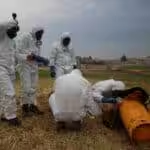
But I guess I would just say this, Aaron. There’s plenty of documentation by the UN’s joint investigative group with the OPCW that looked at incidents in Syria chemical weapons use, from 2013 onwards. They’ve issued several reports. They’ve said that in at least one instance, ISIS used some kind of mustard gas up in northern Syria, but that there are at least four to five documented, clearly investigated, documented instances where the Syrian government, even after the 2013 disarmament deal, when the Syrian government used chemical weapons. Mostly chlorine gas, although I think there’s one allegation of sarin gas use. So, the 2018 incident, I don’t know about that report, but I have no doubt whatsoever that the Syrian government has used chemical weapons on multiple instances, the same government that bombs hospitals, the same government that bombs bakeries, the same government that kills people in detention routinely. Look at the photos that were brought up by the military defector. You know, why would you think they wouldn’t use chemical weapons? Why would you think they would suddenly have moral scruples against these? It doesn’t make a lot of sense.
AARON MATÉ: Well, look, that’s a whole other debate. But I find these allegations pop up in pretty inconceivable situations where, in the case of Ghouta in 2013, the OPCW… no, UN inspectors are already in the country. In the case of Douma, as you said, Syria was about to retake Douma anyway, so why would they do the one thing that they know will trigger US military intervention? And then you have, most importantly to me, the suppressed evidence of the Douma case and allegations of a cover-up at the OPCW in conjunction…
ROBERT FORD: You’re talking about the 2013? 2018.
AARON MATÉ: 2018, yes. Which I find very serious, and I think raises questions about the accuracy of other investigations. But that’s a whole different minefield. That’s not what, admittedly, I brought you on for, so I don’t want…
ROBERT FORD: Have me on again, Aaron, and we’ll talk about it.
AARON MATÉ: Yeah. But listen, I want to give you the final word before you go. Any final words you want to leave viewers with about Syria that you think are important now after 10 years of war?
ROBERT FORD: Yeah, there is one thing. I do think we need to get American troops out of Syria. There’s mission creep. ISIS is defeated. We kind of did what we set out to do. It’s time to declare victory and go home. Can’t fix the Syrian civil war.
By contrast, something the Americans could do that would be hugely helpful is to increase humanitarian aid to the Syrian refugees that number some five million, particularly in Lebanon, where their living circumstances are precarious, very precarious, but also in Jordan and Turkey. That’s something where we have access. The UN can work, other agencies can work. Save the Children, CARE, Médecins Sans Frontières, Doctors Without Borders, all of them can work freely, but it’s a resource issue. And I think we need to increase resources there. I’d like to spend less on the military operation and much more on humanitarian aid.
And then there is the issue of Northwest Syria, Idlib, where the UN is in charge of an operation getting humanitarian aid to some two million displaced Syrian civilians. And if the Russians shut that operation down using a veto in the UN Security Council, people in Idlib will either flee, which is a problem, or they’ll starve, which is immoral. And I think there, too, the international communities are going to need to replace the UN operation with something else to get humanitarian aid in, medicine, food, COVID-19 vaccines. They’re going to have to figure out a way to replace that UN operation, if the Russians do try to shut it down. It would be much better to reach some kind of agreement with the Russians not to shut it down, and I hope that the Biden administration ramps up diplomacy with the Russians over the next few months, before that vote at the beginning.
AARON MATÉ: Robert Ford, you’ve been very generous with your time, and I really appreciate your willingness to engage with some critical questions. So, thank you very much.
Robert Ford is a retired US diplomat and a former US Ambassador to Syria. Robert, thank you.
ROBERT FORD: My pleasure. Thank you, Aaron.
Featured image: File Photo.

Aaron Maté
Aaron Maté is a journalist and producer. He hosts Pushback with Aaron Maté on The Grayzone. He is also is contributor to The Nation magazine and former host/producer for The Real News and Democracy Now!. Aaron has also presented and produced for Vice, AJ+, and Al Jazeera.