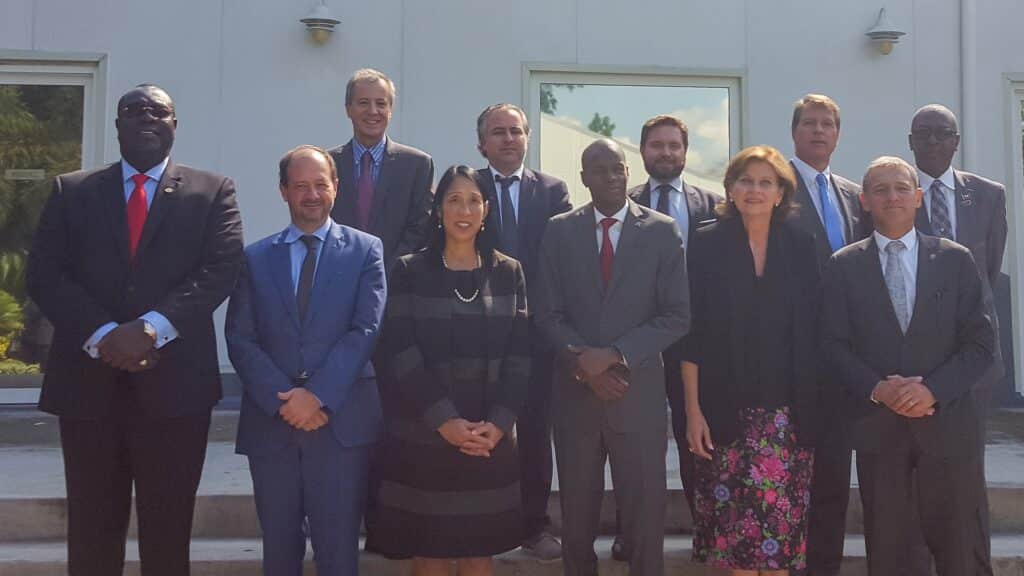
Late Haitian ruler, Jovenel Moïse, during a meeting with the Core Group, November 7, 2018. Photo: Twitter/@USEmbassyHaiti.
Late Haitian ruler, Jovenel Moïse, during a meeting with the Core Group, November 7, 2018. Photo: Twitter/@USEmbassyHaiti.
Caracas, January 2, 2023 (OrinocoTribune.com)—On Thursday, December 29, several political parties of Haiti condemned de facto Prime Minister Ariel Henry’s “National Consensus” that unilaterally promotes constitutional reform and asks for “help from the international community” to combat insecurity in the country. According to the protesting parties, Henry has been trying to illegally remain in power since the assassination of the former president, Jovenel Moïse, in July 2021.
The leader of the Movement for Political and Cultural Independence Party (MEKSEPA), Vilaire Cluny Duroseau, said that the Consensus is a “macabre” attempt of the Core Group to continue controlling Haiti by any means necessary.
Duroseau, who was a candidate in the presidential elections of 2016, strongly condemned Henry’s request for foreign military intervention.
The national coordinator of the Pitit Dessalines party, Moïse Jean Charles, called the agreement a farce and said that its sole purpose is to mislead the international community on the necessary steps to resolve the crisis in Haiti.
US Tax Dollars at Work: Neocolonial Dictatorship, Paramilitary and Police Terror in Haiti Today
Another politician, Clarens Renois, who is the head of the National Union for Integrity and Reconciliation party (UNIR), stated that the consensus does not actually have the consensus of all Haitians, and hence it would not be able to stabilize the country or ensure security.
Likewise, the spokesperson of the Organization of the People in Struggle (OPL), Danio Siriack, called the agreement a ploy aimed at letting Henry “remain in power illegally.”
Henry’s “national consensus” did, however, find support with one opposition group, the Montana Accord—backed by the US—which announced its support for Henry’s initiative and signed the consensus statement.
On December 21, during a meeting held at the Karibe Hotel in Petionville, Haiti, Henry, members of the private business sector, civil society, and some political leaders signed a political agreement “to promote a solution to the crisis facing the country.”
Haiti in the Caribbean: A Political Economy Perspective on the Urgent Crisis of Imperialism
The so-called National Consensus is aimed at a constitutional reform, through which a High Transitional Council (HCT), a Body for the Control of Government Actions (OCAG), and a Provisional Electoral Council (CEP) will be created. According to the signatories of the document, the proposal has the mission of “making the institutions of the republic functional.”
The aforementioned bodies have been mandated with making the necessary arrangements for holding presidential elections in the country “during the course of 2024.” Ariel Henry will remain the head of state until that time. However, according to Henry, elections can only be held after the violence in the country has been quelled. It is precisely this statement for which his opponents insist that Henry is attempting to prolong his stay in power.
On December 24, the opposition platform Montana Accord released a statement announcing that it had signed the agreement.
“The Group of Signatories of the Montana Accord (GROSAM) welcomes the initiative of civil society, political parties and the private business sector in the pursuit of dialogue for a solution to the Haitian crisis,” read the statement. “Thus, GROSAM informs that it signed the document of December 21 in order to test the good faith of the government and other interested partners.”
ACCORD MONTANA: le Groupe Signataire de l’Accord Montana (GROSAM) dans un Communiqué de Presse salue l’initiative de bonne foi de la Société Civile, des partis politiques et le secteur Privé en vue d’une solution à la crise Haïtienne.- https://t.co/WJ16J5ID8z
— LAKAY INFO (@LAKAYINFO1) December 29, 2022
Although the agreement claims to have inclusive consensus, the most influential political parties of Haiti, including the Haitian Tèt Kale Party (PHTK), the Fusion Party of Haitian Social Democrats, Pitit Dessalines, Fanmi Lavalas, Alternative League for Haitian Progress and Emancipation (LAPEH), OPL, and Renmen Ayiti, have not signed.
Presidential elections in Haiti should have been held in January 2020, but then-President Jovenel Moïse refused to follow the constitutional laws on presidential terms, and subsequently ruled by decree for more than a year before being assassinated in his residence in July 2021 by a group of Colombian and Haitian mercenaries, an incident that still remains unsolved. The country, which was already in a state of rebellion, has since devolved into greater chaos. In addition to the ongoing political instability, a cholera epidemic, which has claimed 342 lives, is raging in Haiti; close to 19,000 people have been affected by the disease.
The “National Consensus” was signed on the same day when the 15 member states of the United Nations Security Council, together with Haiti, Canada, and the Dominican Republic, held a meeting to discuss the situation in Haiti. During the meeting, the special representative of the UN secretary-general for Haiti and the head of the UN Integrated Office in Haiti (BINUH), Helen La Lime, who has acted as nothing more than a mouthpiece for US interests on the island throughout her mandate, pleaded for a “multinational military force” to back up the “under-resourced and insufficiently equipped” Haitian National Police (PNH) in order to combat the “alarmingly high levels of gang violence in the country.” However, there were open disagreements at the meeting. While the representatives of the United States and Canada called for foreign military support for the “beleaguered” PNH, the Russian representative, Vassily Nebenzia, slammed the “colonial powers,” namely France, Canada, and the US, for their “historical responsibility” in the “chronic crisis of statehood, socio-economic collapse, and decomposition of legal institutions” in Haiti.
It is of interest to note that the United States does not want a UN Peace Corps mission in Haiti, nor to militarily invade Haiti itself, but to delegate the task to another country or group of countries. Although this is illegal in international law, UN Secretary-General António Guterres has announced his support for the US proposal. However, given the Russian position, it seems certain that the US, its allies, and the national bourgeoisie of Haiti will not be able to obtain UNSC approval for this plan. Nevertheless, the United States has already devised a “Plan B” for such a situation—the Global Fragility Act (GFA), signed into law in 2019 by Donald Trump, and endorsed by the Biden administration as a “peace-building strategy” to “stabilize conflict-affected areas and prevent violence and fragility.” It appears that Haiti has already been selected as the testing ground of GFA.
Orinoco Tribune Special by Saheli Chowdhury
OT/SC/FV/SL

Saheli Chowdhury is from West Bengal, India, studying physics for a profession, but with a passion for writing. She is interested in history and popular movements around the world, especially in the Global South. She is a co-editor and contributor for Orinoco Tribune.