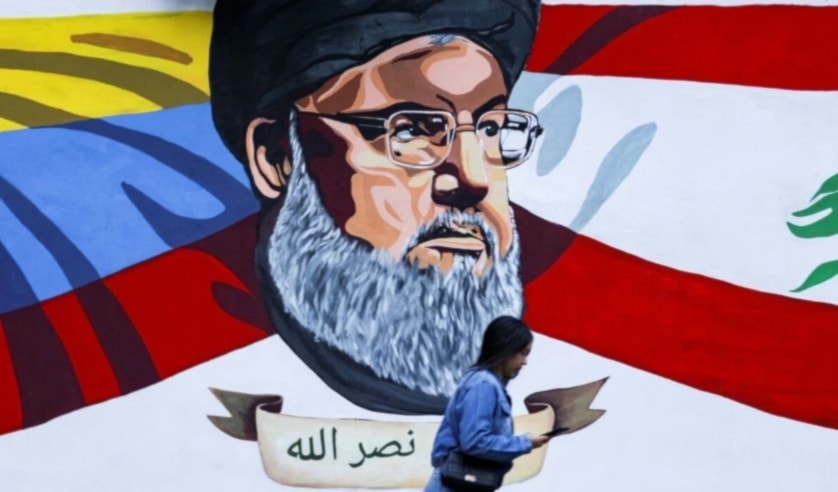
Venezuelan mural showing Sayyed Hassan Nasrallah, the Secretary-General of Hezbollah from 1992 to 2024. Photo: AP.
Venezuelan mural showing Sayyed Hassan Nasrallah, the Secretary-General of Hezbollah from 1992 to 2024. Photo: AP.
By Ali Hassan Mourad – Jan 15, 2026
US accusations do not always require evidence. It is often enough for politics to intersect with imagination, and for an allegation to be repeated inside congressional hearing rooms long enough to acquire the weight of truth. This is how the narrative of “Hezbollah in Venezuela” was manufactured: a political product designed to demonise leftist governments in Latin America, justify their overthrow and the plunder of their resources, export the image of a “global enemy” to legitimise Israel’s wars in the Middle East, and mobilise an electoral base long exploited by Republican candidates.
By the mid-2000s, Hezbollah’s name became a permanent feature of US congressional hearings on Latin America, particularly Venezuela. The story began in 2005, alongside the rise of left-wing governments led by the late Venezuelan president Hugo Chávez. Republican lawmakers began warning of an “approaching terrorist threat” at US borders, linking Chávez, Cuba, Iran, and Hezbollah in a single axis. This linkage was not accidental. It formed part of a broader confrontation with governments pursuing policies opposed to US dominance.
The accusations escalated in 2006, shortly before former Iranian president Mahmoud Ahmadinejad’s first visit to Caracas. US lawmakers warned against Venezuela’s growing ties with Iran, introducing Hezbollah as a third pillar in what they portrayed as a “triangular axis” — echoing the pre-Iraq invasion narrative that linked Saddam Hussein to al-Qaeda.
Over the following years, dozens of congressional hearings discussed Hezbollah’s alleged presence in Latin America, especially Venezuela. Despite the absence of evidence on operational or military activity, repetition alone turned the claim into an established media and academic narrative under the logic of “securitisation”: persuading the public that a looming threat demands urgent action.
Why the US Is So Open About Its Intentions for Lebanese Civil War
A key source of allegations was a book by Spanish journalist Antonio Salas, who claimed to have infiltrated Hezbollah-linked networks in Venezuela. Yet his evidence relied largely on opposition media articles and unverified testimonies. Even Western academics — including figures close to pro-Israel circles — questioned the credibility of these accounts.
The claims spread through international media: training camps on Margarita Island and financial networks backed by Caracas. Independent investigations, including an Al Jazeera report in 2009, found no proof. Margarita’s Arab community, it showed, was overwhelmingly Sunni, with no signs of Hezbollah activity. Still, the lack of evidence did little to slow the propaganda.
The deepest contradiction lies within the US establishment itself. Senior officials from the State Department and the US embassy admitted in congressional testimony that there was no evidence of operational Hezbollah activity in Venezuela or Latin America, distinguishing between fundraising claims and military presence. Yet the narrative persisted.
Over time, Hezbollah was linked to drug trafficking, Mexican cartels, and even figures like El Chapo — claims later dismantled by court documents and investigative journalism. With Chávez’s death and Nicolás Maduro’s rise, the campaign simply evolved. Venezuela was recast as a “terrorist haven,” and figures like Tareck El Aissami were instrumentalised, even when US sanctions documents contained no direct Hezbollah accusations.
Between 2005 and 2018, nearly 100 congressional hearings promoted the Hezbollah narrative, around 40 focused on Venezuela. Most expert witnesses came from think tanks tied to pro-Israel lobbying networks. Through systematic repetition, fiction was elevated into political fact.