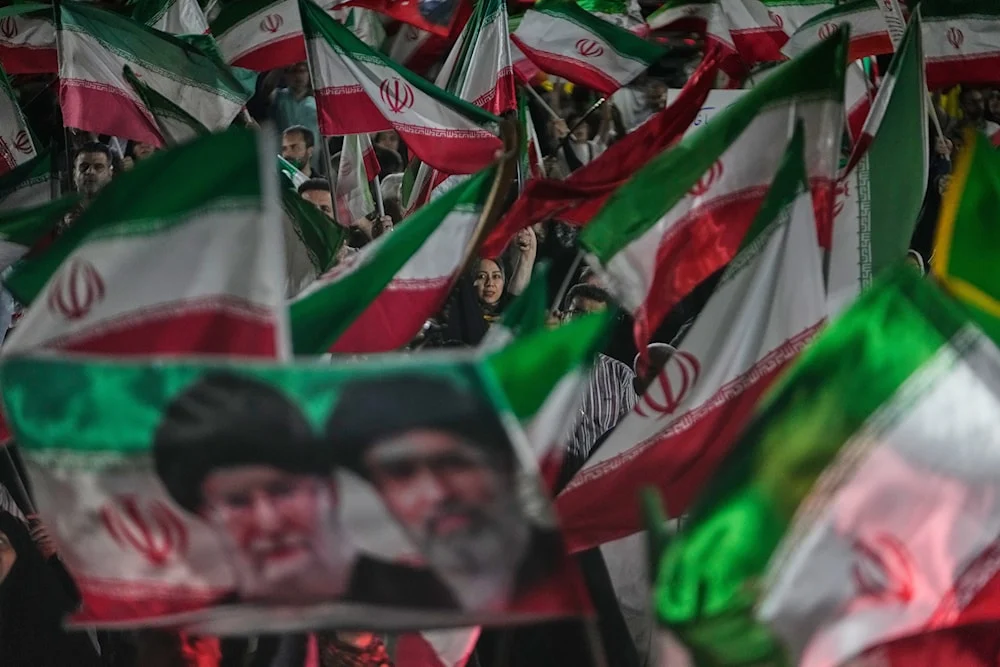
Iranian demonstrator wave Iranian flags and protrait of Iran's Leader Sayyed Mojtaba Khamenei, right, and his late father Sayyed Ali Khamenei in a gathering at a square in Tehran, Iran, May 29, 2026. Photo: AP.
Iranian demonstrator wave Iranian flags and protrait of Iran's Leader Sayyed Mojtaba Khamenei, right, and his late father Sayyed Ali Khamenei in a gathering at a square in Tehran, Iran, May 29, 2026. Photo: AP.
Iranian sources claim a sophisticated intelligence operation tracked US P-8 aircraft and F-35 jets across multiple bases in the Gulf and Jordan.
Iran has executed a sophisticated intelligence and operational plan in the strikes launched against several US military bases in the region early Thursday morning, Fars reported, citing a senior Iranian military source.
The source, speaking to Fars News Agency, stated that the strikes inflicted significant losses on expensive equipment belonging to US forces in the region.
In a detailed account of the operation, the source reported that Iranian forces tracked the flight path and positioning of two large US P-8 aircraft from the moment they took off. One of the aircraft was reportedly arriving from the Diego Garcia airbase in the central Indian Ocean, while the other was flying from a US base in Western Europe, heading toward the southern Gulf.
According to the source, the precise locations of these two aircraft, at the Shaikh Isa Air Base in Bahrain and the Ali Al Salem Air Base in Kuwait, were subsequently struck by Iranian precision weapons.
Furthermore, Iran monitored the positioning of at least three US F-35 fighter jets inside a hangar at the Muwaffaq Salti Air Base in Jordan. The source asserted that the surveillance continued until the final moments before missile launches, at which point the exact location of the hangar was targeted with long-range, solid-fuel missiles.
Iran retaliates to US aggression, hits US bases
Earlier on Thursday, Iran’s Islamic Revolution Guard Corps (IRGC) announced it launched retaliatory strikes against US military positions in Jordan, Kuwait, and Bahrain, in a “punitive action against the aggressor” operation in response to renewed US aggression against Tehran.
According to Tasnim News Agency, the IRGC fired 12 ballistic missiles at Jordan’s Al-Azraq Air Base and its control center, destroying what it claimed were “these facilities and a large number of fighter aircraft,” including US F-35, F-15, and F-16 jets reportedly stationed at the base.
In a separate statement cited by IRNA, the IRGC said it carried out two waves of operations, striking “18 important targets belonging to the US Army” at bases in Kuwait and Bahrain. The Guard specifically identified Kuwait’s Ali Al Salem and Ahmad Al-Jaber air bases and Bahrain’s Sheikh Isa Air Base. Earlier, Iranian media reports had also indicated that the US Fifth Fleet in Bahrain came under attack.
Strait of Hormuz shut down
In further retaliatory actions, the IRGC’s Khatam al-Anbiya Central Headquarters issued a statement declaring the immediate closure of the Strait of Hormuz.
“From this moment, due to insecurity in the region, the Strait of Hormuz is declared closed to the passage of any type of vessel, including oil tankers and commercial ships, and any passage will be struck,” the statement said.
The announcement cited “the continued mischief of criminal America” and “the beginning of attacks by that country’s aggressive army on some areas in the south of Hormozgan province.”
The IRGC also denied US claims that ships were still passing through the strait, stating, “The US claim of a ship crossing the said strait is denied.”
US launches aggression on Iran
Earlier on June 11, Iranian air defenses were activated in several areas early Wednesday after reports emerged of explosions in southern Iran and neighboring Iraq, according to Iranian state media.
Air defense systems were triggered west of the capital, Tehran, while explosions were heard in the cities of Sirik and Minab, both located in the Hormozgan province.
Iranian state television later reported that air defenses had also been activated in Asaluyeh, a major energy hub in southern Iran. The broadcaster added that five hostile projectiles had targeted a location in Minab. Further explosions were reported in Bandar Abbas, including in the vicinity of the city’s airport and an Air Force base, according to the official IRNA news agency.
The activation of air defense systems came shortly after Iranian authorities announced heightened readiness in western Tehran and several southern regions, including strategic energy sites, as regional military tensions continue to rise.
Meanwhile, Tasnim News Agency denied earlier claims of explosions on Qeshm Island and other nearby islands. The agency suggested that some of the reported sounds were linked to broader clashes in the Gulf rather than direct strikes on the islands themselves.