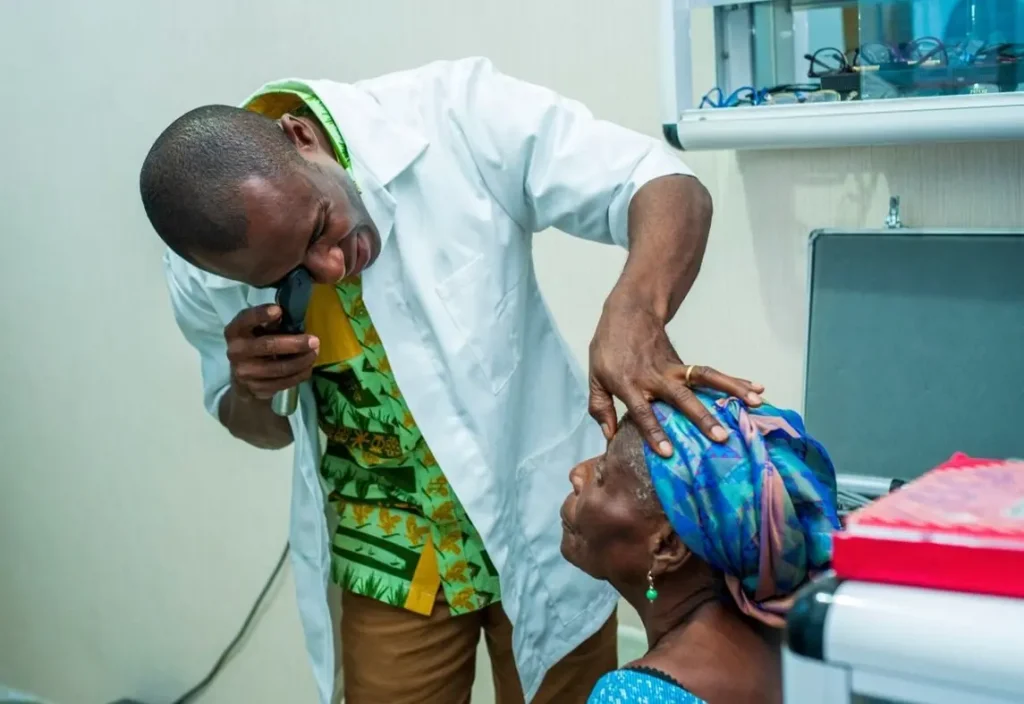
A healthcare professional conducting an eye examination for a patient. Photo: Government of Jamaica.

Orinoco Tribune – News and opinion pieces about Venezuela and beyond
From Venezuela and made by Venezuelan Chavistas
A healthcare professional conducting an eye examination for a patient. Photo: Government of Jamaica.
Jamaica’s Government announced the end of the historical agreement with Cuba on medical missions, while the U.S. presses other countries to cancel these colaboration programs.
Jamaica’s Foreign Ministry announced on Thursday its decision to end a long-standing agreement with Cuba that was related to medical missions on the island, following the expiration of their previous pact in February 2023 and an inability to reach new terms.
The announcement was made through a statement by Foreign Minister Kamina Johnson Smith, who had previously highlighted the importance of Cuban medical colaboration in the country health system. This decision comes amidst broader regional pressure from Washington on Havana’s medical programs.
The Government of Jamaica has expressed its willingness for the Ministry of Health and Wellness to contract these individuals directly to ensure the uninterrupted provision of valuable services by the Cuban medical professionals already in the country, and for their personal safety and welfare.
The Jamaican Ministry of Health and Wellness highlighted that Jamaicans have “significantly benefited” from the ophthalmological care program, as well as the general healthcare provided by Cuban nurses and doctors, a testament to the effectiveness and necessity of this cooperation.
In the past year, Washington’s pressure on Havana has led a dozen primarily Caribbean and Central American countries to cancel or reduce their contracts with Cuba. Initially, nations like Antigua and Barbuda, the Bahamas, Grenada, Guyana, and Trinidad and Tobago defended these programs, which are vital for their respective healthcare systems, but later had to adjust their ties with Havana and modify the terms of their contracts.
Text reads:
“Cuba regrets the decision of the Government of Jamaica to cease medical cooperation ceding to pressure from the United States.”
Cooperation Under U.S. Pressure
The Cuban Government expressed profound regret over Jamaica’s unilateral decision to terminate their decades-long health cooperation agreement, a move Havana attributes to pressure from the United States Government. This action effectively ends a program that has provided essential medical services to the Jamaican people, prompting Cuba to announce the immediate return of its medical brigade.
The Cuban Ministry of Foreign Affairs reported that the Jamaican Ministry of Foreign Affairs officially communicated its unilateral decision to Cuba’s Embassy in Kingston on March, 4. The Jamaica’s announcement comes a day after more than 150 Cuban medical staff left Honduras, following the sudden cancellation of a similar agreement by the new government.
Cuba deeply laments what it describes as an “undervaluation of a fruitful and sustained history of collaboration that has yielded innumerable benefits for the Jamaican people.” As a direct consequence of this decision, Jamaicans will now be deprived of the basic and specialized health services previously provided by Cuban medical professionals.
In response to the step taken by the Jamaican government, the Cuban government has made the sovereign decision to proceed with the return of its Medical Brigade.
Faithful to the historical relations of brotherhood and solidarity that unite it with Jamaica, Cuba reiterates its unbreakable commitment to the Jamaican people, assuring them that they can always count on Cuba’s selfless cooperation in the future, despite this current setback in bilateral arrangements.
Text reads:
“The historical results of Cuban medical collaboration in Jamaica speak for themselves: More than 8,176,000 patients treated. 74,302 surgical interventions performed. 7,170 attended births. More than 90,000 lives saved.”
Undeniable Medical Achievements
Over the past 30 years, more than 4,700 Cuban collaborators have provided medical assistance across the Jamaican island. Prior to the recent announcement, the Cuban Medical Brigade was composed of 277 professionals, whose collective efforts have had a tangible and profound impact on strengthening its health system.
Statistical data highlights the significant scale of their work: more than 8,176,000 patients attended, 74,302 surgical interventions performed, 7,170 births assisted, and over 90,000 lives saved.
Furthermore, through the “Operation Miracle” program, which has been active in Jamaica since 2010, nearly 25,000 Jamaicans have had their vision restored or significantly improved.
Cuban cooperation has also been instrumental in vital projects for the control and prevention of diseases such as malaria and played a critical role in the fight against the COVID-19 pandemic, providing expertise and direct support during a global health crisis.
A recent example of this unwavering dedication was evident after Hurricane Melissa severely impacted the Jamaican island. In those challenging circumstances, the Cuban Medical Brigade remained steadfast at their posts, with many of its members working for more than 72 continuous hours and actively participating in the recovery efforts of hospitals and communities.
Jamaica’s medical cooperation with Cuba dates back more than 50 years, evolving into a crucial pillar of its public health system. The Cuban medical brigades, which began over six decades ago, have sent 600,000 professionals to 165 countries, according to official data.
(Telesur) by Laura V. Mor