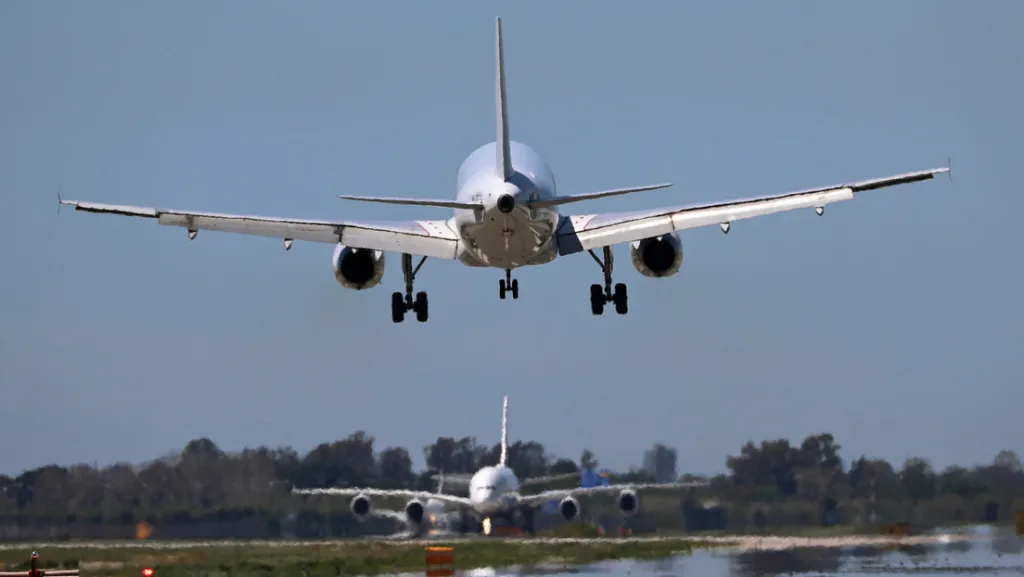
Airplane on a runway. Photo: JoanValls/NurPhoto/Gettyimages.ru.
Airplane on a runway. Photo: JoanValls/NurPhoto/Gettyimages.ru.
On Monday, Colombian President Gustavo Petro announced that Colombia has restored flights to and from Venezuela amid the threats and killings carried out by the US in the Caribbean.
“Colombia is restoring civil air service with Venezuela and invites the world to do the same,” President Petro wrote in a public statement, noting that the current situation calls for diplomacy.
“It is time for dialogue, not barbarism,” President Petro said, stressing that “the US has no right to close Venezuelan airspace. It can do so with its own airlines but not with the world’s.”
President Petro’s message was accompanied by an interview in the newspaper La Razón with Colombia’s transport minister, María Fernanda Rojas Mantilla, who criticized the warning issued by the US Federal Aviation Administration (FAA) regarding flights to Venezuela, referring to the restrictions as political and as violations of the fundamental principles of international aviation.
The Colombian minister, who highlighted that the Colombian airlines Wingo and Satena continue operating flights to Venezuela, said that the US alert about Venezuelan airspace contradicts the Chicago Convention, the treaty governing global aviation that enshrines sovereignty as the central pillar of each nation’s airspace.
The US FAA issued an alert on November 21 against Venezuela, claiming there had been a deterioration in security conditions and an increase in military activity on Venezuelan territory [ironic considering that this “military activity” was initiated by the US deployment of heavy warships and thousands of marines to the Carribean Sea immediately off the coast of Venezuela]. This US attempt to “close” Venezuela’s airspace prompted six international airlines to suspend their connections with Venezuela, including Iberia, TAP, Avianca, Caribbean Airlines, GOL, and LATAM. The decision by those companies, as a violation of Venezuela’s sovereignty and according to the agreements that airlines enter into, led Caracas to revoke their flight permits into Venezuelan territory.
Key elements of US aggression
Military deployment: Since last August, the US has maintained a significant military force off the coast of Venezuela, justifying it as part of the so-called “anti-drug fight.” Washington later announced the launch of Operation Southern Spear, officially aimed at “eliminating the narcoterrorists” of the Western hemisphere and “protecting” the United States “from the drugs that are killing” its citizens.
Lethal operations: As part of these operations, missile strikes have been carried out against alleged drug-trafficking boats [small boats usually used by people fishing], leaving more than 100 people dead, with no evidence that they were actually trafficking narcotics.
Accusations and bounty: Washington has accused Venezuelan President Nicolás Maduro—without evidence—of leading a drug-trafficking cartel and has doubled the reward for his capture to US $50 million.
Venezuelan position: Venezuela’s President Maduro argues that the real US objective is “regime change” in order to privatize Venezuela’s resource industries and control profits from Venezuela’s immense oil and gas assets for the benefit of US corporations.
Lack of evidence: Organizations such as the UN and the DEA themselves indicate that Venezuela is not a main route for drug trafficking into the United States, since more than 80% of the drugs circulating in the region move along the Pacific route.
International condemnation: Russia, the UN High Commissioner for Human Rights, and the governments of Colombia, Mexico, Brazil, and other nations have condemned the US actions. Experts describe the attacks on vessels as “summary executions” that violate international law.
With Imaginary Decree, Trump Attempts to ‘Close’ Venezuela’s Airspace
(RT News) with Orinoco Tribune content
Translation: Orinoco Tribune
OT/CB/SL

Cameron Baillie is an award-winning journalist, editor, and researcher. He won and was shortlisted for awards across Britain and Ireland. He is Editor-in-Chief of New Sociological Perspectives graduate journal and Commissioning Editor at The Student Intifada newsletter. He spent the first half of 2025 living, working, and writing in Ecuador. He does news translation and proofreading work with The Orinoco Tribune.