By Pepe Escobar – Apr 8, 2025
Although perhaps not yet obvious to Washington, a US war on Iran will be viewed as one against Russia and China too. Both Putin and Xi know that Trump’s war is singularly directed at the transformational global ‘changes they are driving together.’
Russia and Iran are at the forefront of the multi-layered Eurasia integration process – the most crucial geopolitical development of the young 21st century.
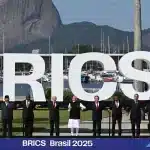
Both are top members of BRICS+ and the Shanghai Cooperation Organization (SCO). Both are seriously implicated as Global Majority leaders to build a multi-nodal, multipolar world. And both have signed, in late January in Moscow, a detailed, comprehensive strategic partnership.
The second administration of US President Donald Trump, starting with the “maximum pressure” antics employed by the bombastic Circus Ringmaster himself, seems to ignore these imperatives.
It was up to the Russian Foreign Ministry to re-introduce rationality in what was fast becoming an out of control shouting match: essentially Moscow, alongside its partner Tehran, simply will not accept outside threats of bombing Iran’s nuclear and energy infrastructure, while insisting on the search for viable negotiated solutions for the Islamic Republic’s nuclear program.
And then, just like lightning, the Washington narrative changed. US Special Envoy for Middle East Affairs, Steven Witkoff – not exactly a Metternich, and previously a “maximum pressure” hardliner – started talking about the need for “confidence-building” and even “resolving disagreements,” implying Washington began “seriously considering,” according to the proverbial “officials,” indirect nuclear talks.
These implications turned to reality on Monday afternoon when Trump allegedly blindsided the visiting Israeli Prime Minister Benjamin Netanyahu with the announcement of a “very big meeting” with Iranian officials in the next few days. Tehran later confirmed the news, with Iran’s Foreign Minister Abbas Araghchi saying he would engage in indirect nuclear negotiations with Witkoff in Oman on Saturday.
It’s as if Trump had at least listened to the arguments exposed by the Islamic Republic’s Supreme Leader Ayatollah Ali Khamenei. But then again, he can change his mind in a Trump New York minute.
The finer points of the Russia–Iran–China axis
Essential background to decipher the “Will Russia help Iran” conundrum can be found in these all-too-diplomatic exchanges at the Valdai Club in Moscow.
The key points were made by Alexander Maryasov, Russia’s ambassador to Iran from 2001 to 2005. Maryasov argues that the Russia–Iran treaty is not only a symbolic milestone, but “serves as a roadmap for advancing our cooperation across virtually all domains.” It is more of “a bilateral relations document” – nota defense treaty.
The treaty was extensively discussed – then approved – as a counter-point to “the intensified military-political and economic pressure exerted by western nations on both Russia and Iran.”
The main rationale was how to fight against the sanctions tsunami.
Yet even if it does not constitute a military alliance, the treaty details mutually agreed moves if there is an attack or threats to either nation’s national security – as in Trump’s careless bombing threats against Iran. The treaty also defines the vast scope of military-technical and defense cooperation, including, crucially, regular intel talk.
Maryasov identified the key security points as the Caspian, the South Caucasus, Central Asia, and last but not least, West Asia, including the breadth and reach of the Axis of Resistance.
The official Moscow position on the Axis of Resistance is an extremely delicate affair. For instance, let’s look at Yemen. Moscow does not officially recognize the Yemeni resistance government embodied by Ansarallah and with its HQ in the capital Sanaa; rather, it recognizes, just like Washington, a puppet government in Aden, which is in fact housed in a five-star hotel in Riyadh, sponsored by Saudi Arabia.
Last summer two different Yemeni delegations were visiting Moscow. As I witnessed it, the Sanaa delegation faced tremendous bureaucratic problems to clinch official meetings.
There is, of course, sympathy for Ansarallah across Moscow intel and military circles. But as confirmed in Sanaa with a member of the High Political Council, these contacts occur via “privileged channels,” and not institutionally.
The same applies to Lebanon’s Hezbollah, which was a key Russian ally in routing ISIS and other Islamist extremist groups during the Syrian war. When it comes to Syria, the only thing that really matters for official Moscow, after the Al-Qaeda-linked extremists took power in Damascus last December, is to preserve the Russian bases in Tartous and Hmeimim.
There’s no question that the Syrian debacle was an extremely serious setback for both Moscow and Tehran, further aggravated by Trump’s non-stop escalation over Iran’s nuclear program and his “maximum pressure” obsession.
The nature of the Russia–Iran treaty differs substantially from that of Russia–China. For Beijing, the partnership with Moscow is so solid, it develops so dynamically, that they don’t even need a treaty: they have a “comprehensive strategic partnership.”
Chinese Foreign Minister Wang Yi, in his recent visit to Russia, after coining a pearl – “those who live in the 21st century but think in Cold War blocs and zero-sum games cannot keep up with the times” – neatly summarized Sino–Russian relations in three vectors: The two Asian giants are “forever friends and never enemies;” Equality and mutually beneficial cooperation; Non-alignment with blocs; Non-confrontation, and non-targeting of third parties. So even as we have a Russia–Iran treaty, between China and Russia, and China and Iran, we have essentially close partnerships.
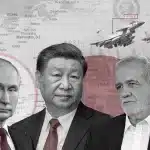
Witness, for instance, the fifth annual joint Russia–Iran–China naval exercises that took place in the Gulf of Oman in March. This trilateral synergy is not new; it has been under development for years.
But it’s lazy to characterize this improved RIC Primakov triangle (Russia–Iran–China instead of Russia–India–China) as an alliance. The only “alliance” that exists today on the geopolitical chessboard is NATO – a warmongering outfit composed of intimidated vassals corralled together by the Empire of Chaos.
Cue to yet another hard-to-resist Wang Yi jade pearl: “The US is sick but forces others to take the medicine.” Takeaways: Russia is not switching sides; China won’t be encircled; and Iran will be defended.
When the new Primakov triangle meets in Beijing
At the Valdai discussion, Daniyal Meshkin Ranjbar, assistant professor in the Department of Theory and History of International Relations at the Moscow-based RUDN University, made a crucial point: “For the first time in history, the diplomatic outlooks of Russia and Iran converge.” He’s referring to the obvious parallels between official policies: Russia’s “pivot to the east” and Iran’s “look east” policies.
All those interconnections plainly escape the new administration in Washington, as well as bombastic Trump–Netanyahu rhetoric that has zero basis in reality – even the US National Security Council admitted that Iran is not working on a nuclear bomb.
And that brings us to the Big Picture.
The Circus Ringmaster – at least until he changes his mind again – is essentially working on a triangulation deal, allegedly offering Russia a transportation framework, access to grain exports in the Black Sea, and Russian banks off the sanction list of SWIFT so he may execute his “pivot” to then attack Iran (deadline to Tehran included).
And if Russia defends Iran, no deal.
That’s as mendacious as Mafia-style “offer you can’t refuse” maximum pressure can get. Russian Deputy Foreign Minister Sergey Ryabkov – an exceptionally able diplomat – destroyed the whole rationale: “Russia cannot accept US proposals to end the war in Ukraine in their current form because they do not solve the problems Moscow considers the cause of the conflict.” Even as Moscow “takes the models and solutions proposed by the Americans very seriously.”
As the Russian angle of Trump’s triangulation falters, Tehran is not merely watching the river flow. How Iran adapted for decades to a sanctions tsunami is now firm knowledge deeply shared with Moscow, part of their deepening cooperation enshrined in the treaty.
For all of Trump’s volatility, non-Zionist-contaminated voices across the Beltway are slowly but surely imprinting the rational view that a war on Iran is absolutely suicidal for the Empire itself. So the odds resurface that Trump 2.0 verbal barrages may be paving the way for a temporary deal that will be spun to death – after all, this is always a battle of narratives – as a diplomatic victory.
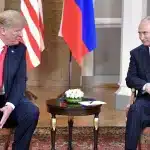
Bets can be made that the only leader on the planet capable of making Trump understand reality is Russian President Vladimir Putin, in their next phone call. After all, it is the Circus Ringmaster himself who created the revamped “nuclear Iran” drama. RIC – or the revamped Primakov triangle – duly addressed it, together, in a crucial, discreet, not-publicized recent meeting in Beijing, as confirmed by diplomatic sources.
Essentially, the RIC has developed a “nuclear Iran” road map. These are the highlights:
• Dialogue. No escalation. No “maximum pressure”. Step-by-step moves. Build mutual confidence.
• As Iran re-emphasizes its veto on developing nuclear weapons, the much-debated “international community”, actually the UN Security Council, recognizes, again, Iran’s right to peaceful nuclear energy under the NPT.
• Back to the JCPOA – and reboot it. To get Trump back on board, the reboot will be an extremely hard sell.
This roadmap was ratified during a second round of RIC trilateral talks in Moscow on Tuesday, where senior officials from the allied nations discussed collaborative efforts to address the challenges faced by Iran.
Iran: Beijing Meeting Urges End to Sanctions and Pressure, Calls for Dialogue
That summit in Moscow
As it stands, the road map is just that: a map. The breathless Zionist axis from Washington to Tel Aviv will continue to insist that Iran, if attacked, will not be supported by Russia, and extra, non-stop “maximum pressure” will force Tehran to eventually fold and abandon its support to the Axis of Resistance.
All that, once again, eschews reality. For Moscow, Iran is an absolutely key geopolitical priority; beyond Iran, to the east, is Central Asia. The Zionist obsessive fantasy of regime change in Tehran masks NATO’s then penetrating into Central Asia, building military bases, and at the same time blocking several strategically crucial Chinese Belt and Road Initiative (BRI) projects. Iran is as essential to China’s long-term foreign policy as it is to Russia’s.
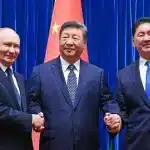
It’s not by accident that Russia and China will meet at the presidential level – Vladimir Putin and Xi Jinping – at a summit in Moscow around 9 May, Victory Day in the Great Patriotic War. They will be analyzing in detail the next stage of “changes that we have not seen in 100 years,” as formulated by Xi to Putin in their groundbreaking 2023 summer in Moscow.
They, of course, will be discussing how the Circus Ringmaster dreams of closing down one Forever War just to start another: the specter of a US–Israel attack on their strategic partner Iran – complete with the counterpunch of blocking the Strait of Hormuz (transit for 24 million barrels of oil a day); a barrel of oil skyrocketing to $200 and even more; and the collapse of the humongous $730 trillion pile of derivatives in the global economy.
No, President Circus Ringmaster: You don’t have the cards.

Pepe Escobar
Pepe Escobar is a Brazilian journalist. He writes a column – The Roving Eye – for Asia Times Online, and works as an analyst for RT, Sputnik News, and Press TV. In addition, he previously worked for Al Jazeera.