Sinophobia Inc: Understanding the Anti-China Industrial Complex


Orinoco Tribune – News and opinion pieces about Venezuela and beyond
From Venezuela and made by Venezuelan Chavistas
By Qiao Collective – Sep 13, 2020
Armed with state funding and weapons industry sponsors, a handful of influential think tanks are setting the terms of the New Cold War on China, propelling the U.S.-led alliance towards a disastrous conflict at the expense of the rest of us.
Take a deep dive into the inner workings of Sinophobia Inc. to learn how to see through the media machine.
The United States’ alliance is barreling towards conflict with China. In recent months, the U.S. government has taken unprecedented steps to upend normal relations with China: sanctioning Communist Party of China officials, banning Chinese tech companies like TikTok and Huawei, interrogating and surveilling Chinese students and scientists, and even forcing the Houston Chinese consulate to close.
Secretary of State Mike Pompeo calls it an end to “blind engagement” with a Chinese state he labels an existential threat to the “free world.” And the other members of the “Five Eyes” intelligence alliance—Canada, New Zealand, and the UK—are by and large caving to U.S. pressure to take parallel measures to isolate China.
Yet the Western policy doctrine of “great power competition” with China has not been accompanied by a robust public debate. Instead, this blustering state rhetoric has coincided with public views of China hitting historic lows. Thanks in part to racist corporate media coverage which blamed China for the spread of COVID-19, unfavorable views of China are skyrocketing.

Pew Research reported in July that unfavorable views of China had reached “new highs” in the U.S.—more than doubling from 35 to 73 percent between 2005 and 2020. Australian trust in their northern neighbors is even worse: in 2020, 77 percent of Australians expressed distrust in China, compared to just 38 percent in 2006.
As the U.S. and other Western nations are mired by the crises of COVID-19, unemployment, wage stagnation, and systemic racism, the fictitious “China threat” should be the least of our worries. After all, China has made clear time and time again that it wants peaceful relations and cooperation with the U.S, and China’s foreign policy principle of a “community of shared future for humankind” is enshrined in the Communist Party constitution. Make no mistake—the New Cold War on China is a one-sided escalation for conflict led by the U.S. and its allies.
RELATED CONTENT: The Difference Between the US and China’s Response to COVID-19 is Staggering
The fact that Western public opinion on China is marching in lockstep with the State Department’s call for Cold War aggression reflects the convergence of state, military, and corporate media interests which monopolize our media ecosystem. Behind the State Department’s bluster and the military “Pivot to Asia” exists a quiet, well-oiled machine that is busy manufacturing consent for war on China. Too often, the hawkish policy stances it enshrines are taken as objective ‘truth’ rather than as pro-war propaganda working in the interests of weapons corporations and political elites.
The fact that Western public opinion on China is marching in lockstep with the State Department’s call for Cold War aggression reflects the convergence of state, military, and corporate media interests which monopolize our media ecosystem.
We call it Sinophobia, Inc.—an information industrial complex where Western state funding, billion dollar weapons manufacturers, and right-wing think tanks coalesce and operate in sync to flood the media with messages that China is public enemy number one. Armed with state funding and weapons industry sponsors, this handful of influential think tanks are setting the terms of the New Cold War on China. The same media ecosystem that greased the wheels of perpetual war towards disastrous intervention in the Middle East is now busy manufacturing consent for conflict with China.
By saturating our news and newsfeeds with anti-China messages, this media machine is convincing average people that a New Cold War is in their interests. In reality, the hype of an imagined ‘China threat’ only serves the interests of the political elites and defense industry CEOs who stand to profit from this disastrous geopolitical escalation.
Who’s Who in Sinophobia Inc.
In order to mount a sustained challenge to the New Cold War on China, the anti-war movement must develop a critical media literacy with which to see through this imperialist media machine. A close eye reveals that a handful of think tanks, pundits, and “security experts” show up time and time again in corporate media coverage of China. What’s more, these “independent” experts have explicit ties to the weapons industry and the state departments of the U.S. and its allies.
The Australian Strategic Policy (ASPI) is one such actor. It’s been called “the think tank behind Australia’s changing view of China” and decried by progressive Australian politicians as “hawks intent on fighting a new cold war.” But despite its right-wing slant, ASPI saturates Western media across the political spectrum—from Breitbart and Fox News to CNN and the New York Times. The broad legitimation of think tanks such as ASPI is one factor behind today’s bipartisan support for imperialist aggression on China.
No matter how outrageous the allegation, ASPI finds warm welcome in a media ecosystem hungry for controversy and a geopolitical climate inching closer to military aggression on China by the day.
From national defense and cybersecurity to human rights allegations, the China hawks of ASPI weaponize a variety of issues in support of their call for military buildup vis-a-vis China. ASPI and its staff have called for visa restrictions on Chinese students and scientists, alleged a secret Chinese biological weapons program, and claimed China is exploiting Antarctica for military advantages. No matter how outrageous the allegation, ASPI finds warm welcome in a media ecosystem hungry for controversy and a geopolitical climate inching closer to military aggression on China by the day.
When it comes down to it, that’s exactly what ASPI wants. ASPI executive director Peter Jennings unabashedly describes himself as a “national security cowboy,” saying that “Australia needs more cowboy and less kowtow.” As Australian PM Scott Morrison has pushed record defense spending, Jennings called for even higher targets, saying “if we’re sliding towards war, the money must flow.”
This belligerent attitude towards military confrontation makes sense in the context of ASPI’s financials. Despite being cited as a ‘non-partisan expert’ on all things China, when it comes to the profits of war, ASPI has skin in the game.
That’s because ASPI—like many of the biggest players in Sinophobia, Inc—receives major funding from the Australian military and U.S. weapons contractors like Lockheed Martin and Raytheon.
In the 2019-2020 fiscal year, ASPI received 69% of it’s funding—over AU$7 million—from the Australian department of defense and federal government. Another AU$1.89 million came from overseas government agencies—including the Embassies of Israel and Japan, the U.S. Department of Defense and State Department and the NATO Strategic Comms Center. Far from being a non-partisan counterbalance to imperialist state agendas, the same governments pushing geopolitical aggression on China are in fact ASPI’s primary funders.
Disturbingly, another AU$1.1 million came from defense industries and the private sector, including Lockheed Martin ($25,000 for a “strategic sponsorship”) and Northrop Grumman ($67,500 for an “ASPI Sponsorship”).
In a blatant display of their conflict of interest, the same weapons corporations sponsoring ASPI’s anti-China call to arms are also supplying the New Cold War on China. In 2016, the Australian department of defense awarded Lockheed Martin a AU$1.4 billion combat “combat system integrator” contract as part of its Future Submarines program to “stand up” to China. Under the same program, defense contractor Naval Group—which contributed a $16,666.68 “ASPI Sponsorship” in 2019-2020—was awarded a $605 million contract for submarine design.
In a blatant display of their conflict of interest, the same weapons corporations sponsoring ASPI’s anti-China call to arms are also supplying the New Cold War on China.
The scope of potential profit from stoking military conflict with China is enormous. Under the auspices of the “Pivot to Asia,” the U.S. has ramped up arms exports to allies such as Japan and Australia as part of a new anti-China containment doctrine. From weapons exports totalling $7.8 billion to Australia and $6.28 billion to South Korea between 2014 and 2018 alone, to loosened regulations allowing military-drone exports to India, these bloated deals are an absolute windfall for U.S. weapons manufacturers.
Every dramatic report on the ‘China threat’ funnels towards the same result: more warships in the South China Sea, more reconnaissance planes sent into China’s airspace, and more missile and anti-missile stations across U.S. ‘allies’ and client states in the Asia-Pacific. The New Cold War on China means billions in profit for U.S. weapons manufacturers, who quietly fund the ‘research’ that provides the justification for increased military buildup vis-a-vis China.
A cycle of perpetual war
This vicious cycle of the military-industrial complex drives Sinophobia Inc. Having watched this convergence of corporate media, weapons manufacturing, and State Department interests manufacture consent for the disastrous Iraq and Afghanistan wars, we should be able to recognize the pattern. But so far, it looks like the same toolkit is working yet again.
First, ‘independent’ security experts such as ASPI, funded by Western governments and their weapons industries, provide ‘irrefutable’ evidence of the so-called China threat.
Second, these reports are picked up, cited, and amplified by the corporate media and then absorbed by the general public.
Third, Western nations and their allies cite these reports on the ‘China threat’ to justify their own geopolitical ambitions and military aggression towards China.
And finally, defense departments award billion dollar contracts to weapons corporations to equip the militaristic “Pivot to Asia”—completing the cycle by padding the pockets of the very corporations funding the think tanks we started with.
RELATED CONTENT: The US is Doing far Worse Than What it Accuses China of Doing to the Uighurs

Of course, ASPI is just one of several heavy hitters in the anti-China industry. Stalwarts of the D.C. security realm like the Center for Strategic & International Studies and the Council and Foreign Relations are similarly obliged to their state and military industry donors.
The Center for Strategic & International Studies has been described as one of the most influential think tanks in the world. Its dramatic reports on Chinese military operations and Chinese “foreign influence” campaigns garner headlines in Forbes, New York Times, and even left-leaning outlets like Politico. Bonnie Glaser, director of CSIS’s “China Power Project,” is a particularly sought-after commentator on China. She’s demonized Chinese subsidies to domestic industry, called Belt and Road Initiative a plan to bring countries into “China’s orbit” and “see authoritarianism strengthened,” called to “push back” against China’s foregrounding of Marxism as an alternative to free market neoliberalism, and called “many of the the things the Trump administration has done to highlight the threats that China poses…correct.”
None of these corporate media op-ed features, interviews, and press quotes bother to mention that CSIS counts among its “corporation and trade association donors” Northrop Grumman ($500,000 annual contribution), Boeing, General Atomics, and Lockheed Martin ($200,000-$499,999 annual contribution), and Raytheon ($100,000-$199,999 annual contribution).
Corporate media op-eds, interviews, and press quotes from ‘non-partisan experts’ such as the Center for Strategic and International Studies never bother to mention that CSIS counts among its funders weapons manufacturers such as Northrop Grumman, Boeing, General Atomics, Lockheed Martin, and Raytheon.
Even worse than simply accepting military industry funding, CSIS has held closed-door meetings with weapons industry lobbyists and lobbied for increased drone exports for the products of war manufactured by funders such as General Atomic and Lockheed Martin.
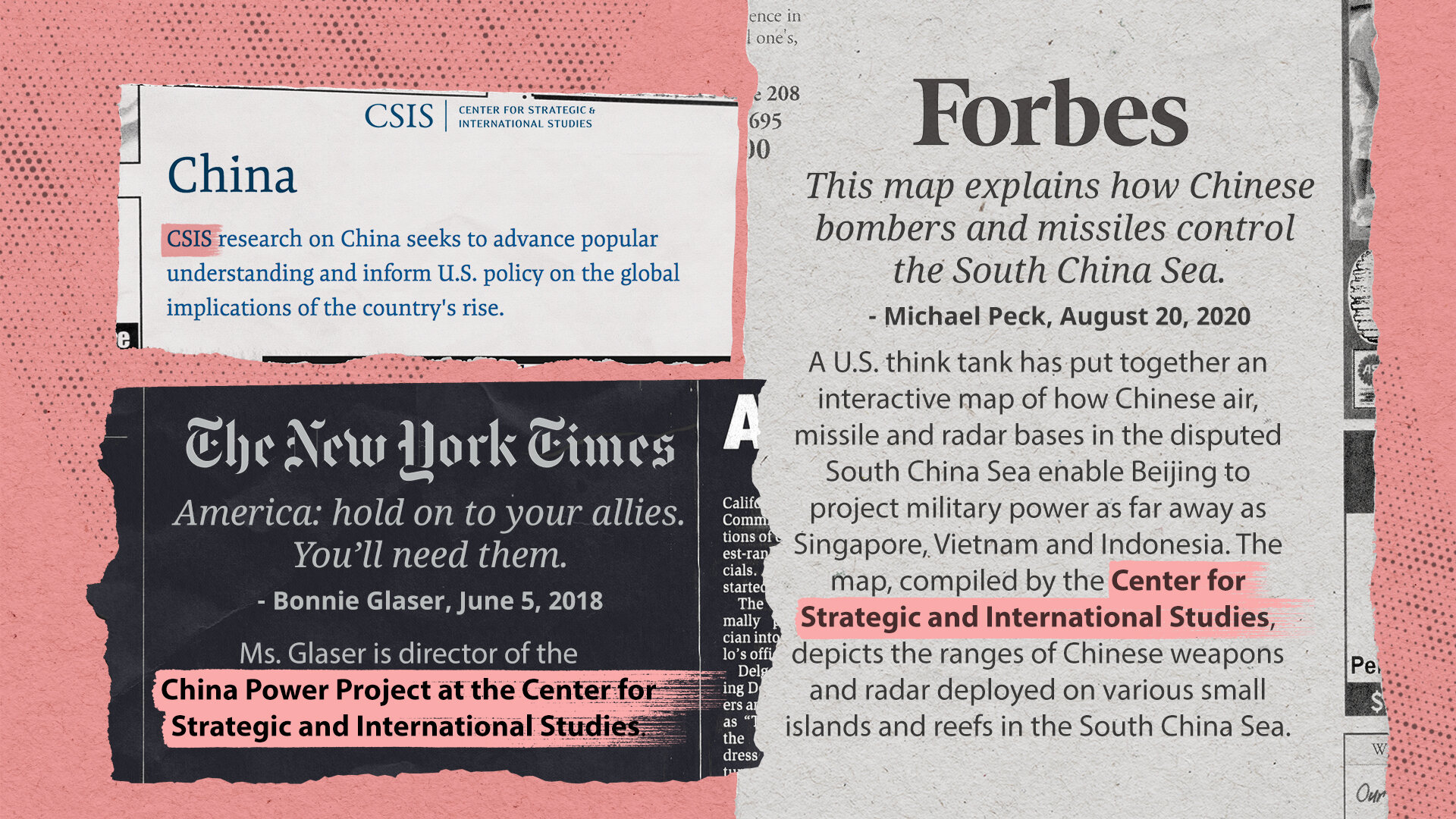
But instead of calling out this conflict of interest, corporate media uncritically lifts up these think tanks as supposedly ‘impartial’ security experts. Only a handful of independent news platforms bother to point out these ‘third-party’ interests in paving the way to perpetual war. Instead, these think tank employees are held up as objective experts and lavished with media attention, making them go-to sources for comments and editorial features on all things China.
According to mainstream media, there’s no conflict of interest: only a pending conflict with China to drum up support for.
A bipartisan revolving door
The incestuous relationship between the Pentagon, security think tanks, and the private weapons sector goes far beyond dirty money. High-level diplomats themselves frequently move back and forth from their posts in the defense department to the boards of weapons corporations and policy institutes, wielding their insider insights to help weapons corporations rake in federal money.
The revolving door of the military-industrial complex crosses party lines. Take Randall Schriver, a China hawk hand-picked by Steve Bannon to serve as the Trump Administration’s Assistant Secretary of Defense for Asian and Pacific Security Affairs. Schriver was the founding president of the Project 2049 Institute, a hardline security think tank funded by weapons giants like Lockheed Martin and General Atomics and government entities including the Taiwan Ministry of National Defense and the National Endowment for Democracy. Predictably, under Schriver’s leadership, Project 2049 called for increased arms sales to Japan and Taiwan while sounding the alarm on the supposed threat of a “flash invasion” of Taiwan or a “sharp war” with Japan.
Not to be outdone, foreign policy veterans of the Obama Administration got rich forming ‘strategic consultancies’ dedicated to leveraging their insider status to help weapons corporations win federal contracts. Michèle Flournoy, a favored pick for a Biden administration’s defense secretary, served as undersecretary of defense for policy from 2009 to 2012 and has overlapping roles as a founder of corporate geopolitics consultant group WestExec Advisors, and co-founder of the Center for a New American Security, a think tank preaching expertise on “the China challenge” and the “North Korea threat” with the help of funding from the usual state and military industry suspects.
Given this resumé, it comes as no surprise that Flournoy has decried the “erosion of American deterrence” and called for new investment and innovation to “maintain the U.S. military’s edge” in Asia, a clear assurance that a Biden administration would mean new and growing contracts to old friends in the security industry.
Enemy number one
The cogs of the military-industrial-information complex have ensured that the debate on China is all but nonexistent. Anti-China posturing has become a defining issue of the November presidential election. But there is effectively zero policy distinction between the approaches espoused by the Biden and Trump camps—only a rhetorical competition playing out in campaign ads and stump speeches to prove who can really be ‘tougher on China.’
The revolving door of Sinophobia Inc. makes certain that whether Republicans or Democrats come out on top in November, the weapons contracts will continue to flow.
The revolving door of Sinophobia Inc. makes certain that whether Republicans or Democrats come out on top in November, the weapons contracts will continue to flow.
Despite incessant fear mongering over the looming threat of ‘Chinese aggression,’ China has been explicitly clear that it does not want conflict with the U.S., let alone hot war. In August meetings with the European Union, Chinese foreign minister Wang Yi called for renewed cooperation, proclaiming that “a Cold War would be a step backwards.” Where the U.S. pursues unilateralism, sanctions, and the threat of military intervention to get its way, China has invested in international organizations, stepped up to fund the World Health Organization in the absence of the U.S., and promoted pandemic aid, cooperative vaccine development, and helped nations suffering under U.S. sanctions fight COVID-19.
Make no mistake: there is no supposed “mutual escalation” or “inter-imperial rivalry” here—U.S. aggression in military buildup, propaganda and economic sanctions is a one-sided push for conflict and war in spite of China’s repeated calls for mutual respect, win-win cooperation, and continued engagement premised on recognition of China’s national sovereignty and dignity.
U.S. political elites have turned to Sinophobia as a bogeyman to distract from the failures of capitalism, neoliberalism, and a violent U.S. empire that invests more in perpetual war than in basic health care and infrastructure for the American people. That’s what makes Sinophobia Inc. so effective: mass discontent fomented by an unresolved pandemic, rising unemployment, and American anxieties over the future can all be shunted onto the ‘real’ threat: China.
What makes Sinophobia Inc. so effective is China’s use as the ultimate bogeyman. Mass discontent fomented by an unresolved pandemic, rising unemployment, and American anxieties over the future can all be shunted onto the ‘real’ threat: China.
Sinophobia Inc. is working overtime to convince average Americans that China—and not white supremacy, capitalism, and militarism—is the ‘real enemy.’ It’s working: 78% of Americans blame China for the spread of COVID-19—more than blame the Trump administration itself for its handling of the pandemic. That’s why Congress has rubber-stamped a record defense budget for 2021 while declining to pass pandemic aid, eviction moratoriums, or other protections for American workers.
As Sinophobia Inc. draws us closer to war on China every day, it’s up to all of us to jam the gears of this war machine. That means a critical eye to the information apparatus busy manufacturing consent for a war that will only serve the bottom line of the American empire and the corporations that it serves.
The self-fueling war machine of think tanks, governments, and weapons corporations is chugging along, convincing the masses that conflict with China is in the national interest. But it’s clearer than ever that it’s the CEOs of Raytheon and Lockheed Martin that stand to profit—at the expense of the rest of us.