By Mohammed Al Faraj – Dec 8, 2025
One year after Syria’s government fell, the promised liberation has given way to dispossession. While Washington and Tel Aviv celebrate the dismantling of an independent military model and the severing of the Axis of Resistance, Syria’s people face massacres, economic strangulation, and a government more concerned with courting Israeli approval than building sovereignty.
On the morning of 8 December 2024, a pivotal shift unfolded in our region: the Syrian state collapsed after a 14-year war led by the United States. Veiled behind false concern for democracy and human rights, Washington’s agenda for the country was clear. It aimed to dismantle Syria’s independent model that challenged US regional dominance for years, and clear the way for expanded Israeli influence over the region.
Eliminating Syrian sovereignty
On 31 March 1986, the CIA produced a document that projected the future of Israel and outlined potential threats to it. The document surfaced publicly in 2011. Among other things, it states that the growing capabilities of the Syrian Arab Army pose a danger to the Israeli occupation — particularly if this buildup coincided with the rise of any “radical” governments in Jordan and/or Egypt.
Accordingly, Israel’s rapid strike on Syrian Army assets in the immediate aftermath of Assad’s fall was hardly unexpected, with Israeli tanks even violating the 1974 ceasefire line. The Israeli occupation sought to erase the remnants of the Syrian military model, which had maintained a deterrent balance for decades despite the difficulties of upgrading its arsenal after the Soviet Union’s collapse at the end of the millennium.
Israeli occupation forces reported carrying out 480 raids in the first two days following the fall of the Assad government, hitting airports, aircraft, air defence batteries, tanks, and weapons production facilities. Throughout the year, the strikes continued, bringing the total to 1,000 air operations since the state collapsed.
If all these attacks are viewed alongside the strict conditions Israel is attempting to impose on Syria — demilitarising the south, enforcing rigorous monitoring of new military acquisitions, and establishing a no-fly zone stretching from Damascus to the border — it becomes clear that the US-Israeli objective is to eliminate Syria’s established and independent military model, regardless of who governs the country.
The previous government pursued policies that challenged the Israeli occupation and refused to sign a peace agreement. Yet Israel’s long-term strategy rests on continually weakening surrounding states and preserving its qualitative military edge. When Henry Kissinger asked Israeli officials why they refused to give Anwar Sadat what he wanted — despite his lack of hostility toward them — their response was that they were preparing for the possibility of another Jamal Abdel Nasser emerging one day. The Israeli occupation adopts the same strategic logic toward Syria today, even as the actors, roles, and ideological orientations differ.
Syria’s economy under permanent siege
Under the former government, Syria’s economic model was typical of those that fall under Washington’s crosshairs. It was marked by protective policies that shielded national industries. It adhered to central economic planning inherited from its alliance with the Soviet Union, even though the state had, in its later years, adopted policies that undermined its domestic economy — especially through expanded economic ties with Turkey and the advance of privatisation.
After Assad’s fall, media narratives highlighted the fragile economy inherited by the new governing groups, asserting that they were left with an economy in collapse. While figures and statistics support this claim, such conditions are typical of a country that endured a 14-year war. Broadening the timeline, it becomes clear that Syria’s economy had actually tripled in size before the conflict (2000–2011), with GDP rising from $19 billion to $67 billion. The war years, combined with US sanctions, drove it sharply downward, returning it to levels comparable to — or worse than — those of 2000.
On 13 May 2025, Trump announced the lifting of sanctions on Syria at the request of Saudi Crown Prince Mohammed bin Salman. Media outlets celebrated the move. Yet six months later — specifically after Ahmad al-Sharaa (al-Jolani) visited Washington — it became evident that this sanctions relief was designed as a measure renewed every six months. As a result, the Syrian economy remains suspended by the noose of sanctions, permitted limited breathing room through aid but deprived of long-term investment prospects.
Less than two months after taking power, the new governing groups in Syria declared their intent to privatise factories and ports. In doing so, they aligned themselves with the US vision of dismantling the longstanding model of a “resistance economy” that had characterised Syria for decades.
“Human rights” disappear into the background
Despite “human rights” being the most prominent headline in the mainstream media against continued rule by Assad’s Ba’ath Party, it has become less important since he was deposed — a period marked by grave violations against the Syrian people. Reports issued by US Congress this year show that Washington’s interests are still centred on the same framework — counterterrorism, weapons of mass destruction, US military bases, the regional security system. “Human rights” is listed last.
The US did not oppose the human rights violations or the policies of power monopolisation that took place throughout the year, including:
- Establishing a transitional government copied from the previous “Idlib government” model.
- Holding a National Dialogue Conference that excluded the broadest segment of Syrians.
- The massacres that occurred in the Syrian coast against Alawites and in Suweida against Druze.
- Arbitrary detention of Syrians and systematic killings with an absence of accountability.
- Cases of kidnapping of Syrian women.
In November alone, the Syrian Observatory for Human Rights documented the killing of 41 Syrians, 23 of which were classified as due to sectarian affiliation, distributed across diverse geographical areas: the Damascus countryside, Homs, Aleppo, Hama, Idlib, Daraa, and Deir Ezzor.
The first year of the new ruling groups has demonstrated their inability to manage internal Syrian affairs or navigate complex regional dynamics:
- Building a civil state in Syria has become difficult under a faction with a deep terrorist history and a sectarian foundation. Even if the new ruling groups publicly claim to have shifted their approach to managing all social components, field reports have shown the involvement of Defence Ministry personnel in massacres on the Syrian coast and in Suweida.
- The terms of the agreement between al-Sharaa (al-Jolani) and Mazloum Abdi — the military commander of the Syrian Democratic Forces in northern Syria — have not produced tangible outcomes. The atmosphere remains tense and distrustful. After witnessing the massacres in the coast and Suweida, Kurdish communities in the north have clung to their weapons even more firmly, and there is no indication that they will lower their demands regarding decentralisation or the federalisation of the new Syrian army in a manner that meets the expectations of the Kurdish component. This unfolds alongside competing regional agendas: Turkey is alarmed by an armed Kurdish enclave in Syria supported by the United States and the Israeli occupation, while partition aligns with Israel’s interest in keeping the Syrian state permanently weak.
- Given the new ruling groups’ failure to build a unifying framework for Syrians — and in light of their sectarian background and their conduct over the past year — a broad sentiment is emerging among Syrians in favour of decentralisation, including within national political bodies that view it as impossible for the new regime to create an umbrella structure that brings Syrians together. This aligns with long-standing Israeli aspirations, articulated by Gideon Sa’ar, the current Israeli foreign minister, who stated in 2015 that the Syria of the past could never return.
Syria’s fall was a strategic prize for the Israeli occupation
After Israeli forces were defeated in the July 2006 war against Lebanon, they worked intensively to develop a new military approach to future confrontations — an approach described in The Human Machine Team as one that aims to ‘narrow the gap between intelligence and the decision to fire.’
Intelligence is typically part of pre-war preparation, shaping the direction of later military operations. However, during the 2024 war on Lebanon, intelligence became integrated directly into the conduct of operations and functioned in real time alongside conventional attacks. For example, pager explosions occurred simultaneously with the collection of new intelligence and ongoing airstrikes.
Despite the unexpected blows Hezbollah faced in the latter half of September 2024 — including targeted assassinations of senior figures, among them Al-Shahid Sayyed Hassan Nasrallah — the organisation managed to regain initiative on the ground and scored notable achievements in key operations, such as those targeting Netanyahu’s residence in Caesarea and the Golani Forces’ position south of Haifa.
The ceasefire went into effect on 27 November 2024. In his statement on the agreement, Netanyahu declared that ‘Assad will pay the price,’ as if anticipating what would unfold 10 days later.
At that moment, the Israeli occupation faced two choices: continue the war against Hezbollah — accepting the costs of the resistance regaining its momentum, overcoming the pager attacks, and absorbing the loss of Sayyed Hassan — or seize the larger strategic prize: the collapse of the Syrian state, which would dismantle the geographic link in the Axis of Resistance stretching from Iran and Iraq to Lebanon. Securing this strategic gain meant disrupting or severing the primary supply route for weapons to the resistance in Lebanon. The Israeli occupation chose this second option and complemented it by exploiting the agreement’s 60-day window to accomplish what it could not achieve during the war. It established new positions inside Lebanese territory and maintained intermittent shelling throughout the year, targeting resistance members and hindering civilian reconstruction in southern Lebanon to intensify pressure on the resistance’s social base.
Venezuela Condemns Zionist Bombardment of Palestine, Lebanon, Syria
For its part, the resistance opted to absorb this phase without retaliation until it could adjust to the new realities — most notably the Syrian factor, which created an additional burden: adapting to the loss of strategic depth in Syria and the disruption of the supply route that passed through it.
The Syrian transformation goes beyond a shift from ally to a neutral government — it has become a government with historical animosity toward the resistance in Lebanon, carrying grudges from past confrontations in Syria and influenced by deep sectarian motivations that serve both extremist Syrian and foreign groups.
The border, once a conduit for arms to confront Israel, now tells a different story. While the resistance repeatedly asserts its refusal to lay down arms, Syrian official statements increasingly court Israel, implicitly signalling a potential readiness to join the Abraham Accords in the future.
The US envoy to Lebanon, Tom Barrack, did not hesitate on multiple occasions to leverage Ahmad al-Sharaa (Abu Mohammad al-Jolani) against Lebanon, even referencing the Sykes-Picot agreement as a mistake — suggesting Syrian influence over Lebanon. Al-Sharaa (al-Jolani), meanwhile, has maintained a similar stance, declaring that he had ‘ended the presence of Hezbollah and Iran in Syria’ and would not allow Syria to serve as a platform for attacks against Israeli Occupation Entity.
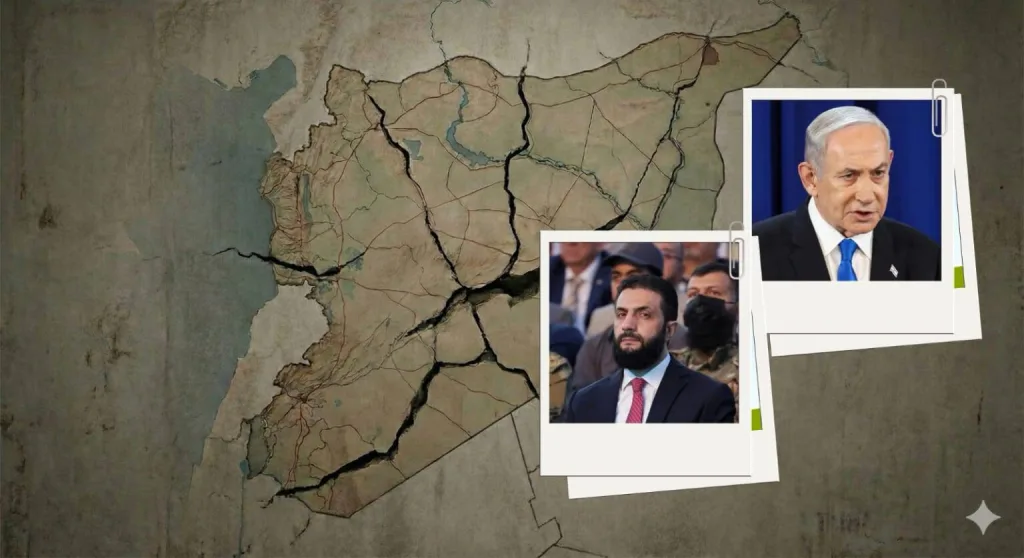
Over the course of the year, Al-Sharaa (al-Jolani) took steps to secure close ties with Israeli occupation forces, including meetings between Foreign Minister Asaad al-Shaibani and Israeli politician Ron Dermer in Baku, Paris, and London. However, Israel did not respond with the warmth the new Syrian regime expected. Instead, it bombed areas around the Presidential Palace and the Ministry of Defense, signalling its demand for the new Syrian government’s total submission— and ending the parity that defined relations for decades. Netanyahu recently stated that an agreement is possible, but only if it includes a demilitarised zone stretching from Damascus to Jabal al-Sheikh — a condition possible only under complete capitulation.
Tensions escalated recently in the Beit Jinn region, southwest of Damascus, when a group of young Syrians ambushed Israeli soldiers, wounding 13. This incident highlights a new challenge for Israeli occupation forces: the transformation of resistance in Syria from a state-centred force to a popular movement.
A new Syria for Iran and Turkey
Under the former government, existing Syrian equipment and radars at least provided early warning to Tehran of Israeli fighters crossing Syrian airspace, even if they could not jam or intercept them. In the 12-day war on Iran, the new Syrian government remained silent, issuing no official condemnation of Israeli aggression — unlike other Arab states, including Gulf countries with long-standing tensions with Iran, which were concerned about the war spreading toward US military bases on their soil. This silence, coupled with prior statements about ending Iran’s role in Syria, effectively signalled alignment with Israel.
Turkey emerged as the largest investor in the Syrian war over 14 years. It shares the longest border with Syria (900 kilometres), supports and exerts authority over the greatest number of armed groups during the war, and influences political efforts to form a unified opposition framework against the Assad government.
Yet, Turkey has not fully recouped its investment in the Syrian war — the gains achieved after Assad’s overthrow fell short of its expectations. This is largely due to the strong influence of other actors on the Syrian stage, particularly Israel and the United States.
Tensions between Turkey and Israel in Syria can be summarised in several points:
- The Israeli occupation seeks to shape Syria’s new security framework entirely on its own terms, which limits Turkey’s influence. For instance, in April 2025, Israel bombed airbases that Turkey had inspected to establish a presence for its forces within Syria.
- Israel supports Kurdish autonomy in Syria as part of its broader policy of ‘pinching the peripheries’ and partitioning the state, while Turkey views this separation as a major security concern regarding Kurds in northern Syria.
- Turkey aims to secure a role in Syria’s post-war economy and reconstruction projects, but this ambition does not necessarily align with US priorities—especially since Trump delegated the leading role in lifting sanctions to Mohammed bin Salman, rather than to Erdogan.
Time for zero-sum games?
Following the collapse of the Syrian state, heightened tensions among regional actors are expected. The key question remains: will this escalate into a zero-sum game between them?
- Increased friction between Israel and Hezbollah is likely. The US and Israel previously attempted to spark a conflict within Lebanon to trigger civil unrest, but failed. Israel continues to weigh the costs of a long-term weakening of Hezbollah against the risks of a wider-scale war, while Hezbollah seeks to fully recover from the last conflict and optimise its existing capabilities.
- Turkey, which maintains strong trade relations with Israel (accounting for 2.5 per cent of total Israeli imports), is now increasingly aware of the risks posed by Israeli policies in Syria and following the war on Iran. Could these developments narrow the gap between Iranian and Turkish foreign policies in the region? So far, Ankara has shown no significant indication of this shift.
- Israel has intensified military operations in Gaza and the West Bank, disregarding even calls from Arab governments for a two-state solution—a position already rejected by the vast majority of the Arab public.
We are entering a period of hyper-tension among all actors, at multiple levels. Without at least an acceptable framework for a zero-sum approach against Israel, occupation and aggression are unlikely to abate.