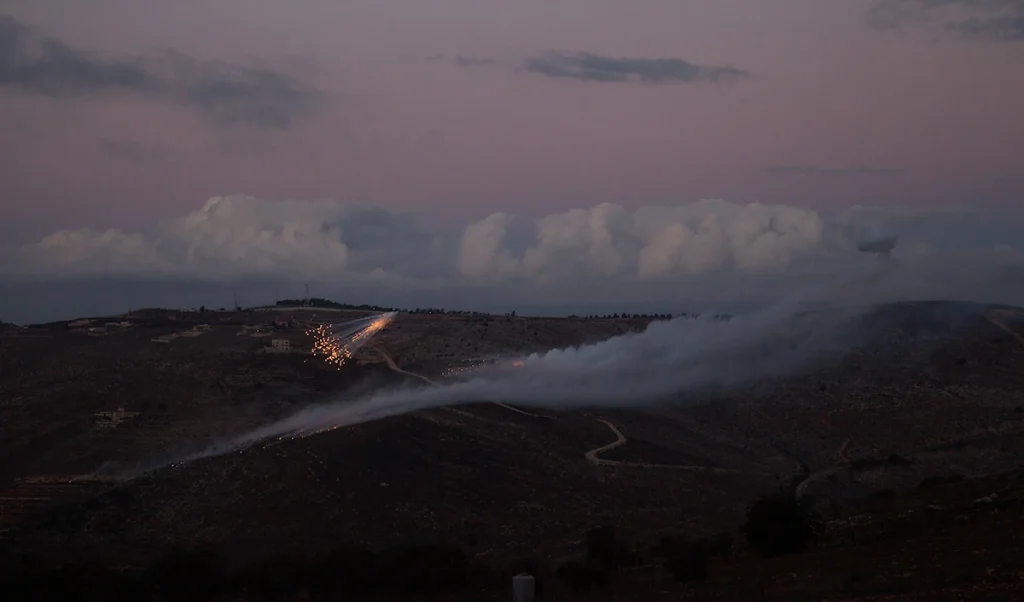
Artillery fire from an Israeli position hits the hills near the outskirts of the border town of Odaisseh in southern Lebanon. Photo: Hasan Fneich/AFP/Getty Images.
Artillery fire from an Israeli position hits the hills near the outskirts of the border town of Odaisseh in southern Lebanon. Photo: Hasan Fneich/AFP/Getty Images.
By Ingrid Chahine – Feb 24, 2026
On February 3, residents reported sightings of low-flying Israeli warplanes spraying an unknown chemical substance over agricultural lands in southern Lebanon, primarily targeting the villages of al-Bustan, Aita al-Shaab, al-Hima, Khallat Warda, and Marwahin. The Border Towns Association condemned this terrorist act, highlighting how this deliberate contamination is designed to “poison the soil and destroy its fertility” and turn the area into a “hyper-securitized uninhabitable zone.” The Agricultural Movement called it a clear “environmental crime,” noting similar attacks with herbicides over agricultural lands, olive groves, and rural border areas in the South in January 2025 and earlier this year in Syria’s Quneitra Governorate, in January 2026.
Chemical substances have long been central to zionism’s settler-colonial logic in the region. In Lebanon, since the early seventies, Israel has used phosphorus weapons targeting civilians and fertile agricultural lands. A United Nations Environment Program (UNEP) post-2006 assessment report also finds evidence of Israel’s use of white phosphorus, noting that many mortars failed to explode, delaying the release of the toxic and extremely flammable compound.
Along the Gaza border, aerial spraying has always been routine practice. Organizations started documenting coordinated attacks in 2014, usually conducted during December-January and again around April. The occupation claims the spraying is for pesticides, usually done on the Israeli side of the border, refusing to disclose the exact locations. It was in 2015 when an IOF spokesperson admitted spraying herbicides inside the Gaza Strip and not along its borders, in order to “enable optimal and continuous security operations.” The Palestinian Ministry of Agriculture estimates that between 2014 and 2018, herbicide spraying damaged more than 13,000 dunams (13 square kilometres) of farmland in Gaza. During its 2008-2009 assault on the Strip, IOF used internationally banned US-made white phosphorus shells in areas heavily populated with civilians.
While the occupation army’s use of internationally banned white phosphorus is more common in the region, other chemical substances can be deployed such as Glyphosate, Diuron, and Oxyfluorfen. Glyphosate, the most notorious herbicide, is also known under its trade name “Roundup”. Heavily marketed to this day as a benign weedkiller to promote industrial agriculture, its toxicology profile reveals otherwise. Glyphosate is highly soluble, leaching rapidly into soil, contaminating groundwater, and accumulating into plant tissues, making it even harder to eliminate herbicides on the long run. Studies show that only a fraction of applied glyphosate kills weeds, while the rest remains in the environment, reducing crop yields and the quality of agricultural products, degrading soil fertility, and contributing to water pollution, thus threatening all human and animal life.
The International Agency for Research on Cancer (IARC) classifies glyphosate as “probably carcinogenic to humans.” Critical research, such as the first in vitro experiment conducted in 2018, found that exposure to a concentration ten times lower than the industrial recommendation (1 µL/mL Roundup, corresponding to a glyphosate concentration of 0.36 µg/mL) crippled human sperm motility and mitochondrial function, which is a direct attack on reproductive health and future generations. In rat studies, prenatal exposure disrupted endocrine and developmental parameters.
The intensive use of glyphosate has led to the contamination of different ecosystems adversely affecting animals, plants, and microorganisms, which further leads to the deterioration of food chains, leading to nutritional deficiencies and chronic disease, crippling communities from within.
The primary manufacturers of white phosphorus, Glyphosate, and other chemical substances are infamous firms that have long served as the empire’s chemical-arms dealers. They are also among the few conglomerates who own about 60% of global food markets.
The US Agency for Toxic Substances listed in 2020 key Glyphosate producers. At the top is Monsanto, a US subsidiary of German pharmaceutical giant Bayer following a $56 billion merger in 2016, consolidated in 2018. Monsanto/Bayer faces a staggering 192,000 Roundup/Glyphosate lawsuits, with thousands of them being in the US alone. In 2018, for example, a US court ordered Monsanto to pay $289 million to a California resident and cancer patient, when his disease was found to be caused by his exposure to Roundup. Monsanto is also a documented manufacturer of weaponized white phosphorus.
Another top producer of glyphosate is the Israeli company Adama Agan Ltd (ADAMA), formerly Makhteshim Agan Industries, based in occupied Palestinian territories and owned by China’s state-owned ChemChina. ADAMA embeds its operations within illegal settlements and their expansion, employing regional specialists and distributors in illegal colonies in the West Bank and Golan Heights. It also produces other herbicides used in IOF aerial spraying to clear vegetation along the Gaza border wall.
ADAMA also produces the chemical Diuron. While the US Environmental Protection Agency (EPA) notes its low acute toxicity in its 2003 assessment, the agency confirmed Diuron’s chronic toxicity targets blood, bladder, and kidney, and causes reproductive harm, immune system damage, and cancer.
Oxyfluorfen, widely recognized by its trade name “Goal”, is produced by ADAMA and US-based Dow Chemical, now part of DowDuPont, the world’s largest chemical company. The EPA has classified Oxyfluorfen as a possible human carcinogen since 1992. The US Department of Agriculture (USDA) identifies it as a health hazard for handlers and consumers.
A Legacy of Ecocide
The corporate-military infrastructure enabling today’s agroterrorism is built on a century of documented mass ecocide.
DuPont, following its $130 billion merger with Dow, began as a gunpowder supplier, later becoming part of the Manhattan Project and producing plutonium for the Nagasaki atomic bomb. Dow Chemical also produced napalm. Both Monsanto and Dow, were leading providers of Agent Orange to the US military during the Vietnam War.
Between 1961 and 1971, the US Army sprayed about 80 million liters of the defoliant Agent Orange, containing 366 kilograms of tetrachlorodibenzo-pdioxin (known as TCDD), one of the most poisonous chemicals ever made by man, over 30,000 square miles of Vietnam, Laos, and Cambodia. The chemical caused catastrophic birth defects, cancers, and multi-generational illness. By the end of the US war on Vietnam in 1975, nearly 4.8 million Vietnamese had been exposed, resulting in 400,000 deaths and millions more condemned to a lifetime of suffering. Released documents in 1983 prove that Monsanto and Dow knew of the fatal risks associated with extreme dioxin contamination.
Ultimately, from Vietnam to Gaza, and villages of al-Bustan, Aita al-Shaab, and Marwahin in southern Lebanon, the same logic prevails: the calculated targeting of native agriculture is a direct hit to food sovereignty and communal survival. Most importantly, however, is that the same corporate lineage supplies and enables the slow eradication of heritage and livelihoods to this day.