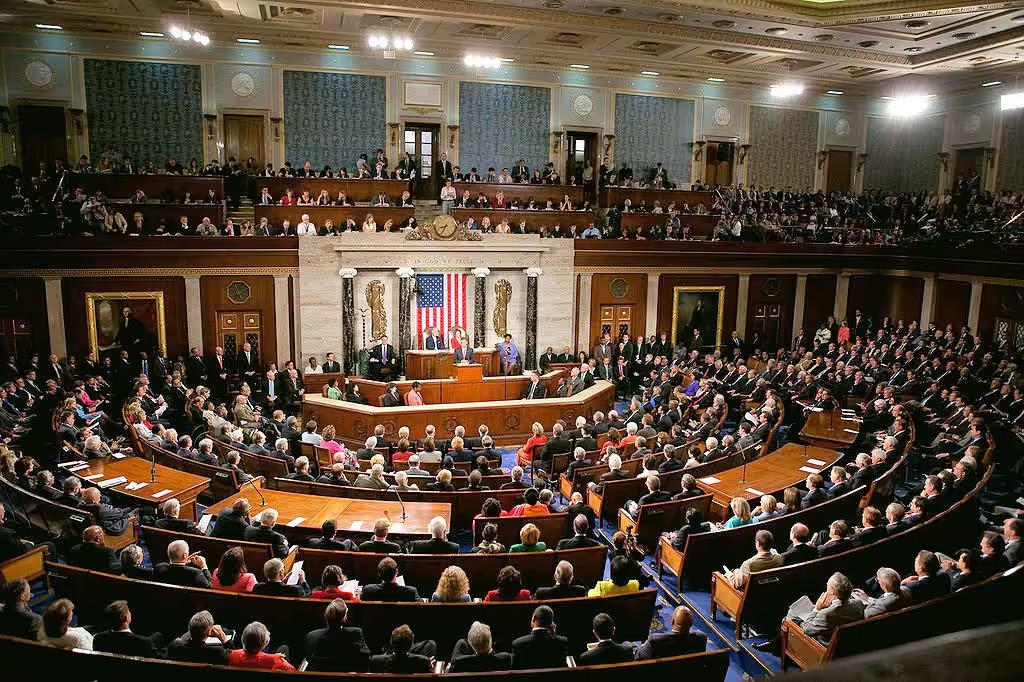
US Congress. File photo.
US Congress. File photo.
By Travis Ross – Aug 24, 2022
With Russia and China increasingly assertive and influential worldwide, Washington recently rolled out its gambit to maintain global hegemony and gather former colonies and neo-colonies under its wing: the Global Fragility Act (GFA).
The U.S. government has selected Haiti to be the first GFA “partner” in the Western Hemisphere. Also in the GFA’s pilot group are Libya, Mozambique, and Papua New Guinea, along with West Africa’s Benin, Côte d’Ivoire, Ghana, Guinea, and Togo.
The GFA has been largely applauded by U.S. policy commentators and think-tanks as something novel and enlightened, but it is essentially a reformulation of Washington’s same-old imperial policies under new nomenclature.
What is the Global Fragility Act?
The GFA was signed into law on Dec. 20, 2019 by President Donald Trump with full bipartisan support. It is endorsed by the Biden administration as a means to “advance America’s national interests on the world stage” at “the dawn of a decisive decade.” The Biden administration hopes the GFA will establish the United States as a “trusted partner — a force for peace and stability in the world.”
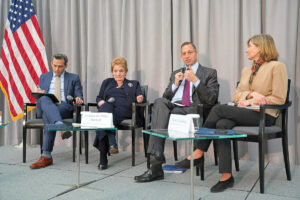
The GFA outlines a “peace building” strategy to “stabilize conflict-affected areas and prevent violence and fragility.” It emphasizes building relationships with “local civil society” by “strengthen[ing] the capacity of the United States to be an effective leader of international efforts to prevent extremism and violent conflict.”
This “capacity” also includes “planned security assistance”.
A report on the GFA by the Alliance for Peace building, a coalition of NGOs that advocated for the GFA’s passage, also emphasizes the “critical role of the Department of Defense” in the “implementation related to the Global Fragility Strategy” by “ensuring a broad range of security assistance activities” which would enable “the United States to successfully execute military objectives by, with, and through its partners in fragile states.”
Funding is managed by United States Agency for International Development (USAID) and its parent, the U.S. State Department. (Afghanistan was a prototype for the new State/Defense collaboration where “the partnership between the military and USAID was described as ‘unusually close,’” the report notes.)
Patrick Quirk, a senior director at the International Republican Institute (IRI) of the National Endowment for Democracy (NED), describes the GFA as “an integral part of the Biden administration’s strategy for global democratic renewal” to maintain the United States’ “geo-political and economic position.” According to Quirk, the GFA is “an opportunity for the United States to posture itself to reduce violence and fragility in a manner that positions America to secure short-term interests” and “compete with its geopolitical rivals.”
RELATED CONTENT: Haiti: Beware of Washington’s Trap!
Bilateralism over Multilateralism
The GFA’s bipartisan support reflects a general consensus in both of the U.S. ruling class’ political wings – Republican and Democrat – that Bretton Woods multilateral institutions like the United Nations no longer suffice for the protection of U.S. foreign policy goals and might even impede them. China and Russia have shown a growing willingness to use their veto power at the Security Council to prevent the imperialist countries – France, Britain, and the U.S. – from having their way with the world body.
In a speech last year, Secretary of State Antony Blinken described the Biden administration’s top foreign policy priorities, among them the United States’ rivalry with China. He described China as “the only country with the economic, diplomatic, military, and technological power to seriously challenge the stable and open international system– all the rules, values, and relationships that make the world work the way we want it to.”
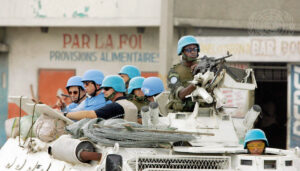
A “world work[ing] the way we want it to” includes ensuring that U.S. multinational corporations have access to the raw materials they want.
In a recent speech, U.S. Treasury Secretary Janet Yellen said “we cannot allow countries like China to use their market position in key raw materials, technologies, or products to disrupt our economy and exercise unwanted geopolitical leverage.”
The push to implement the GFA is the U.S. government’s attempt to develop bilateral relations with “fragile states” to gain access to “key raw materials” and prevent China from gaining “unwanted political leverage.” Washington wants to ensure that “geopolitical leverage” remains in U.S. hands.
In a recent article for the American Enterprise Institute, Katherine Zimmerman writes that “the GFA is an opportunity to drive the necessary change” that will prevent “adversaries such as China and Russia to expand their influence.”
Echoing the bipartisan consensus on the GFA’s goals, Paul B. Stares, a senior fellow at the Council on Foreign Relations and a GFA advocate, encouraged the act’s other proponents to “align our priorities to what will now be front and center in U.S. foreign policy going forward,” especially after Russia’s invasion of Ukraine: “countering Russian influence, Chinese influence, and dealing with other malign actors on the international stage.”
Why is Haiti a “Priority” for the GFA?
So where does Haiti fit into this geopolitical framework of “countering Chinese and Russian influence” in so-called “fragile countries”? According to Elizabeth Hume, the Alliance for Peace building’s executive director, Haiti represents “the first bite at the apple. If all goes well, eventually every country, every conflict-affected and fragile state would be a GFA country.”
“WHAT WILL NOW BE FRONT AND CENTER IN U.S. FOREIGN POLICY GOING FORWARD: …”
Meanwhile, Frances Z. Brown, a senior fellow at the Carnegie Endowment for International Peace, sees the GFA’s “bilateral agreements with fragile states” as a way to prevent China and Russia from “preying upon weak governance.”
Writing for the United States Institute for Peace, Keith Mines claims that “Haiti represents the very definition of fragility,” where a “staggering void of governance prevails.” Mines omits from his analysis that the United States and its CORE group allies appointed unelected de facto Prime Minister Ariel Henry and hence are the primary authors of this “void of governance.” Nonetheless, Mines concludes that the U.S. State Department’s decision to make Haiti a priority under the GFA is both “both welcome and logical.” Mines is enthusiastic for the GFA’s 10-year plan that will “allow for the integration and sequencing of U.S. diplomatic, development, and military-related efforts toward the political goal of a lasting and resilient peace.”
Anyone familiar with past U.S. “assistance” or “commitments” to Haiti should be alarmed about the Biden administration’s enthusiasm for implementing the GFA’s “new framework” on Haiti as a “partner.”
…COUNTERING RUSSIAN INFLUENCE, CHINESE INFLUENCE, AND DEALING WITH OTHER MALIGN ACTORS ON THE INTERNATIONAL STAGE.”
Georges Fauriol, a former NED vice-president, is a senior associate for the Center for Strategic and International Studies (CSIS). He endorses the GFA, claiming it is “what is needed to help Haiti regain its footing.” (Fauriol was one of the IRI strategists who helped overthrow President Jean-Bertrand Aristide in 2004.) He views Washington’s strong support for Ariel Henry as “ambivalent” and its central role in supposedly inter-Haitian negotiations as “essential” for preserving Haiti’s “governing structure.”
One would be safe in assuming that this “governing structure” that must be preserved includes compliant leaders who will give preferential treatment to U.S. capitalists in Haiti by ensuring rights to exploit mineral resources like gold and dictate the minimum wage in cheap labor textile factories.
Old Wine, New Bottles
The GFA fundamentally represents a repackaging of U.S. interventionist policies. Its clauses encouraging input from “local civil society groups” are merely window dressing that will not change U.S. policies one iota.
For over a century, the Unites States has violated Haiti’s sovereignty and undermined its democracy by launching invasions, orchestrating coups, and backing dictators. Ariel Henry remains an unelected leader ruling by decree and dictate due to diplomatic support from the U.S. government and its CORE group allies.
Haiti is a priority GFA “partner” because the Biden Administration wants to maintain U.S. hegemony there. An agreement to implement the GFA in Haiti could help facilitate a fourth U.S. military occupation of the country. Given the growth of Haitian armed groups in the past few years, U.S. troops would likely face far fiercer resistance than they did in their 1915, 1994, and 2004 interventions.
With its Jul. 15, 2022 Resolution 2645, the UN Security Council also remains “seized of the matter” regarding Haiti, although under the UN Charter’s Chapter 6, not Chapter 7, which authorizes the deployment of a multinational “peace-keeping” force. Although Russia or China might veto it, there remains the possibility that the Security Council could decide to declare Haiti a “threat to international peace and security” so as to deploy another MINUSTAH, the UN’s “stabilization” force that occupied Haiti from 2004 to 2017. But the bilateral GFA may obviate this option.
The Biden administration also wants to prevent Haiti from developing closer diplomatic relations and economic ties with Russia and China. Some have speculated that the U.S. may have green-lighted President Jovenel Moïse’s assassination on Jul. 7, 2021 due to his alleged plans to strengthen relations with Russia. Meanwhile, Haiti remains one of only 14 countries worldwide which recognize Taiwan as an independent nation, the so-called “Republic of China.” The People’s Republic of China has sought to woo Haiti to drop Taiwan and formally establish diplomatic relations with it, just as the neighboring Dominican Republic did in 2018. In 2017, China offered to overhaul Port-au-Prince’s crumbling infrastructure with a $4.7 billion aid package if Haiti would recognize it and join its “One Belt, One Road” Initiative. So far that hasn’t happened, and the GFA aims to keep things that way.
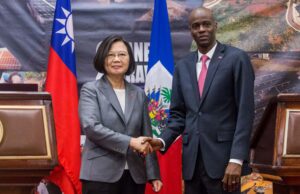
Washington fears that desperate Haiti might approach the BRICS (an alliance of Brazil, Russia, India, China, and South Africa), seeking investment, aid, and trade. Most Haitians feel that U.S. government guidance and aid has had devastating effects on Haiti’s economy, agricultural sector, human rights, and sovereignty, and view it with skepticism at best.
It is no wonder that the Biden administration seeks to ward off multipolar suitors – BRICS or otherwise – by harnessing Haiti with the GFA.
RELATED CONTENT: Rise of BRICS: The Economic Giant That Is Taking on the West
Who Can Legitimately Negotiate on Behalf of Haiti?
It also remains unclear how the GFA can be implemented in Haiti anytime soon. Who has the authority to negotiate bilateral agreements on behalf of Haitians, locking Haiti into “peace building” deals under the GFA that could last a decade? Ariel Henry certainly doesn’t have the legitimacy or authority. This is one reason why Washington is pushing so doggedly for rapid elections.
If Ariel Henry continues to falter in his mission to deliver an elected government, Washington may turn to the other sector of Haiti’s bourgeoisie which is vying for control of government, the Montana Accord group, headed by figures like Magali Comeau Denis and Ted Saint Dic, who supported the coups against President Jean-Bertrand Aristide.
The Montana Accord is vague about its international posture, with its Article 45b specifying a need for a “re-evaluation of Haiti’s diplomatic representation” based on a “Roadmap” developed by the organizations which back the Accord. While the Montana group’s “Monitoring Office” (BSA) has selected interim leaders for a transitional government – Fritz Alphonse Jean, a former governor of Haiti’s Central Bank, as president and former senator Steven Benoit as prime minister – they also would not be popularly elected officials and their timetable for elections is at least two years, which Washington surely feels is too long to wait. Although Jean-Bertrand Aristide’s party, the Lavalas Family, and the Fort National-based anti-imperialist grassroots group MOLEGHAF have withdrawn, there remain nominally leftist members in the Montana Accord coalition which may also make Washington uneasy.
Some of those “civil society” groups signed a recent open letter to President Joe Biden, The authors were clear: “Haitian people strongly demand their confiscated independence, their freedom to choose from now on by themselves and for themselves their leaders as well as the political, economic, and social orientation to be given to their country.”
Such statements do not augur well for Haiti joining any “partnership” with the U.S. government in the framework of the GFA.
Travis Ross is a teacher based in Montreal, Quebec. He is a co-editor of the Canada-Haiti Information Project. His articles have been published in Truthout, Haiti Liberté, and Rabble.ca.