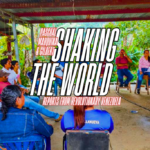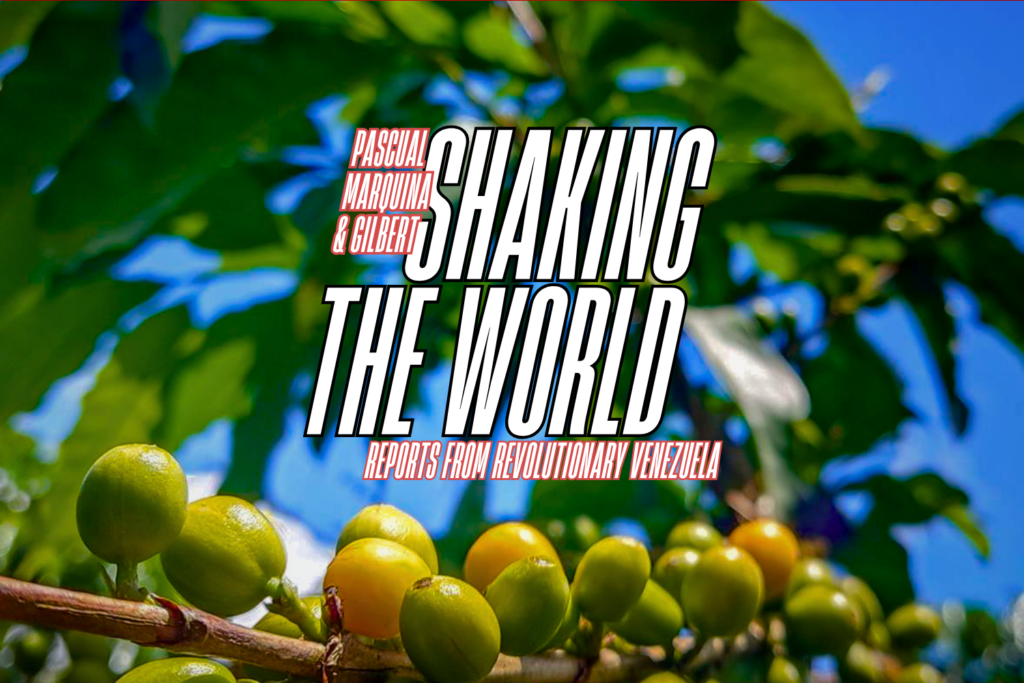
Photo: Rome Arrieche/Voces Urgentes.

Orinoco Tribune – News and opinion pieces about Venezuela and beyond
From Venezuela and made by Venezuelan Chavistas
Photo: Rome Arrieche/Voces Urgentes.
In the mountainous coffee-growing region of Morán municipality, in Lara state, generations of campesino families have built their lives growing coffee. Steep slopes, misty mornings, and hard physical labor are part of daily life in this territory, where coffee is not only a crop but a way of organizing time, work, and community. In recent years, this long history of cooperation has taken a new form through the Vida Café Communal Economic Circuit, an initiative that brings together seven coffee-growing communes in a joint effort to sustain production, life, and collective organization under adverse conditions.
Communal economic circuits are initiatives promoted by the Bolivarian government to organize production, processing, distribution, and reinvestment at the territorial level. Vida Café is one such circuit: a relatively recent but robust project that brings together freely associated producers organized within their communes, while also addressing broader community needs such as infrastructure, communications, and access to healthcare and services.
This testimonial work explores the origins, functioning, and meaning of Vida Café through the voices of the people who built it. The first installment focused on the history of the territory and its long-standing practices of cooperation. This new installment delves into the organizational efforts behind the Communal Economic Circuit as part of a larger story about commune-building, collective resistance, and the ongoing effort to build economic sovereignty.
The following interviews were carried out in August 2025.

How Vida Café was born
Mauro Jiménez: There came a point—drawing on everything we had learned through years of commune-building and under the pressure of the blockade—when we realized that producing coffee was not enough. Our experience organizing in the territory had already taught us how to deliberate collectively, plan, and resolve common problems together. We had forged a solid communal practice. As producers, we often worked side by side and harvested good coffee, but when it came to selling it, each of us faced the intermediaries alone. That remained outside our collective control, and it meant an entire year of work could turn on a single negotiation, in which we had little leverage and no shared strategy.
The product of our labor was extracted at the final step of the process. Intermediaries imposed low prices on our crop, and at the beginning of the production cycle, precisely when we needed money to purchase inputs, they offered credit under harsh terms. By the time the harvest was delivered and accounts settled, we were left with razor-thin margins—barely enough to cover costs. When the next season came, we had little choice but to return to the same intermediary for credit, reproducing our dependency year after year.
Some time back, we had the PACCA and COPALAR projects, two efforts to bring producers together and improve our bargaining power in the market [see Part 1]. From those experiences, we learned that organization matters. Over time, we also came to understand something even more important: without connection among the communities across the territory, any economic structure remains fragile. If the communes are not economically linked, they stagnate. Chávez himself warned about that!
The idea of the Communal Economic Circuit grew out of this realization. It was never just about selling coffee together; it meant organizing all the links in a long chain—production, collection, processing, transport, and reinvestment—under a communal vision. That is how the conversations began among us, and with spokespeople from the Ministry of Communes. It’s how what would later be called “Vida Café” slowly took shape.
Norkys Ramos: By 2021–22, when we began designing the Communal Economic Circuit, many of the communes were already consolidated—though a commune is always an ongoing construction, always in the making. Yet on the economic front, producers were still operating largely in isolation when bringing their coffee to market. There was cooperation, but it had not crystallized into an integrated structure capable of collectively organizing production and commercialization.
Vida Café emerged as a way of weaving together what was already taking shape in the territory. Producers from seven communes—each with its own history and character—shared the same main product: coffee. We asked ourselves: if coffee shapes our culture as growers, if it organizes our daily life, and if we already cooperate in so many ways, why shouldn’t we also come together economically?
Kennedy Linares: The situation was anything but easy. We were living under the pressure of the economic war. Inputs were scarce, fuel unreliable, transport costs rising, and prices constantly shifting. If each producer tried to confront those difficulties alone, some of us could have been pushed to the brink, struggling simply to put food on the table. In that sense, the Economic Circuit was born as a defensive measure.
But it was never only defensive. From the beginning, it opened up a new horizon. Vida Café was a way of reorganizing the economy collectively—bringing production, transport, and reinvestment under communal coordination. In doing so, it not only protected us; it strengthened the communal connections in the territory.
Rafael Sequera: In our assemblies, we discussed this at length: a commune cannot exist only as a political entity. It has to sustain life materially. The Economic Circuit generates that material dimension. It connects producers with communal government and allows economic decisions to be made collectively, among those who actively participate in Vida Café.
Morelys Malvacias: For us, building the Communal Economic Circuit wasn’t an abstraction. We knew the producers, and we knew the needs. When we began to meet, the question was simple: How do we prevent coffee from leaving the territory without leaving value behind?
Mairelis Escalona: And how do we ensure that what is produced here benefits the community first? Those questions guided us from the beginning.

What a Communal Economic Circuit means in practice
Ramos: A Communal Economic Circuit is not a private company. It is not a cooperative. It connects producers. They remain producers on their parcels, but they associate freely with Vida Café through their communes. The Economic Circuit plans the use of our shared assets—including the grader for road repairs, the tractor-trailer, and a heavy-duty pickup belonging to the Sectores Unidos Commune—and it coordinates credit, transport, sales, and reinvestment. Decisions are not made individually; they are collectively deliberated in our Planning Table.
Jiménez: In practical terms, we organize coffee collection, manage transport logistics, coordinate processing at Café Cardenal [a coffee processing plant one hour from Morán], and handle financial planning. We also assess needs: who requires credit, which roads must be repaired, and what machinery should be prioritized. We do not eliminate individual initiative; we strengthen it through a collective structure.
Linares: If someone thinks this is about centralizing everything, they misunderstand it. Each commune participates. Each is represented. The Planning Body is not symbolic—it functions as the coordination body of Vida Café.
Sequera: The difference from previous projects of this kind is that here the economic factor is inseparable from communal self-government. It’s not just about better prices. It’s about sovereignty in production and, ultimately, about living better.
Planning Body (Mesa de Planificación)
Ramos: The Planning Body is where coordination happens. Each commune sends its spokespeople to the meetings. We review production forecasts, infrastructure needs, financial flows, and reinvestment priorities. It’s not always easy—there are many debates!—but that is what collective construction requires.
Jiménez: The Planning Body includes a financial committee, where transparency is fundamental. If people are going to trust the Circuit, they must understand how resources circulate and how decisions are made. That’s why the committee’s work has to be careful and precise. It’s not just about accounting; it’s about building trust and commitment. Without trust, you cannot consolidate a commune or strengthen the links between communes and producers.
Malvacias: Planning is not only about production; it’s about the territory. If a road collapses—as often happens in these mountains—distribution is affected. If telecommunications fail, coordination breaks down. Everything is interconnected!
Escalona: The Planning Body is led, in great measure, by women. That wasn’t imposed. It happened because we were already doing much of the organizational work in the communes. We assume responsibility. We don’t wait for someone else to solve problems. We lead by example.

Initial institutional support
Ramos: In the beginning, we had strong institutional backing. The Ministry of Communes not only supported but actively promoted the creation of the Economic Circuit. Producers received credit. Machinery was transferred to Vida Café. They accompanied us technically and politically. That support allowed us to take our first concrete steps.
Jiménez: The “Toronto” tractor-trailer we received through the Ministry of Communes changed everything. Before that, transportation costs cut into production. Now, with our own vehicles, we can organize coffee collection more efficiently and reduce dependence on private haulers.
Sequera: Two other machines, the dump truck and backhoe that were transferred into communal management, were also decisive. Roads in these mountains deteriorate quickly. If access isn’t maintained, coffee cannot leave the territory. Now, with the machinery operating under communal coordination, we can respond directly instead of waiting indefinitely for municipal intervention.
Malvacias: The Communal Economic Circuit was forged at a time of close coordination with the Ministry of Communes. That institutional support was fundamental.
Escalona: The situation today is different. All across the country, there are dozens of Communal Economic Circuits, but they are no longer so central to the Ministry’s vision. There are no hard feelings. What matters is that the structure that we built remains standing, and the support we received in those early years left us with assets that continue to help the region. All the credits we received were repaid in full and on time.
Along the way, we learned something essential: we could not depend indefinitely on external backing and needed our own roots. The creation of the Communal Economic Circuit was a qualitative leap. It made us less vulnerable as producers and strengthened our communes. Infrastructure is now better maintained. The surplus generated by our economic activity does not disappear into private hands; it returns to the community through fair credit, support for our health center, and the upkeep of shared goods and services.
Chávez spoke of the leap from the communal council to the commune, and then from the commune toward the communal state. For us, the Economic Circuit has been that necessary bridge—a step that allows the communal project to scale up. Without it, the seven communes that make up Vida Café could become little more than enlarged communal councils, addressing organizational needs, while leaving the economic sphere untouched. With the Economic Circuit, communal life began to shape production itself.

Reinvestment and logic of the Economic Circuit
Jiménez: The Economic Circuit functions in cycles. When producers need fertilizer or support for the harvest, credit is extended. The need to buy fertilizer is the main cause of indebtedness for small coffee growers here. If you cannot fertilize your plants properly, your harvest collapses, but if you borrow from intermediaries, that produces dependency.
We established a clear and transparent principle in our assemblies during the early days of Vida Café: repayment is made in green [untoasted] coffee at harvest time, under terms that we define—not by usurers. This breaks with the logic of “la dobla,” in which a lender provides money or inputs equivalent to one sack of green coffee and then demands two or even three in return, trapping the producer in a cycle of dependency year after year.
Once the coffee is collected, it is processed through our agreement with Café Cardenal and sold as “Café Cardenal: Hecho en Comuna” [Made in the Commune]. The first step is to settle outstanding credits. What remains does not go into individual pockets; the surplus returns to the Circuit.
Ramos: During harvest season, we keep a part of the surplus in green coffee. That way, when there is inflation, the coffee becomes a reserve of value. It protects us from devaluation.
From there, we organize what we call our “tres potes” [three funds]. The first fund is for road maintenance—without road access, coffee cannot leave the mountains. The second is for health services: the Economic Circuit helped repair the local ambulance, and it now supports maintenance of the medical center when needed. The third fund is for telecommunications, which is essential for coordination across this large territory.
That’s why we say that, at Vida Café, the economy is in the service of the community, not the other way around.
Sequera: The initial credits we received allowed us to buy fertilizer, organizing the repayment in green coffee. At the same time, vehicles and machinery were incorporated into the communal structure. The tractor-trailor is administered directly by the Economic Circuit. The dump truck and backhoe operate through our Empresa de Propiedad Social de Vialidad (EPS) [Communal Roadworks Social Property Enterprise].
An EPS is a communal enterprise whose assets are not privately owned but collectively managed for social benefit. Activating the Roadworks EPS gave us the operational capacity and legal structure to repair rural roads. In this mountainous territory where rain constantly damages the access routes, having a roadworks enterprise changes everything.
The headquarters of Vida Café, called El Rastrillo, was acquired through a non-returnable credit from the Ministry of Communes. It became a permanent space for assemblies and cultural activities.
Since then, the credit system has expanded to incorporate hundreds of producers, reinforcing the cycle of collective financing with repayment in green coffee.
Malvacias: All financial decisions pass through the Planning Table. Each commune sends its spokespeople. We evaluate production forecasts, credit needs, infrastructure priorities, and reinvestment plans.
Our Economic reports are presented in general assemblies. Producers know how much coffee was collected, how much was sold, how credits are functioning, and how the surplus is being distributed. Transparency is not something decorative here: it builds trust.
Vida Café is not simply a commercialization initiative. It is an economic structure that has the aim of building communal life —politically, economically, socially, culturally, and even spiritually.
In practice, the Economic Circuit intervenes at the most vulnerable point—fertilization—while organizing interest-free repayment of loans in coffee. It also coordinates processing through Café Cardenal, develops and maintains the communal enterprises such as the Roadworks EPS, and manages collective assets acquired through both state support and the efforts of the communes.
The gains from coffee sales are not privately accumulated. They circulate collectively and return to the territory as infrastructure and services, thereby reinforcing the material foundations of communal life.
The Communal Economic Circuit is not merely about marketing coffee under the label “Hecho en Comuna.” It is about transforming relations of production in the territory. It ensures that the value generated by communal labor remains under communal control, while turning economic coordination into a pillar of self-government. That is how autonomy deepens, how communal scaling up becomes possible, and how economic sovereignty ceases to be a slogan and becomes a lived reality.
(Monthly Review) by Cira Pascual Marquina and Chris Gilbert

Cira Pascual Marquina is a Political Science professor at the Universidad Bolivariana de Venezuela in Caracas. She is also co‐producer and co‐host (with Chris Gilbert) of the Marxist education program Escuela de Cuadros. She is actively engaged with grassroots organizations in Venezuela and abroad, and is dedicated, both as a militant and as an investigator, to communal initiatives.
Pascual Marquina is co-author of Venezuela, the Present as Struggle: Voices from the Bolivarian Revolution (Monthly Review Press) and co‐compiler of two books: Para qué sirve El Capital: un balance contemporáneo de la obra principal de Karl Marx and ¿Por qué socialismo? Reactivando un debate (both Editorial Trinchera).