Young men chant slogans against the power of Lieutenant-Colonel Damiba, against France and pro-Russia, in Ouagadougou, Burkina Faso, Sept. 30, 2022. Photo: Sophie Garcia/AP.
Young men chant slogans against the power of Lieutenant-Colonel Damiba, against France and pro-Russia, in Ouagadougou, Burkina Faso, Sept. 30, 2022. Photo: Sophie Garcia/AP.
By Ramzy Baroud – Oct 17, 2022
The moment that Lieutenant-Colonel Paul-Henri Sandaogo Damiba was ousted by his own former military colleague, Captain Ibrahim Traore, pro-coup crowds filled the streets. Some burned French flags, others carried Russian flags. This scene alone represents the current tussle underway throughout the African continent.
A few years ago, the discussion regarding the geopolitical shifts in Africa was not exactly concerned with France and Russia per se. It focused mostly on China’s growing economic role and political partnerships on the African continent. For example, Beijing’s decision to establish its first overseas military base in Djibouti in 2017 signaled China’s major geopolitical move, by translating its economic influence in the region to political influence, backed by military presence.
China remains committed to its Africa strategy. Beijing has been Africa’s largest trading partner for 12 years, consecutively, with total bilateral trade between China and Africa, in 2021, reaching $254.3 billion, according to recent data released by the General Administration of Customs of China.
The United States, along with its western allies, have been aware of, and warning against China’s growing clout in Africa. The establishment of US AFRICOM in 2007 was rightly understood to be a countering measure to China’s influence. Since then, and arguably before, talks of a new ‘Scramble for Africa’ abounded, with new players, including China, Russia, even Turkiye, entering the fray.
The Russia-Ukraine war, however, has altered geopolitical dynamics in Africa, as it highlighted the Russian-French rivalry on the continent, as opposed to the Chinese-American competition there.
Though Russia has been present in African politics for years, the war – thus the need for stable allies at the United Nations and elsewhere – accelerated Moscow’s charm offensive. In July, Russia’s Foreign Minister Sergey Lavrov visited Egypt, Ethiopia, Uganda, and the Republic of Congo, fortifying Russia’s diplomatic relations with African leaders.
“We know that the African colleagues do not approve of the undisguised attempts of the US and their European satellites .. to impose a unipolar world order to the international community,” Lavrov said. His words were met with agreement.
Russian efforts have been paying dividends, as early as the first votes to condemn Moscow at the United Nations General Assembly, in March and April. Many African nations remained either neutral or voted against measures targeting Russia at the UN.
South Africa’s position, in particular, was problematic from Washington’s perspective, not only because of the size of the country’s economy, but also because of Pretoria’s political influence and moral authority throughout Africa. Moreover, South Africa is the only African member of the G20.
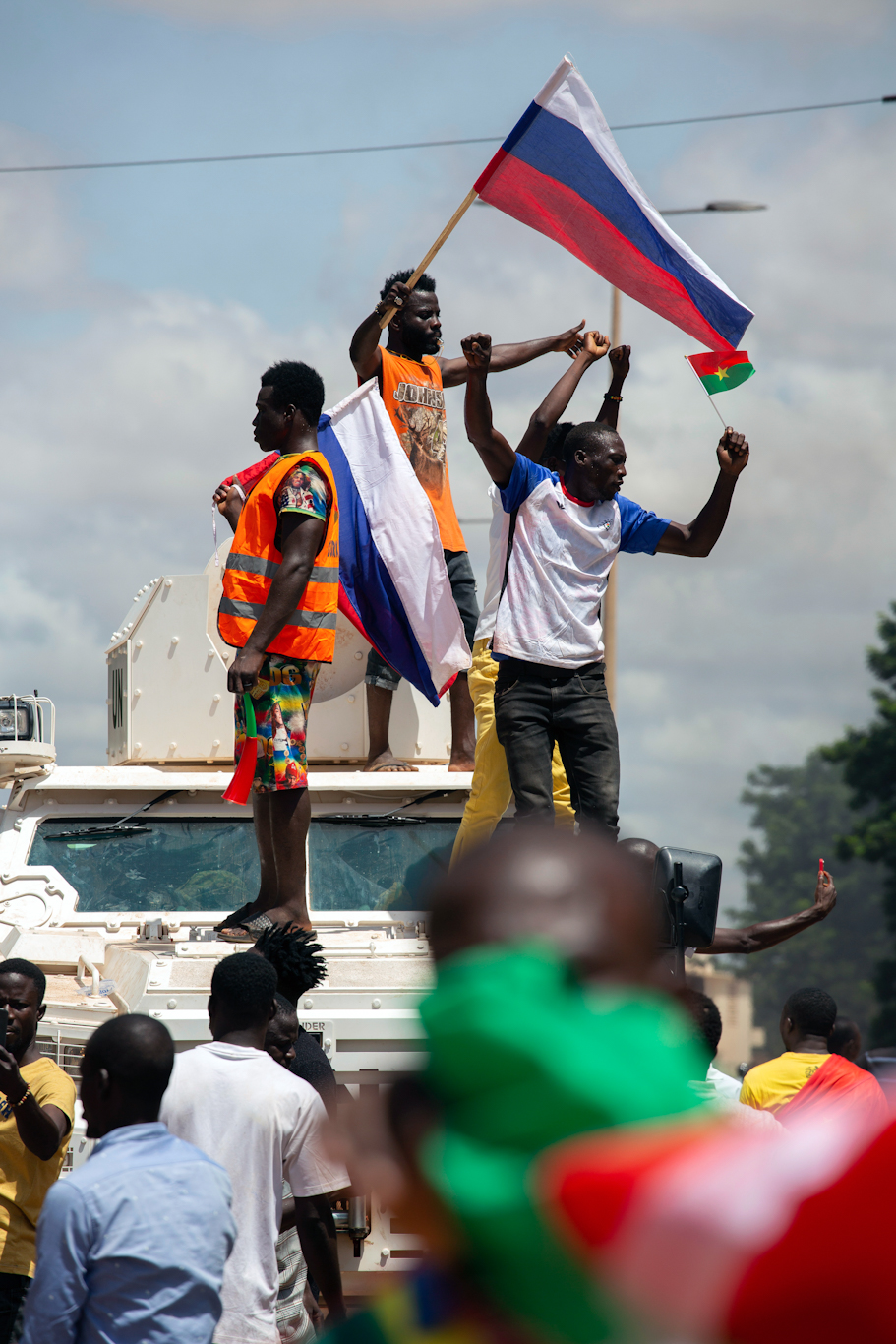
Supporters of Capt. Ibrahim Traore wave Russian flags as they cheered in the streets of Ouagadougou, Burkina Faso, Oct. 2, 2022. Kilaye Bationo | AP
In his visit to the US in September, South Africa’s President Cyril Ramaphosa defended his country’s neutrality and raised objections to a draft US bill – the Countering Malign Russian Activities in Africa Act – that is set to monitor and punish African governments who do not conform to the American line in the Russia-Ukraine conflict.
The West fails to understand, however, that Africa’s slow, but determined shift toward Moscow is not haphazard or accidental.
The history of the continent’s past and current struggle against western colonialism and neocolonialism is well-known. While the West continues to define its relationship with Africa based on exploitation, Russia is constantly reminding African countries of the Soviet’s legacy on the continent. This is not only apparent in official political discourses by Russian leaders and diplomats, but also in Russian media coverage, which is prioritizing Africa and reminding African nations of their historic solidarity with Moscow.
Burning French flags and raising Russian ones, however, cannot simply be blamed on Russian supposed economic bribes, clever diplomacy or growing military influence. The readiness of African nations – Mali, Central African Republic and, now, possibly, Burkina Faso – has much more to do with mistrust and resentment of France’s self-serving legacy in Africa, West Africa in particular.
The Intricate Fight for Africa: The Legacy of the Soviet Union vs Western Colonialism
France has military bases in many parts of Africa and remains an active participant in various military conflicts, which has earned it the reputation of being the continent’s main destabilizing force. Equally important is Paris’s stronghold over the economies of 14 African countries, which are forced to use French currency, the CFA franc and, according to Frederic Ange Toure, writing in Le Journal de l’Afrique, to “centralize 50% of their reserves in the French public treasury”.
Though many African countries remain neutral in the case of the Russia-Ukraine war, a massive geopolitical shift is underway, especially in militarily fragile, impoverished and politically unstable countries that are eager to seek alternatives to French and other western powers. For a country like Mali, shifting allegiances from Paris to Moscow was not exactly a great gamble. Bamako had very little to lose, but much to gain. The same logic applies to other African countries that are fighting extreme poverty, political instability and the threat of militancy, all of which are intrinsically linked.
Though China remains a powerful newcomer to Africa – a reality that continues to frustrate US policymakers – the more urgent battle, for now, is between Russia and France – the latter experiencing a palpable retreat.
In a speech last July, French President Emmanuel Macron declared that he wanted a “rethink of all our (military) postures on the African continent.” France’s military and foreign policy shift in Africa, however, was not compelled by strategy or vision, but by changing realities over which France has little control.

Ramzy Baroud is a journalist and the Editor of The Palestine Chronicle. He is the author of five books. His latest is “These Chains Will Be Broken: Palestinian Stories of Struggle and Defiance in Israeli Prisons” (Clarity Press). Dr. Baroud is a Non-resident Senior Research Fellow at the Center for Islam and Global Affairs (CIGA). His website is www.ramzybaroud.net