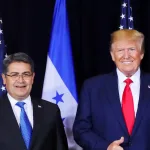
U.S. Army Gen. Laura Richardson, the commander of U.S. Southern Command (Left) and Honduras' President Xiomara Castro (Right). Photo: U.S. Southern Command.
U.S. Army Gen. Laura Richardson, the commander of U.S. Southern Command (Left) and Honduras' President Xiomara Castro (Right). Photo: U.S. Southern Command.
By Wyatt Reed – Sep 13, 2024
The leftist government of Honduras is on the defensive since its diplomatic dustup with Washington. Our investigation reveals a network of US government-backed regime change assets is driving the attacks, and using lawfare tactics to manufacture scandal ahead of next year’s elections in Tegucigalpa.
The Honduran government has slammed the US for attempting to initiate a “coup d’etat” in the Central American country, after the media outlet Insight Crime released decade-old footage appearing to show the current president’s brother-in-law negotiating a payment with men who later confessed to trafficking drugs.
The tape was leaked amidst a diplomatic spat with the US over the Honduran government’s friendly relations with Venezuela following its disputed elections in July. Days before the footage emerged, Honduran president Xiomara Castro hinted at its release while announcing an end to a longstanding extradition deal with the US: “I will not allow the instrument of extradition to be used to intimidate or blackmail the Honduran Armed Forces.” For many of those who support the left-wing president, the timing speaks for itself.
In legacy media outlets, the move to circumvent a coming political assault from Washington was framed as an act of corruption. One outlet ran with the headline: “Honduras’ Castro May Be Part of the Narco-Corruption She Vowed to End.”
Yet an investigation by The Grayzone reveals that key figures in the diplomatic power play are directly linked to the US government, including Insight Crime, which is funded by the State Department. Our probe indicates the tape was strategically deployed in an effort to rein in an increasingly independent-minded Castro administration.
The video was reportedly captured in 2013 by a narco-trafficker working as an informant for the Drug Enforcement Administration (DEA), and its release came as diplomatic tensions boiled over on August 28 after a meeting between the military chiefs of Venezuela and Honduras led the American ambassador to publicly accuse the Honduran official of “sitting down with a drug dealer.” Carlos Zelaya maintains he had no idea who the men were and never accepted any money from them, but has since stepped down from his post in Congress, pending the results of an investigation.
Within the Castro administration, the US ambassador’s aggressive statement was seen as a shot across the bow, and an undeniable precursor to a color revolution-style regime change attempt. The timing was particularly conspicuous, they say, because they believe Insight Crime has had possession of the footage since at least 2022.
Elected by a wide margin in 2021, the administration of Xiomara Castro represents a return to social democracy after 12 years of what Hondurans widely referred to as the “narco-dictatorship” — a dark period ushered in by the US-backed 2009 coup d’etat which saw Castro’s husband, Manuel Zelaya, removed from the presidency by military force. In June 2024, the most visible face of that narco-dictatorship, former president Juan Orlando Hernandez, was sentenced to 45 years in a New York federal prison. However, as The Grayzone reported in a multi-part investigation, the US government had protected Hernandez for years, looking the other way as he made good on his stated promise to “stuff the drugs right up the noses of the gringos.”
Though it initially appeared willing to tolerate the government which replaced him, the US is now launching its first broadside against the Castro administration.
“The intention is destabilization”
Carlos Estrada, an adviser to the Honduran president who specializes in international relations, told The Grayzone, “It is very clear that the words of the ambassador coincided with the moment in which this video was going to be leaked.”
“The intention,” Estrada emphasized, “is destabilization.”
According to Estrada, the Castro administration decided to end the extradition treaty with Washington when the US ambassador to Honduras “made a highly irresponsible and highly anti-diplomatic comment” regarding a “completely normal action of a minister, of our Minister of Defense at that time, who visited the Minister of Defense of Venezuela.”
“The ambassador’s comment, when she qualified a visit to a person who is linked to drug trafficking — according to the United States — put [us] on alert, since it is a way of expanding the framework of lawfare against the main leaders of this government, President Xiomara Castro and her husband, former President Manuel Zelaya.”
According to Estrada, more trouble is on the horizon. He says the media attacks “coincide with other operations that are being done in Honduran territory by the same opposition,” which contains many parties linked to the cartels.
The efforts by US officials to restore control over an increasingly independent Honduras preceded the current dust-up. An early warning sign, says Estrada, came when Biden choice Laura Dogu as US ambassador to Honduras. Nominated for that post just three weeks before Castro’s landslide presidential victory in November 2021, Dogu previously served as US ambassador to Nicaragua, where she helped oversee a violent coup in 2018 which claimed hundreds of lives.

“The logic behind the leaking of the video has to do with a way of neutralizing actors. I mean, in this case, the agenda imposed by the US ambassador is extremely disruptive,” Estrada notes. “She came from a destabilizing role in Nicaragua and, when she was appointed by the US to Honduras, she couldn’t change her logic of action.”
From the beginning, Dogu has served as an aggressive watchdog for the interests of the US ruling class, with her first statement of “concern” coming just four months into the Castro presidency, when she pushed back against energy reforms the new Honduran government implemented to clamp down on overcharging by power companies.
“And that’s where the denunciations of the presidency begin — in this case of the president, directly,” Estrada adds. “Since then, she’s been constantly dedicated to giving her opinion on sovereign decision-making… From social policy, economic policy, foreign relations — I mean, everything.”
Dogu was joined in her latest incident of foreign meddling by Insight Crime, which dumped the leaked Zelaya tape. It remains unclear how the outlet acquired the footage, but the circumstances of the video’s creations and statements by the website’s authors may give some clues.
In an article accompanying the Zelaya tape, the publication noted that the video had been “delivered… to US authorities” by the convicted drug traffickers who produced the footage, Devis and Javier Rivera. The pair, which at the time headed the ‘Los Cachiros’ cartel, gave up the video after they “struck a deal with the Drug Enforcement Administration (DEA) in December 2013,” after which the tape was “placed… under seal.” In Devis’ case, the DEA was apparently so eager to secure a deal that it was willing to overlook the suspect’s confessed involvement in 78 murders.
As a result of their cooperation, “none of the traffickers who appeared went to trial upon being charged in the United States,” which means that “the video has never been released publicly before.” Nevertheless, InSight Crime somehow “received a copy of the video from a source,” who apparently “asked to remain anonymous.”
Asked whether the American government might be using Insight Crime to do its bidding, Estrada responded: “Logically, the US is not going to get their hands dirty” by launching attacks directly.
Insight Crime: the State Department’s favorite “independent” outlet?
Since it was founded by Jeremy McDermott and Steven Dudley in 2010 with grants from billionaire George Soros’ Open Societies Foundation, Insight Crime quickly established a reputation for targeting Latin American governments demonized by Washington.
This is no coincidence, given that Insight Crime is financially dependent on the US government. Government grant trackers show that since 2022, Insight Crime has raked in over a million dollars from the US State Department. And that’s just the tip of the iceberg. According to American University, “InSight Crime’s key funders” also “ include Open Society Foundations, the British Embassy in Colombia, USAID, the International Development Research Centre of Canada, and the Swedish government, among others.”

Insight Crime’s website highlights its leaders’ frequent interactions with the State Department, with one entry celebrating its participation in Foggy Bottom’s 2022 “International Anti-Corruption Conference” and another bragging that McDermott “briefed the US State Department and other international players on the presence of Colombian guerrillas in Venezuela.”

McDermott’s profile on Insight Crime’s website describes him as “a former British Army officer, who saw active service in Northern Ireland and Bosnia,” both of which remain notorious hotspots for British intelligence. His LinkedIn page notes that he served as a captain in the Grenadier Guards, the elite British infantry unit known for its distinctive tall fur caps and for fielding a disproportionate number of SAS operatives.
By its own admission, Insight Crime maintains working relationships with organized crime figures, writing on its “About Us” page that it conducts “extensive ground research, which includes speaking to all the actors, legal and illegal.”
Questions sent by The Grayzone to Insight Crime about its potential relationships with intelligence agencies and the State Department went unanswered.
The Honduran elite’s Hail Mary pass?
Since the publication of the Zelaya tape, Honduran political figures have reacted somewhat predictably, with the Libre Party largely rallying around President Castro, and a number of opposition factions demanding her resignation. But the claim that Zelaya might actually be guilty of any crime was undermined by Insight Crime’s other co-founder, Steven Dudley, who appeared to agree with the target of their leaked tape during an appearance on Honduran TV.
President Maduro Reiterates Support For Honduras’ President Castro After Coup Attempt
“As Carlos Zelaya himself said, there’s no proof that he accepted the money… How can we be sure that he knew who he was with?” Dudley wondered.
“Carlos Zelaya himself said, ‘some businessmen called me.’ And in some ways, he’s right, too. They are important businessmen that need to be heard, and they’re going to give their [financial] support.”
Securing any type of conviction in the case of the president’s brother-in-law, Dudley said, would be “complicated on a judicial level, and maybe even more complicated on a political level.”
But if the video had not been leaked in an effort to see Castro’s relatives jailed, what was the point of releasing it? Dudley’s subsequent comments hinted at the real motive:
“The video generates a type of impact that is distinct from other forms of evidence. And that’s why we knew it was going to generate the effect that it’s generated so far… Whether or not these actions are prosecuted, I think it’s going to have a very negative impact.”
“It could change who could be leading the country,” Dudley speculated.
For the Honduran government, those words are a clear confirmation that the lawfare “operation” is aimed in large part at simply tarnishing Libre’s reputation among its likely voting base.
“They intended with this to portray the Libre Party as equivalent to the other political parties, which were with the narco-dictatorship,” Estrada says. “But what it really served to do was to show the real context in which the country finds itself at the moment, amid the public policies that the president is implementing, which are helping to practically rescue the country — from a political point of view, but at the same time from an economic point of view.”
“And those achievements and those successes do not benefit in any way the previous establishment, those who made up the previous regime, nor the main families of the Honduran oligarchy. That’s to say, all the plutocracy of Honduras, the main rich people of Honduras, fear that this government will reach such a high level of popularity that they cannot get it out in the next two elections.”
There are a number of groups which could be employed to keep Libre from following through on its ambitious domestic agenda. At the top of the list is the National Anti-Corruption Council (CNA), a conglomerate of 12 NGOs, unions, and industry groups.
“At no time has the CNA questioned the narco-dictatorship in a tangible way”
When CNA president Gabriela Castellanos issued an open letter demanding Castro’s resignation, mainstream media immediately relayed the news to English-language audiences, with Reuters dutifully declaring in a headline: “Honduran president faces call to resign as video scandal intensifies.”
Left entirely unmentioned by corporate news outlets was the ongoing feud between Castellanos and the Castro administration, which accuses her of double standards, pointing to the nine years she spent as CNA president under the previous administration in which she refused to investigate the corruption of ex-president – and now-convicted drug trafficker – Juan Orlando Hernandez.
Proof of her hypocrisy, they say, is in the fact that Castellanos is now insisting on Castro stepping down, despite never insisting on Hernandez resigning while his brother faced charges of drug-trafficking in a US federal court. Those suspicions were bolstered by a warm greeting between Castellanos and Hernandez at the former president’s own criminal trial in New York, where he was ultimately convicted of smuggling 550 tons of cocaine into the US.
Under Castellanos, “at no time has the CNA questioned the narco-dictatorship in a tangible way, that is, at no time did they initiate real processes,” Estrada says. Instead, “they argued that they could not do anything because the justice system did not work… their role has been practically to wash the image of the [parties] that took part in the narco-dictatorship.”
In the end, Castellanos’ track record speaks for itself. Asked point-blank whether the head of the last government was “corrupt,” she demurred: “I will never speak out about something that I do not have sufficient evidence to support.”
As Estrada explains, Castellanos was signaling “that she couldn’t talk about the [last] government because she had to have some kind of neutrality. Obviously, she doesn’t have it with this one.”
(Grayzone)

Wyatt Reed is a Blacksburg, Virginia-based writer and activist who spent several years in Latin America.