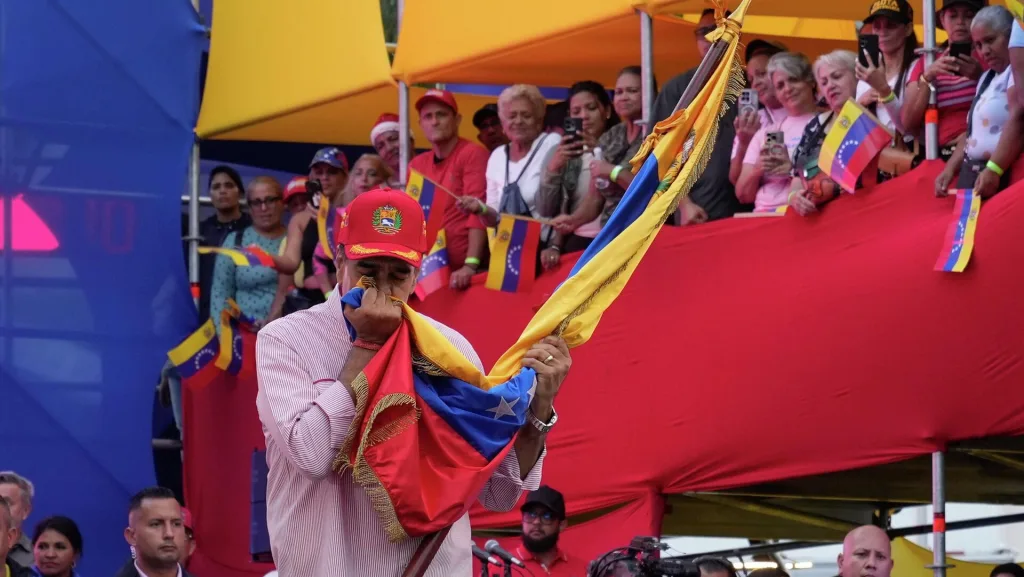
Nicolás Maduro, President of Venezuela. Photo: AP Photo / Ariana Cubillos.
Nicolás Maduro, President of Venezuela. Photo: AP Photo / Ariana Cubillos.
Venezuelan President Nicolás Maduro pointed out that his country has faced “22 weeks of aggression that can be described as psychological terrorism,” while reaffirming his government’s willingness to continue defending the nation’s peace and sovereignty.
The president’s warning comes in a context of maximum pressure from US President Donald Trump, who stated days earlier that Venezuelan airspace was “completely closed,” resulting in the cancellation of dozens of international airline flights and leaving thousands of people stranded in airports around the world.
Venezuelan political analyst Emilio Hernández told Sputnik that Washington’s announcement may mark the beginning of an air and maritime siege strategy intended to suffocate Venezuela’s economic recovery from years of illegal US coercive economic measures (euphemistically referred to as “sanctions”), adding that it fits into a predictable escalation of US pressure.
“A next step in the aggressive escalation”
The specialist broke down the evolution of what he describes as a multifaceted aggression. “Exactly,” said Hernández. “Not just an air blockade but also a maritime one. That is, both an air and maritime physical blockade, is the next step in the aggressive escalation of the United States against Venezuela.”
In his view, this aggressive phase follows a logical sequence after earlier coercive measures: “First, there was the entire financial blockade … no access to the SWIFT system to make payments, etc. And then, the theft of Venezuelan assets in many parts of the world.” The latter includes Venezuelan gold frozen in the Bank of England’s coffers.
Hernández also mentioned the blockade on publicly owned Venezuelan petroleum company Petróleos de Venezuela (PDVSA) aimed at severing the country’s main source of foreign currency. However, he believes these measures will have limited effectiveness given the diversification of non-oil exports that Venezuela has been working to expand.
“With a diversification of exports, it becomes impossible to threaten every potential buyer of the wide variety of products Venezuela is exporting,” said Hernández. “So the logical step for the United States is a naval and air blockade.”
The goal, in his opinion, is clear: “To suffocate the Venezuelan economy.” Even so, he argues that the window for causing devastating impact may have passed.
“These measures do not have the same effect now as they might have had five or ten years ago,” he contends, citing the development of an internal productive base, over 95% national food supply, and the presence of strategic partners.
“There are countries that will not comply with the US call for an air and naval shutdown… There will likely be cargo flights—Chinese, Russian… I don’t believe the US is prepared to confront China or Russia by shooting down a cargo plane,” he noted.
Regarding the long-term sustainability of a potential physical siege, Hernández is skeptical: “I don’t think it is sustainable because Venezuela can find alternatives,” he said, outlining scenarios such as using land routes to neighboring countries for re-export. “What will the United States do? Block Colombia’s or Brazil’s airspace as well, or sanction them even further?”
Washington, he suggests, is wagering on a rapid collapse. “They are trying to provoke an immediate effect, a virtually unconditional surrender of Chavismo and of Maduro within a few months. However… it is very clear that this will fail. Venezuelans are already used to hardship—we trained for this in 2016–2017, learning how to overcome any difficulty.”
The Libyan precedent: A repeatable script?
When asked about events that led to the assassination of Muammar Gaddafi in Libya by US-backed terrorists in 2011—where a no-fly zone preceded NATO bombings—Hernández draws a crucial distinction: the absence of an armed proxy force inside Venezuela.
“I don’t think it is repeatable in Venezuela for one main reason,” said Hernández. “The United States does not have on-the-ground support from an armed movement or even a paramilitary-type force.”
The analyst reviewed failed attempts by the Venezuelan opposition to create or co-opt armed elements: trying to divide the Bolivarian National Armed Force (FANB), negotiating with Colombian paramilitaries, or in his words, “attempting to hire criminal groups.”
These efforts, far from succeeding, reportedly had a paradoxical outcome: strengthening state action against organized crime. “The result has been positive for Venezuelans, because we have reduced the homicide rate to under two per 100,000 inhabitants … when it used to be an average rate in the Latin American context.”
In summary, Hernández concluded: “The United States does not have a group, an armed force on the ground, as it did in Syria and Libya. … The Venezuelan opposition has not become an armed force on the ground. In fact, what we have seen instead is a massive emigration of opponents. So, I do not believe the same model of aggression used in Libya can be replicated here.”
(Sputnik) by José Negrón Valera
Translation: Orinoco Tribune
OT/CB/SL
Cameron Baillie is an award-winning journalist, editor, and researcher. He won and was shortlisted for awards across Britain and Ireland. He is Editor-in-Chief of New Sociological Perspectives graduate journal and Commissioning Editor at The Student Intifada newsletter. He spent the first half of 2025 living, working, and writing in Ecuador. He does news translation and proofreading work with The Orinoco Tribune.