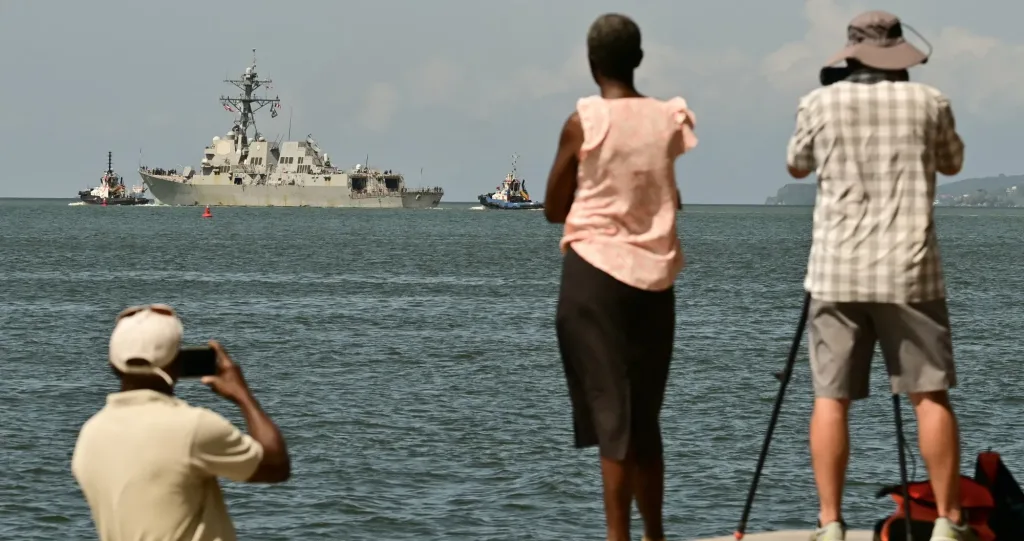
USS Gravely, a US Navy warship, docked in Trinidad and Tobago for four days in October, within striking distance of Venezuela. Photo: Martin Bernetti/AFP/file photo.
USS Gravely, a US Navy warship, docked in Trinidad and Tobago for four days in October, within striking distance of Venezuela. Photo: Martin Bernetti/AFP/file photo.
Caracas (OrinocoTribune.com)—Venezuelan Foreign Minister Yván Gil reported Tuesday that his nation delivered a letter to the United Nations Security Council repudiating the “serious use of force, abduction, and piracy” by the United States.
The letter, presented by Venezuela’s ambassador to the UN, Samuel Moncada, to Security Council President Samuel Z’bogar of Slovenia, concerns the Dec. 10, 2025, incident in international waters of the Caribbean wherein US forces targeted a private oil tanker engaged in legitimate trade while it transported Venezuelan oil. The Venezuelan crew members were abducted and remain missing.
“Venezuela will continue to exercise its sovereign and inalienable right to legitimately trade its resources and demand that no legal operation be subjected to theft, seizure, or acts of piracy, regardless of its origin,” Minister Gil stated.
Venezuela claims the US action deserves the Security Council’s attention, as it involves the use of force in international waters and the disappearance of civilians and sets a dangerous precedent for regional security.
More US executions
A few hours earlier, on Monday night, the US Southern Command (SOUTHCOM) reported new extrajudicial killings and strikes against three small boats allegedly operated by “designated terrorist organizations in international waters.” As usual, the US did not deign to provide any evidence of its accusations or any detailed information. The announcement was made via a social media post by the US military.
The post stated that the strikes killed eight people—three on the first boat, two on the second and three on the third—in the Eastern Pacific. Media reports claim that the extrajudicial executions occurred off the coast of Ecuador.
According to a detailed count by Orinoco Tribune, the US has now assassinated 95 civilians in this murderous campaign. Public records show that 48 (51%) were killed in Caribbean waters and 47 (49%) in Eastern Pacific waters. The US has murdered—at the very least—civilians of Venezuela, Trinidad, and Colombia, and one Ecuadorian survivor has been reported. Analysts claim that nationals of other countries are certainly among the victims.
On Tuesday, US Secretary of State Marco Rubio and Secretary of War Pete Hegseth appeared before the US Senate to answer questions about SOUTHCOM’s controversial operation, reflecting a heated internal debate over its nature and legality and about the opacity of information provided to legislators.
In statements after the briefing, Rubio remained defiant, claiming that the operation would “remain ongoing.” Mainstream media reported that top US officials did not provide an unedited video of the September 2 strike as demanded by many legislators and the public.
US Democratic Senator Chris Murphy told press after the briefing that “there is no legal or national security justification for what they are doing. Not even close.” He added that Rubio and Hegseth acknowledged that no fentanyl comes to the US from Venezuela and that the relatively small amounts of cocaine that may be trafficked through Venezuela are destined for Europe and not the US.
US Senator Joaquin Castro, commenting on the briefing, reiterated that despite White House attempts to avoid seeking approval for a land operation against Venezuela, US Congress will demand it. He noted that a War Powers Resolution will be discussed next week to block President Donald Trump’s hostilities against Venezuela.
Despite the US claims of a “war on drugs,” most analysts agree that Washington’s true intention is to overthrow the democratically elected president of Venezuela, Nicolás Maduro, and install a government that is compliant with US demands.
Trinidad reaffirms subservient role
Also on Monday, the government of Trinidad and Tobago announced that it will allow US military aircraft to transit through its Piarco and Arthur NR Robinson airports in the coming weeks, referring to the actions as bilateral security cooperation of a “logistical nature.”
According to Trinidad and Tobago’s Foreign Ministry, the transits will facilitate resupply and routine personnel rotations and do not change the country’s defense policy.
However, last week, revelations about Trinidad and Tobago’s role in aiding the US to seize a Venezuelan oil tanker led to a public outcry. Domestic analysts and politicians noted that newly installed US radars were used in Washington’s seizure of the oil tanker Skipper, which was carrying 1.9 million barrels of Venezuelan oil.
The government of Trinidad and Tobago reiterated that the cooperation with the US fulfills the commitment by Prime Minister Kamla Persad-Bissessar to strengthen national security. However, since taking office, she has launched anti-Venezuelan tirades against Venezuelan authorities and migrants.
Venezuela Terminates Gas Supply to Trinidad and Tobago Over Complicity in US Crimes
Trinidad and Tobago’s authorities have lent diplomatic and operational support to the US killing spree in the region despite the fact that innocent Trinidadian fishers were among the victims of the US strikes. In a controversial “double-tap” strike of September 2, apparent survivors of a first strike were then subsequently killed by a second round of US strikes. The victims were nationals of Trinidad and Tobago.
The Trinidadian government issued a rather hollow statement in an attempt to garner support for what have been referred to as actions that are submissive to the US crimes and warmongering in the region. In an attempt to justify its actions, the government claimed that “the United States Embassy in Trinidad and Tobago has also supported national development through educational initiatives, including school equipment donations and infrastructure enhancement projects.”
Internal political tension in the small Caribbean country has reached unprecedented levels as a result of these actions. Meanwhile, Venezuela has retaliated by suspending the multi-million-dollar Dragon Field project a few weeks ago and, on Monday, halting all natural gas supply to the Trinidad and Tobago.
Special for Orinoco Tribune by staff
OT/JRE/SL