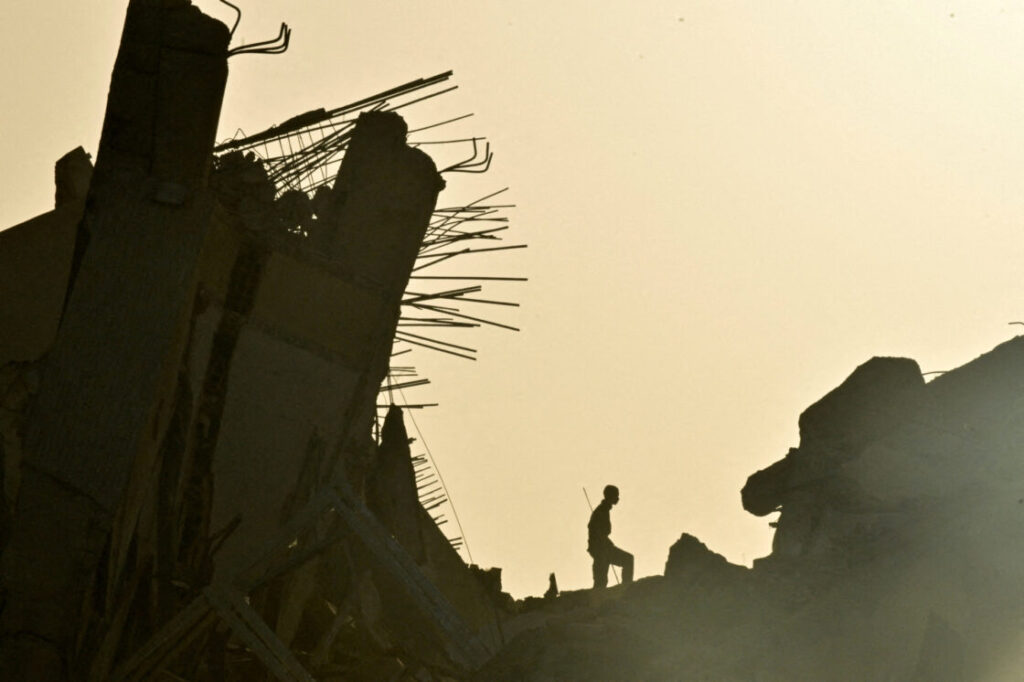
A person walks amid the ruins of a building destroyed by the earthquakes in La Guaira, Venezuela, June 25, 2026. Photo: Maxwell Briceño/Reuters.
A person walks amid the ruins of a building destroyed by the earthquakes in La Guaira, Venezuela, June 25, 2026. Photo: Maxwell Briceño/Reuters.
By Arantxa Tirado – Jul 2, 2026
On June 24, Venezuela experienced two simultaneous high-magnitude earthquakes, 7.2 and 7.5 on the Richter scale, which caused severe damage primarily in La Guaira, Los Palos Grandes, and the Chacao municipality of Caracas, as well as an undetermined number of casualties. To date, official figures report 1,943 people dead, 10,571 injured, and 6,461 rescued alive from the rubble. Given the collapse of 189 buildings, many being high-rise, it is expected the number of deaths will multiply exponentially once the rescue operations come to an end.
The earthquakes occurred in a country that experienced the exceptional situation of US special forces kidnapping President Nicolás Maduro and his wife Cilia Flores on January 3, both of whom are currently imprisoned in New York and awaiting trial. That event marked a turning point in relations between the US and Venezuela, which have shifted from an open and covert multifactorial war to a sui generis diplomatic negotiation framework. The result, without any euphemism, is Venezuela is now a de facto country overseen by the US authorities, who also boast about such by announcing a three-phase plan to end the Bolivarian Revolution. This plan consists of stabilization, recovery, and transition.
Many things have changed in the politics between the US and Venezuela in recent months, but even these changes have not put an end to the bias and prejudice with which any event in the country is reported. Those of us who thought that the new moment in Venezuelan politics would spare us from the anti-journalism, as Fernando Casado defined it, which has been practiced against Bolivarian Venezuela since Hugo Chávez rose to presidency in 1999, leading the country to begin the process of revolutionary transformation, were mistaken.
Without surprise, and with certain indignation aggravated by deep pain of collective tragedy that is being experienced at this moment, we observe how the Spanish media, whether press, television, or radio, are once again covering themselves in glory by addressing the impact of earthquakes in Venezuela. Suddenly, what would merely be a secondary comment in the news about a devastating phenomenon in any other country, namely, the ability of a State and its governmental authorities to respond to a catastrophe of such magnitude, takes on a central category when it comes to Venezuela.
Earthquakes as an excuse to judge Chavismo
Reviewing all the news, opinion articles, editorials, comments, or insidious questions that our media have given us in a week would be unmanageable, but as a sample, I will highlight only a few examples that I have come across in recent days, without having conducted a systematic search: “When what trembles is the State” (editorial of ABC, Friday, June 26), “Solidarity replaces the shortcomings of the State in Venezuela” (cover page of La Vanguardia, June 29), “Venezuelans expect the government to be able to resettle them, which seems like a utopia considering the chronic weakening of Venezuelan structures” (voice-over in the program “La Hora de La 1” of RTVE), “Do you think these earthquakes will end with a regime change in Venezuela?” (question to a Venezuelan guest in the TV3 program Més Nit).
In opinion programs, pundits turned specialists in Venezuelan politics dedicate themselves not only to questioning the State but also the current government, previous Chavista governments, and, above all, the political process as a whole. Except for a few rare cases where the commentator tries to maintain a posture of prudence, at the risk of being labeled a defender of a “dictatorship,” Chavismo is brought to the media courts under the pretext of the earthquakes: “The country is deteriorated after 20 years of a corrupt, rotten regime that has abandoned its own citizens,” “I believe that Chavismo has been absolutely devastating for Venezuela,” “We are all perfectly aware here of what the Chavista regime has been.”
These phrases were said in 10 minutes of discussion on a morning RTVE program, although according to the Spanish (far) right, the Spanish public television is under the control of a supposedly Bolivarian government. The level of dissociation reached the point where a Venezuelan guest, part of a civil association of Venezuelans in Spain, had to shed common sense by urging everyone to abandon political assessments and focus on the issue of earthquakes.
In addition to the summary judgment on the Bolivarian project, even more rampant, if possible, are discussions of private media, whose opinions have been mixed with directly false statements that have passed off as information: “There are no public policies in Venezuela,” “The government cannot even clear the rubble,” “The collapsed buildings were constructed by the government as part of the Housing Mission,” “The Venezuelan Army is not working,” “The government is blocking access to La Guaira because it wants to prevent aid from arriving” (ignoring the need to restore order amid the avalanche of volunteers that blocked the only access road to the most affected area); and, the kicker: “The Venezuelan government lacks empathy.” And so on and so forth, in a never-ending stream of assertions, some of which are refuted by the very images presented in those programs or by taking the time to find information through alternative channels.
To gauge the level of bias in how the management of earthquake-caused crisis in Venezuela is being presented, I invite anyone reading this to consider what was said about the diligence of the authorities, or the Mexican political system, when the 7.1 magnitude earthquake struck Mexico in September 2017. Does anyone in Spain remember who was in power in Mexico at that time? What political and economic model did it have in the preceding decades? Any criticism of neoliberal policies? Did anyone associate the collapsed buildings at the epicenter of the earthquake in the state of Puebla to the responsibility of its governor, the actions of its political party, or the absence of public policies? The answer to these questions allows us to understand that Venezuela is once again the target of a delegitimization campaign that discredits and seems to operate on a global scale, as we have witnessed the same arguments in other international media.
When Venezuelan opposition enters the scene
With Venezuela, everything gets “politicized” in the worst sense of the term. Evidently, the political vision is important and must always be present. No one denies the politics that exist in every activity or human response to collective problems. There is also politics in crisis management or negligence, lack of resources, or insufficient action by the authorities in any country. This should never be hidden. However, transparency must be carried out based on well-dimensioned, contextualized, and informed analysis, which does not happen when evaluating anything that has occurred in Venezuela.
Anyone who knows Venezuela is aware that, even before the arrival of Chavismo to power, the country suffered from administrative, organizational, and public planning problems, surely associated with a political culture imbued with the short-term logic granted by oil opulence. Without starting from this truth, any analysis that places a problematic starting point in Chavismo lacks honesty.
In the case of Venezuela, it is practically impossible to conduct an impartial assessment because the debate about State limitations ends up repeating the worn-out mantras questioning Venezuelan sovereignty, in a way that the focus on humanitarian issues, which should be a priority, shifts to partisan interests, ultimately placing a political agenda at the forefront that alters the debate and shatters any semblance of good intentions. As a result, interviews with Leopoldo López, columns by María Corina Machado or Edmundo González Urrutia are combined with interviews with other lower-profile Venezuelan opposition figures, without that counterbalance of analysis from a different approach.
From the moment an exclusive voice is given to the Venezuelan opposition to set their political agenda, opportunistically and irresponsibly in the midst of tragedy, without providing the testimony of Venezuelan authorities at the same level who can refute some of the lies that these people with vested interests spread, a stance is taken that does not align with a press that boasts of plurality, impartiality, and independence.
Everything we are experiencing is not new; it is yet another episode in the death of journalism when it comes to Venezuela. Journalists who filter information through their ideological prejudices and are unable to hide their animosity toward a sovereign and legitimate political process. An uneasiness that affects the entire ideological spectrum of the journalistic profession, to a greater or lesser extent, from progressives to the most reactionary positions.
Only the rescuers on the ground and the most technical voices are carrying out this situational transparency, without any prior ideological prejudices, highlighting the limits imposed by a catastrophic disaster, which are essential to gauge the response capabilities of any State, irrespective of how efficient or inefficient it may have been beforehand. As the head of the expedition of the Firefighters of the Generalitat of Catalonia said the other day, “No State is prepared for a situation of this magnitude; it is impossible for the country to attend to it without help.”
Venezuela Earthquake Toll Reaches 2,295 Dead and 6,461 Rescued 1 Week After Tragedy
Historical knowledge, geopolitical analysis, and defense of Venezuelan sovereignty
The reality of countries must be contextualized historically and geopolitically. But this is absent in all the biased information that wants to take advantage of this moment to continue attacking Chavismo in Venezuela. The more than 1,000 unilateral coercive measures imposed by the US that largely caused the Venezuelan GDP to fall by about 80% between 2012 and 2020 are absent from most analyses that highlight the limitations of the Venezuelan State, and don’t bother to ask why.
Evidently, this sanctions offensive has enabled the economic and financial suffocation of the country, preventing its autonomy and hindering Venezuela’s free access to international markets, with all that it entails. It is also worth noting that the US and other countries have frozen more than $30 billion of Venezuelan State assets abroad, and that right now, it is precisely the US that is managing the country’s oil revenues. We are not talking about minor data or irrelevant information. We are highlighting the political limitations within which the previous Chavista governments and the current government will have to operate within, now with the additional problem of needing those sanctioned resources to cover the $6.7 billion losses, in a climate of limited political autonomy.
In conclusion, highlighting the limitations of the Venezuelan State to address a crisis of this magnitude without putting at the epicenter the economic impact that a warlike offensive by the world’s number one superpower has had on the State itself for decades: in how the US also limits Venezuela’s ability to access its oil revenues and reserves, and how it is not even lifting its unilateral restrictions, except for very specific licenses that are functional to its companies and banks, is an action of dishonesty. This is an even graver dishonesty because it occurs in a context where the US, in addition to bleeding Venezuela, can take advantage of the crisis to deepen its regime change agenda, while also wanting to control the lucrative reconstruction business.
We must allow Venezuela to work unitedly, through its State, its government, the numerous volunteers, its Civil Protection, its firefighters, the rescuers belonging to the more than 51 international delegations, the rescue dogs that help save so many lives, and all the people whom are at this moment concerned with the most crucial thing: human life. Above all, let us be aware that the best way to provide long-term help is to advocate for the future international system to be an order in which Venezuela and other countries in the world, whether with or without oil resources, can have sovereign development, even if it be against the interests of the US. This would be the first step in supporting Venezuela. Maybe some will arrive late, but, as the saying goes, it’s better late than never.
(La Marea)
Translation: Orinoco Tribune
OT/SC/SH