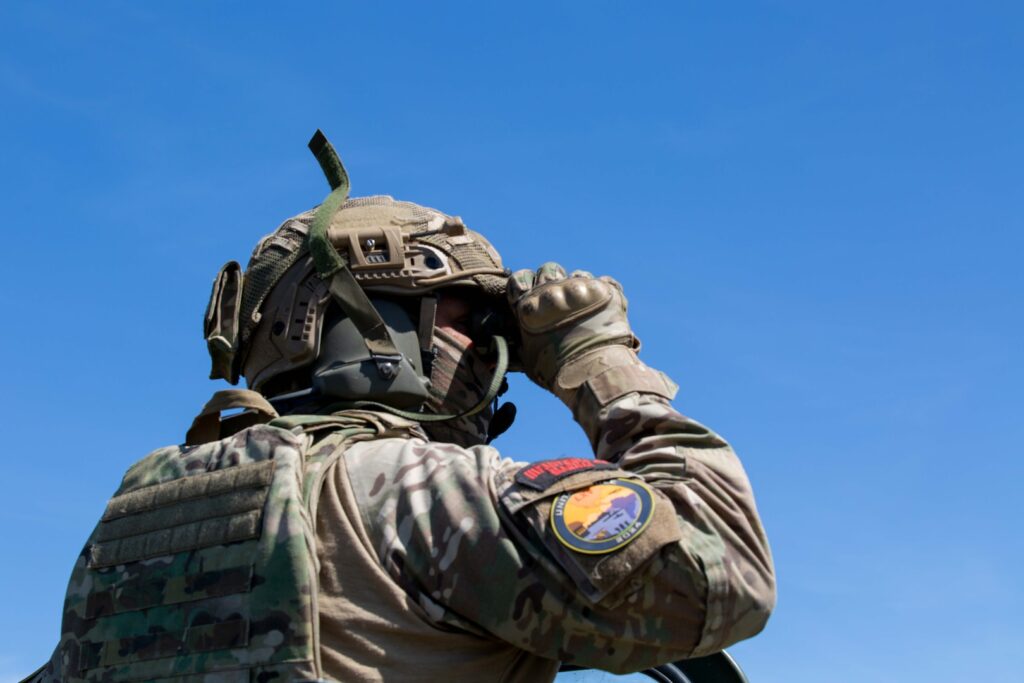
Chilean soldier conducts target acquisition from his Light Armored Vehicle during a live fire range, at the Expeditionary Advanced Base North, in Puerto Aldea, Chile, on Sept. 5, 2024, while participating in UNITAS LXV. Photo: Lance Cpl. Payton Goodrich/US Marine Corps/file photo.
By Misión Verdad – Mar 5, 2025
Last February 18, the government of Guyana reported an alleged attack against its troops on the banks of the Cuyuní River in the Venezuelan territory of the Essequibo. According to Georgetown, six Guyanese soldiers were wounded when alleged “Venezuelan” armed men opened fire during a resupply mission.
However, Venezuela categorically rejected these accusations as a “vile fabrication” designed to manipulate public opinion and cover up the repeated violations of the international legal framework committed by Georgetown in the disputed territory.
Through an official communiqué, the Venezuelan Foreign Minister, Yván Gil, denounced that this incident was a false-flag operation orchestrated to justify the increasing militarization of the zone with the support of the US Southern Command.
According to preliminary information gathered by Caracas, the injured persons did not belong to Guyanese troops on a regular mission but to elements linked to illegal mining operating in the region under the protection of the army and police of the neighboring country.
The Cuyuní River incident cannot be understood as an isolated event; it is the first sign of a new agenda of provocation against Venezuela.
Such operations, historically used as a framework for military interventions, sanctions, or interference in various regions, follow a well-defined pattern: covert maneuvers are carried out to blame the adversary and create a narrative that legitimizes subsequent measures of force and aggression.
Joint military operation “General Domingo Antonio Sifontes”
On March 1, Guyanese President Irfaan Ali—dubbed the “Zelensky of the Caribbean” for his role as a proxy in the conflict against Venezuela—accused Venezuela of incursions into waters he claims belong to Guyana.
Ali stated on Facebook: “At approximately 7:00 a.m. on Saturday, a Venezuelan Navy patrol vessel entered Guyana’s waters and approached several assets in our exclusive waters.” These assertions lack legal basis, as the waters remain undelimited and fall under the territorial dispute governed by the 1966 Geneva Agreement.
Guyana further claimed it had “alerted international partners after a Venezuelan military patrol vessel informed floating production, storage, and offloading (FPSO) vessels in the Stabroek block they were operating in disputed waters.” Such statements aim to polarize the dispute and craft a victim narrative, ignoring ExxonMobil’s unlawful exploitation of resources in the area.
In response, Venezuela’s Bolivarian National Armed Force (FANB) disclosed the presence of 28 foreign drilling vessels and tankers in undelimited waters operating with Ali’s government consent. These activities blatantly violate international law and the Geneva Agreement, the sole legal framework for resolving the territorial dispute.
The FANB executed Operation “General Domingo Antonio Sifontes”, deploying the oceanic patrol vessel AB Guaiquerí (PO-11) to monitor Venezuela’s Atlantic maritime spaces. Satellite imagery confirmed foreign vessels in the contested area.
Venezuela has repeatedly accused Guyana of acting as a proxy for foreign powers, enabling resource exploitation that undermines its historical and legal rights. The FANB condemned Ali’s statements and biased regional organizations for fueling hostility instead of fostering peace.
International complicity
The Organization of American States (OAS) and allied governments issued statements disregarding the Geneva Agreement, revealing complicity in regional security matters.
• The OAS condemned FANB actions as “acts of intimidation” and a “clear violation of international law.”
• The US, through its Undersecretary for Western Hemisphere Affairs, called Venezuela’s actions “unacceptable” and a “violation of Guyana’s maritime space,” warning of consequences for the “Maduro regime.”
• The U.K.’s Foreign Secretary, David Lammy, labeled FANB deployments “provocative acts.”
• France expressed “concern” over Venezuela’s patrol boat incursion into Guyana’s “exclusive economic zone” and urged respect for Guyana’s sovereignty.
These actors seek to legitimize further interference in the region.
The precedent of the Gulf of Tonkin: forcing casus belli
History has shown on multiple occasions how the United States, in its eagerness to justify military interventions and hostile actions, has forced incidents that serve as excuses to escalate conflicts.
One of the most emblematic examples of this strategy was the Gulf of Tonkin incident in 1964, a crucial event that marked the beginning of Washington’s massive involvement in the Vietnam War. Such a historical precedent has alarming parallels with the current situation facing Venezuela on its eastern border.
In August 1964, the US government reported two alleged North Vietnamese attacks against the destroyer USS Maddox in the aforementioned Gulf. In particular, the second attack, reported on August 4, never occurred. Subsequent investigations, including the “Pentagon Papers” declassified in 1971, revealed that the incident was the product of a fabrication.
Despite this, then-President Lyndon B. Johnson used both episodes to petition Congress for the Gulf of Tonkin Resolution, which authorized military escalation without a formal declaration of war. This argument allowed the United States to increase its military presence in Vietnam from 60,000 to 500,000 troops, which marked the beginning of one of the longest and most devastating wars of the 20th century.
The CIA’s involvement in covert operations in the region, as well as the subsequent declassification of documents, confirmed that the US government was looking for an excuse to escalate its intervention in Vietnam.
The Gulf of Tonkin incident was nothing more than a political manipulation designed to sustain a war that responded to geopolitical and economic interests, and not to a real threat.
Venezuela is currently facing a situation of similar characteristics, in which external actors, in complicity with Ali’s government, seek to build an argument to support intimidating actions against the Bolivarian nation.
The recent declarations of the OAS, the United States, the United Kingdom, and France, condemning the legitimate actions of the FANB in Essequibo Guyana, are part of a pre-established and deliberate script to present Venezuela as an aggressor in this regional scenario.
The strategy seeks to escalate the conflict and establish motives for a possible interference, as occurred with the Gulf of Tonkin incident.
Changing Trump’s agenda: an ongoing psychological operation
In this context, it is clear that a carefully orchestrated psychological and media operation is underway to capture the attention of the US administration, particularly President Donald Trump.
By presenting Venezuela as an imminent threat, it seeks to pressure the White House to prioritize this dispute as a regional security issue. The logic is simple: if that government perceives that the stability of the Caribbean and access to energy resources in the area are at risk, it is more likely to intervene or reinforce its support for Guyana.
However, this also responds to an internal dynamic in the United States. Trump, known for his more pragmatic and less interventionist approach to foreign policy, has shown a preference for withdrawal in international conflicts.
This represents a challenge for sectors of the US political class that have historically promoted coercive agendas against Venezuela. For these actors, the tensions with Georgetown are an opportunity to open a new front of attention that will force Trump to take a more active position, even if this goes against his natural tendency to retreat.
In fact, the characterization of Irfaan Ali as the “Zelensky of the Caribbean” responds to the fact that this subject is presented as a victim of external aggression, which facilitates the mobilization of foreign support, as is the case with Ukraine.
Such discourse, amplified by the media and allied political actors, has the ultimate goal of capturing Trump’s attention and forcing his administration to take concrete measures, be it through sanctions, military support, or an increased presence in the region.
The Cuyuní River incident, Guyana’s unfounded accusations, and the biased statements of international organizations clearly aligned with Washington seem to follow an already known scheme: to fabricate a threat to justify hostile actions, in defense of ExxonMobil’s private energy interests.
Following the coordinates of the Gulf of Tonkin, where a fabricated incident served as a pretext for military escalation in Vietnam, an attempt is now being made to construct a narrative that presents Venezuela as an aggressor with a view to justifying a new international offensive of aggression.