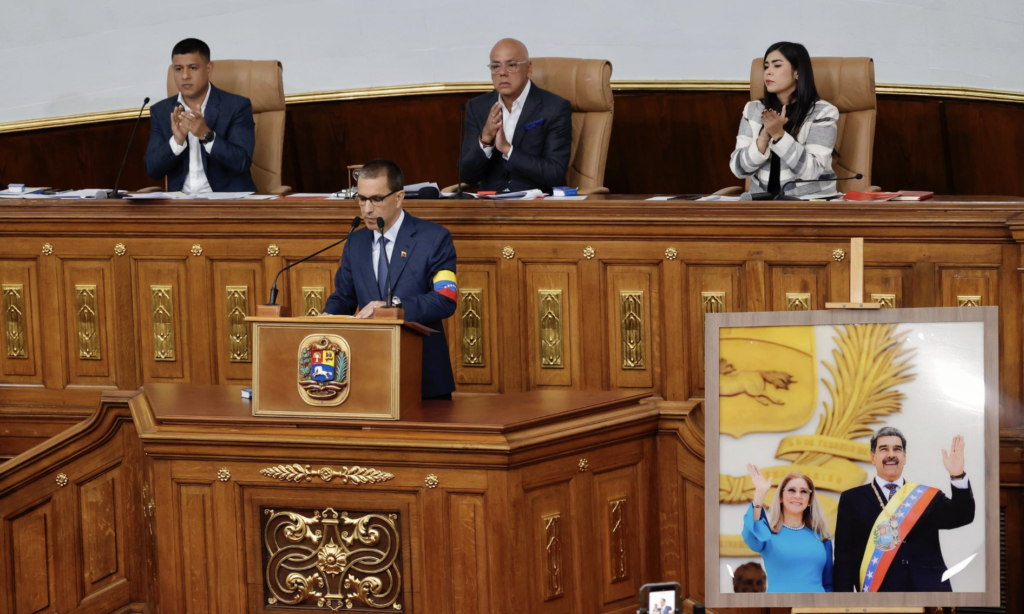
National Assembly Deputy Jorge Arreaza addresses the parliament during a discussion on the amnesty law. File Photo.
The Venezuelan National Assembly released the full text of the Amnesty for Democratic Coexistence bill, a 13-article piece of legislation that seeks to heal wounds caused by political polarization.
I. Foundations and purpose (Arts. 1 to 5)
Object (Art. 1): To grant a general and full amnesty to those prosecuted or convicted for political crimes or related acts between Jan. 1, 1999, and Jan. 30, 2026.
Purposes (Art. 2): To promote peace, national reconciliation, and political pluralism to prevent these events from recurring.
Principles (Art. 3): The law is governed by justice, freedom, and the preeminence of human rights.
General interest (Art. 4): The law is declared to be of public order and general interest, which guarantees its immediate application.
Interpretation (Art. 5): In case of doubt, the interpretation that most favors the human rights of the beneficiary will always be applied.
II. Scope and exceptions (Arts. 6 and 7)
General amnesty (Art. 6): The heart of the law forgives historical events such as April 11, 2002, the 2003 oil strike, the 2014, 2017 and 2019 protests, as well as the political events of July 2024.
Exclusions (Art. 7): There will be no pardon for serious human rights violations, crimes against humanity, war crimes, intentional homicide, drug trafficking, or corruption crimes.
III. Execution and legal effects (Arts. 8 to 13)
Extinction of action (Art. 8): All criminal, civil and administrative actions are eliminated by operation of law. Deprivation of liberty measures and extradition requests cease immediately.
Judicial procedure (Art. 9): Courts must verify cases and order dismissal or annul final judgments through replacement rulings.
End of inquiries (Art. 10): All police bodies and military authorities are ordered to close investigations for amnestied events.
Record expungement (Art. 11): State agencies must delete from their files any criminal record or police registry of the beneficiaries.
Implementation (Art. 12): The National Executive, through the Ministry of Pententiary Services, will coordinate the logistics of the releases.
Effective date (Art. 13): The law will take effect on the day of its publication in the Official Gazette.
The president of the National Assembly, Jorge Rodríguez, confirmed that the second discussion of the law will take place on Tuesday, February 10, with the goal of having all beneficiaries in their homes by next Friday. The draft bill is currently being widely discussed and reviewed across Venezuela, as mandated by the Venezuelan constitution. Rodríguez asked the commission in charge of the consultation to consult all those affected by deprivations of liberty, as well as all victims of the violent acts that could be amnestied.
There have been many opportunities in which the Bolivarian Revolution has amnestied or pardoned acts of political violence promoted by far-right factions that have been historically supported and financed by US imperialism, as analysts indicate. On this occasion, many Venezuelans hope that appropriate follow-up actions will be taken regarding the most violent amnestied individuals to prevent them from repeating acts of violence.