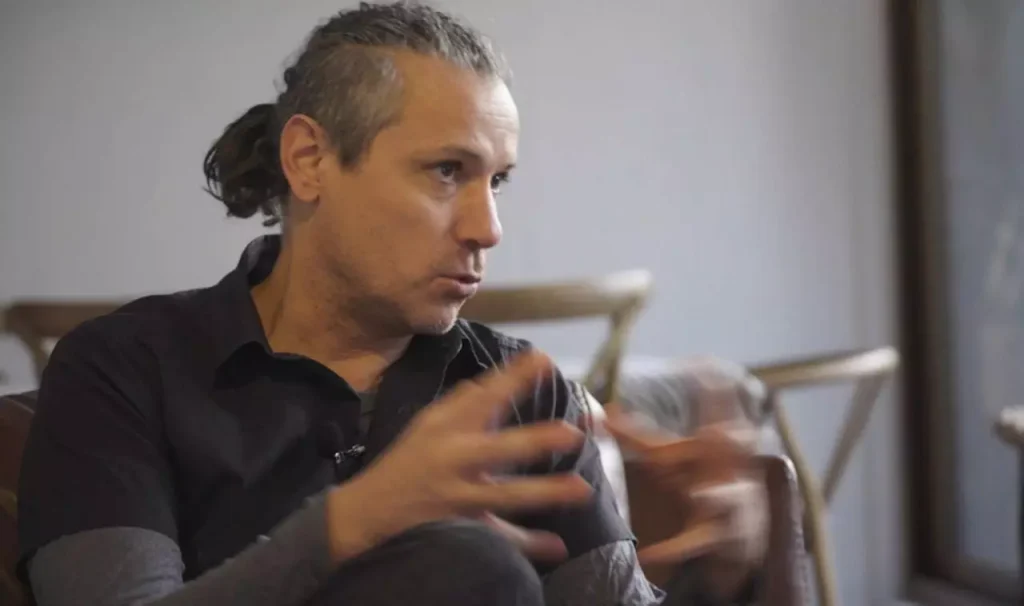
Pablo Sepúlveda Allende speaks to Declassified UK in Santiago, Chile, 2023. Photo: Declassified UK.
Pablo Sepúlveda Allende speaks to Declassified UK in Santiago, Chile, 2023. Photo: Declassified UK.
By John McEvoy and Pablo Navarrete – Sep 11, 2023
In Santiago, Declassified spoke with Pablo Sepúlveda Allende about Margaret Thatcher’s friendship with Chile’s dictator and how the UK Labour Party helped Pinochet evade justice for crimes against humanity.
• “The colonialist countries in general have collaborated so that the decolonised countries can’t become independent,” Pablo Allende told us
• In contrast his grandfather Salvador Allende “wanted the country to develop and industrialize.”
• Pablo believes there was a “secret agreement” between the UK and Chile not to extradite Pinochet for crimes against humanity
• New files show the Foreign Office encouraged Chileans to expect foreign intervention against Allende, and therefore to vote against him
On 11 September 1973, Chile’s socialist president Salvador Allende was overthrown in a CIA-sponsored military coup, paving the way for a brutal military dictatorship under General Augusto Pinochet.
Declassified US files show why Washington wanted to remove Allende.
On 5 November 1970, shortly after Allende had won Chile’s election, US Secretary of State and National Security Adviser Henry Kissinger noted that Allende “poses one of the most serious challenges ever faced in this hemisphere.”
The example “of a successful elected Marxist government in Chile would surely have an impact on… other parts of the world,” Kissinger added. He thus recommended that the US government “do all we can to keep him from consolidating power.”
Over the next three years, the CIA orchestrated a series of covert operations in Chile designed to destabilize the Allende government, and prepare the ground for its removal.
On 16 September 1973, just five days after the coup, Kissinger told Nixon in a private phone call that: “We didn’t do it. I mean we helped them… [Redacted] created the conditions as great as possible.”
Over the following years, the US government supported the Chilean dictatorship, as it rounded up, tortured, and murdered its political opponents. In 1976, Kissinger privately told Pinochet: “We are sympathetic with what you are trying to do here.”
While Washington’s role in the 1973 coup is notorious, less is known about Britain’s secret campaign against Allende, its support for the Chilean dictatorship, and the Labour government’s decision to protect Pinochet from extradition.
On the 50-year anniversary of the coup, Declassified sat down with Salvador Allende’s grandson, Pablo Sépulveda Allende, to discuss the sordid history of British interference in Chile.
Though Pablo was born after the 1973 coup, his grandfather’s legacy is clearly not forgotten. The living room table is adorned by books about the Popular Unity (UP) movement in Chile, the left-wing coalition which brought Allende to power in 1970.
Pablo is now a political activist, and a doctor. He was recently detained while providing medical treatment to protesters battling against neoliberalism and police brutality in Chile, both remnants of the Pinochet dictatorship which only ended in 1990.
We began the interview by reading excerpts from recently declassified British files, all of which have only been released into the UK national archives during the past few years.
The files show how the CIA was not the only foreign actor which had Salvador Allende in its crosshairs. In fact, Britain’s Cold War propaganda unit, the Information Research Department (IRD), had been working to prevent Allende from coming to power since at least 1962.
In the run-up to Chile’s 1964 election, the IRD had been distributing its “more serious [propaganda] material to reliable contacts and to securing the publication of certain press articles.” This was designed to delegitimize Allende and promote his main opponent, the Christian Democrat candidate Eduardo Frei.
“Britain had been working to prevent Allende coming to power since at least 1962”
After Frei won the election, IRD officials could not contain their joy. “I should like, if I may, to send our congratulations to all those contributing to local IRD work,” wrote the head of the IRD’s Latin America desk, Rosemary Allott, just days after the results came in.
As Allende’s electoral prospects improved during the late 1960s, Britain’s covert propaganda operations in Chile intensified. “We are concentrating on covert operations which we think could influence the result of the next elections,” noted Pat Dyer, the IRD field officer in Santiago, in 1968.
‘Our Major Interest Is Copper’: Britain Backed Pinochet’s Bloody Coup in Chile
In 1970, the incoming British ambassador in Santiago, David Hildyard, was briefed that the IRD had “been concentrating on preventing an extreme left-wing alliance from gaining power in the presidential elections.”
Remarkably, Dyer also confessed that he was “not discouraging Chileans from thinking that there could be foreign intervention if the Marxists gain control here, because this could influence many independent voters, particularly women, to vote against Marxism at the next elections.”
In other words, the IRD was encouraging Chilean voters to expect a coup against Allende, and therefore to vote against him.
Between 1962 and 1970, Britain thus interfered in two presidential elections in Chile, and engaged in a range of covert operations designed to prevent Allende from ever coming to power.
‘It’s not surprising’
This was the first time that Pablo had learned about Britain’s hidden hand in Chile, but he was not surprised by the evidence.
“I didn’t have much information about the actions of the British government against Allende in Chile,” he says. “But, as you know, given the role of the US, it’s not surprising. From an Anglo-Saxon point of view, the US and Britain act as one in many respects.”
For Pablo, these operations sit within a wider context of colonial powers seeking to thwart the economic development of smaller countries.
“The colonialist countries in general have collaborated, let’s say, so that the decolonised countries can’t become independent, so that they don’t have any real economic or political independence.”
Indeed, British covert action in Chile was often undertaken in collaboration with the US during this period, with advice and intelligence being shared with the US embassy in Santiago.
‘My enemy is dead’
With this in mind, it is not surprising that the UK government welcomed the 1973 coup.
The Foreign Office felt that the Pinochet regime had “infinitely more to offer British interests than the one which preceded it.” As Declassified recently revealed, Britain’s MI6 and its embassy in Santiago even aided Chile’s military in the aftermath of the coup.
In order to suppress domestic opposition to the Pinochet regime, Foreign Office propagandists also seemingly planted articles in the British press blaming Allende for the political chaos, and arguing that “there is no firm evidence to suggest the Americans inspired the fall of President Allende.”
Four days after the Chilean coup, The Economist similarly declared that: “The temporary death of democracy in Chile will be regrettable, but the blame lies clearly with Dr. Allende… Their coup was homegrown, and attempts to make out that the Americans were involved are absurd.”
One of the Economist’s writers on Latin America and a longstanding IRD contact, Robert Moss, reportedly ran through the corridors of the newspaper’s office in London chanting: “My enemy is dead!”
‘At the service of economic power’
We asked Pablo to talk about the British media’s response to the coup, and why certain journalists would be delighted to see the death of democracy in Chile.
“The unfortunate thing is that certain parts of the press are not independent. They’re financed or form part of major economic interest groups,” he says. “And well, we can’t be surprised that certain media organizations, particularly the big ones, reacted in this way towards emancipatory movements across the world.”
He relates the British response to how the Chilean elite reacted to the coup. “They had champagne parties to celebrate,” he says. “The media are at the service of economic power. So they influence public opinion through the production of information, which then influences policy.”
The inverse is also true, he adds. When repressive governments serve powerful interests, “the media hide or manipulate” the truth, even when military regimes like that of Pinochet “consolidate their power through massacres, killings, coup d’états. The media minimize or relativize it.”
The BBC’s coverage of the Chilean coup offers a useful case in point.
After its Panorama team visited Chile to cover what was happening, the Foreign Office privately noted that the journalists had “been extremely conscientious” such that their documentary should “be about 60 to 75% favorable to the new regime.”
Once the BBC documentary had been aired, moreover, then UK foreign secretary Alec Douglas-Home noted with apparent glee that the program “was a well-balanced and documented piece relatively favorable to the Chilean military takeover.”
Pinochet’s spy in Northern Ireland
After the British Labour Party returned to power in 1974, the UK government took a more hostile approach to the Pinochet regime.
During the Harold Wilson and James Callaghan governments (1974-1979), Britain welcomed more Chilean refugees to Britain, imposed an arms embargo on the Pinochet regime, and removed the British ambassador in Santiago.
The shift in policy was taken in response to pressure from the British trade union movement and Chile solidarity campaigners, who successfully lobbied the UK government to uphold a more ethical policy towards Chile.
Not all of the British trade union movement, however, was on board.
Classified files released by WikiLeaks show how Norman Willis, then the assistant general secretary of the British Trades Union Congress (TUC), privately briefed the US embassy in London in May 1974 that “the TUC was clearly not enthusiastic” about the “blacking” of British arms to Chile in the East Kilbride Rolls Royce factory.
Nonetheless, British hostility to the Chilean dictatorship was clearly widespread and effective.
In 1975, the Pinochet regime even dispatched a spy to Northern Ireland to take pictures of Britain’s internment camps there. The idea was to present the images at the UN Security Council, and embarrass the UK government into taking a more restrained position on Chile.
The plan only failed because the images arrived too late, but the photos later appeared in Chilean daily El Mercurio.
‘That is the history of Latin America’
After Margaret Thatcher was elected in 1979, British policy reversed course.
As historian Grace Livingstone wrote in Declassified, Thatcher’s government “not only lifted a British embargo on the sale of weapons to Chile imposed by the previous Labour government, it also sold arms that could be used for internal repression while training hundreds of Chilean soldiers.”
In 1982 Pinochet also provided secret assistance to the British war effort over the Falkland Islands. For this, Thatcher would go on to say that Pinochet was “this country’s staunch, true friend.”
We asked Pablo what he thought about the relationship between Thatcher and Pinochet, and the legacy it has left on Chile.
“Let’s remember how Pinochet provided air bases during Britain’s war with Argentina and gave intelligence to British forces.” he begins. “And, as they say, Chile was the neoliberal laboratory, and Thatcher was the one who really initiated those kinds of anti-trade union, neoliberal, privatization policies in Britain.”
The two figures thus “coincided ideologically,” but Chile was still in a position of “subordination” to Britain as “a supplier of raw materials” to the global North.
Allende, by contrast, “wanted the country to develop and industrialize, and fought with the latifundista [large landowning] right-wing which wanted to continue being subordinated to the countries of the north.”
“That is the history of Latin America, in a sense,” he adds.
Indeed, one of Allende’s major transgressions, in the view of the US and UK governments, was the nationalization of Chile’s copper industry.
Washington was concerned “not only about the loss to the copper companies, but also about the precedent that the Chilean action would set for the nationalization of other American interests throughout the developing world,” ambassador Secondé observed in 1973.
A Foreign Office brief written the same year similarly noted that Britain’s “major interest in Chile is copper,” and the UK government therefore had “a major interest in Chile regaining stability.”
Pinochet’s extradition
Chile’s return to democratic government in 1990 followed Pinochet’s call for a national plebiscite on his dictatorship in 1988, something he was not expecting to lose. However, the “No” campaign won a resounding victory in October of that year, with 56% of the population voting to end the 15-year-old dictatorship.
Unwilling to relinquish power, the Chilean military started to make plans, “using violence as a pretext,” to suspend the plebiscite “if Pinochet appears to be losing.” Remarkably, US and British officials “passed messages of concern to Chilean military contacts,” urging them to respect the vote.
Though Pinochet eventually agreed to step down, he remained head of the Chilean military, and maintained a significant amount of political power.
Throughout the 1990s, Pinochet made a number of visits to London, shopping at Harrods and going for afternoon tea with his long-time friend, Margaret Thatcher.
The British public had not forgotten about Pinochet’s brutal legacy in Chile, with scores of angry letters being sent to the Foreign Office demanding the government refuse his entry.
“Over the following 16 months, London became the site of a dramatic legal battle”
As the letters flowed in, the UK government deliberated whether new arms deals with the Chilean military justified the diplomatic embarrassment of welcoming Pinochet to the country. He was not refused entry.
In October 1998, Pinochet was once again in Britain, this time recovering from a recent back surgery at the London Clinic. Spanish magistrate Baltasar Garzón saw an opportunity, and issued an international arrest warrant for Pinochet regarding crimes against humanity committed during the dictatorship.
Over the following 16 months, London became the site of a dramatic legal battle, with victims of the Pinochet regime hoping the dictator would finally be held accountable for his actions.
Indeed, many expected the New Labour government might proceed with extradition. Its leader Tony Blair had told the party conference in 1999 that he found the former dictator “unspeakable,” while his close ally Peter Mandelson declared that most British people would find it “gut-wrenching” to see him evade justice.
In January 2000, however, home secretary Jack Straw announced that Pinochet would not be extradited to Spain on health grounds. He subsequently returned to Chile, where he died in 2006.
‘A secret negotiation’
The decision not to extradite Pinochet was met by international opprobrium. Chile’s leading human rights lawyer, Hernán Montealegre, declared that “the freeing of Pinochet was a political decision taken by the British government.”
Evidence has since mounted to support Montealegre’s claim.
According to a book published by Chilean journalist Monica Pérez and Felipe Gertdtzen, the son-in-law of former Chilean president Eduardo Frei Ruiz-Tagle, organized a “back channel” to orchestrate Pinochet’s release, with the issue of his health used as political cover to avoid diplomatic embarrassment.
“It would obviously be embarrassing if all this came out”
A recently declassified British file, meanwhile, indicates a more unusual reason for refusing Pinochet’s extradition.
In October 1998, Blair was briefed by his private secretary, John Holmes, that the circumstances surrounding the legal case were “rather more complicated than it might seem.”
“Apparently we have an understanding with him [Pinochet] from the past,” Holmes wrote, “because of our cooperation with the Chileans against Argentina at the time of the Falklands crisis, that we would help him with medical treatment in London.”
He added: “It would obviously be embarrassing if all this came out.”
‘A secret negotiation’
We asked Pablo about the extradition case, and whether he believes that a political solution was privately negotiated between the UK and Chilean governments.
“I believe that it was a diplomatic negotiation, so to say, a secret negotiation, not public, between the Chilean and British governments to free him.”
He added: “The Chilean government, despite being a government supposedly of the left, demanded at all cost that Pinochet should be returned and judged in Chile, even though in Chile that was never going to really happen.”
After Pinochet returned to Chile, he was determined to be mentally fit to face trial, and placed under house arrest on a series of charges relating to forced disappearances, tax evasion, and corruption. This penalty, however, was less severe than what he had faced and escaped in Europe.
Pablo continued that the Chilean government’s actions with regards to the extradition case were a source of “embarrassment.” “You don’t expect this from governments of the left, and especially not those of the Socialist Party, which was Salvador Allende’s party.”
Pinochet was “fundamentally an ally of the US and UK governments, so it’s not particularly strange that they did this,” Pablo adds. On a sombre note, he concludes that much of the “shame lies with Chile, who requested this and protected him.”
(Declassified UK)
BLA

Independent journalist @theCanaryUK, @jacobinmag, @ColombiaReports , & International History Review.
Pablo Navarrete is a journalist and documentary filmmaker.