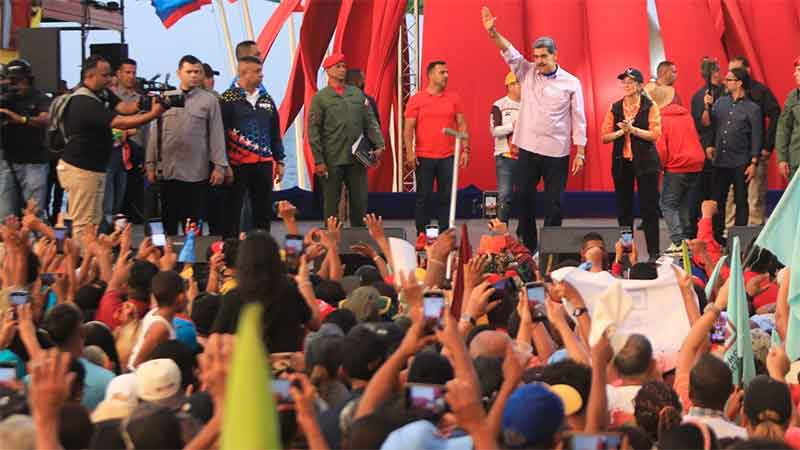
President Nicolás Maduro at a rally in La Guaira state on August 22, 2024. Photo: Venezuelan Presidential Press.
President Nicolás Maduro at a rally in La Guaira state on August 22, 2024. Photo: Venezuelan Presidential Press.
By Francisco Dominguez – Jun 23, 2025
On the eve of Venezuela’s presidential election on 29th July 2024, Guardian correspondents, Tiago Rogero (based in Rio de Janeiro) and Sam Jones (based in Madrid) predicted the vote “could end 25 years of socialist rule.” It did not. The following, 30 July, another group of Guardian correspondents gave prominent coverage to far-right wing Venezuelan politician Maria Corina Machado, quoting her claim that “Maduro’s exit was inevitable.” Yet, Nicolas Maduro was inaugurated as the re-elected president for the 2025-2031 term on 10 January 2025.
The July 2024 presidential election was followed by the election for National Assembly deputies and all 24 governorships of Venezuela’s federal structure on 25 May 2025. Venezuela’s US-funded far-right opposition, led by Machado boycotted the vote. Corporate media outlets –including the New York Times, The Washington Post, Le Monde, El País, the BBC, and others – framed their coverage by labelling the election “divisive” and extensively quoting Machado’s claim that “85% of the electorate did not obey the regime and said no.” In reality, she falsely portrayed the opposition’s boycott as a political victory, implying widespread voter rejection.
Unlike the July 2024 presidential election –when the far-right factions instigated street violence resulting in 27 deaths at the hands of armed thugs, including two armed attacks on the presidential palace –, the 25 May 2025 legislative and gubernatorial elections (Venezuela’s 32nd electoral process), proceeded calmly and peacefully. However, the far-right’s boycott was never merely a peaceful protest against an election organized by a government they refuse to recognise. Their actions went far beyond that.
On 28 May, Venezuela’s Interior Minister, Diosdado Cabello, reported the arrest of over 70 individuals of various nationalities (Venezuelan, Colombian, American, Argentine, Spanish, Ecuadorian, Serbian, Albanian and others). Several foreign-funded ‘NGOs’ appeared implicated in the plot. Authorities seized explosives, assault rifles, and other military equipment intended for attacks on foreign embassies, hospitals, emergency services, electricity substations, police stations, and high-profile political figures – particularly those from the opposition who participated in the election. The suspects had entered Venezuela via Colombia. Cabello also revealed that Venezuela’s armed forces had thwarted nearly 60 attacks on oil installations in the preceding ten days. Evidence indicated the terrorist group was led by Venezuela’s far-right leaders.
This was not their first attempt. The government has also reported the arrest of mercenaries coming from Trinidad and Tobago with ties to a broader network trained in Ecuador – a country now reportedly a hub of cocaine exports. A glance at a map reveals Venezuela’s encirclement by US-aligned hostile forces: Guyana, Ecuador, Colombian narcotraffickers, and SOUTHCOM to its north and beyond.
Machado’s boycott strategy backfired, fracturing her already divided coalition further when several former boycotters decided to stand as candidates and urged their supporters to vote. The result? Chavismo secured 253 of 285 for the National Assembly and 23 of 24 governorships, including the election of a governor for Guayana Esequiba –a territory Venezuela claims. The sole governorship not won by Chavismo, Cojedes, went to Alberto Galíndez, an opposition politician who recognises Maduro’s legitimacy and accepted the overall results. Moreover, Chavismo gained 1.3 million more votes than in the 2021 elections, demonstrating growing support. With this victory, President Maduro and the Bolivarian Revolution now hold not only the presidency until 2031, but also commanding majorities in the National Assembly and among governorships.
The May 2025 election results marked a resounding triumph for the Bolivarian government and a stinging defeat for the Trump administration –particularly with the election of Chavista, Admiral Neil Villamizar as governor for Guayana Esequiba. On 23 May, The Guardian quoted Guyana’s president Irfaan Ali, who denounced the election in this state as an “assault on Guyana’s sovereignty and territorial integrity.” Yet, the report conveniently omitted any mention of the 1966 Geneva Agreement, which underpins Venezuela’s claim.[2]
In collusion with Guyana, the US has transformed Guyana into a military enclave, using it as a base for regular military provocations against Venezuela since 2021. Strangely, just one day after the election, on 26 May 2025, The Guardian wrote an exhaustively researched feature with stunning photographs –not on Venezuela’s election, but on…the Orinoco crocodile.
Beyond their self-defeating abstentionism, Machado and the far-right further eroded their credibility by enthusiastically endorsing U.S. sanctions –effectively advocating for Venezuela’s economic strangulation – and cheering Trump’s brutal deportation policies targeting Latin Americans, especially Venezuelans whom he falsely labels as “government-controlled criminals.
When asked whether she supported Trump’s deeply unpopular policy of deporting Latino and Venezuelan migrants to El Salvador’s CECOT prison –a facility notorious for torture– Machado replied “Absolutely!” –uncritically parroting Trump’s baseless claims.
The record of Venezuela’s far-right opposition is simply appalling. Not only have they been heavily involved with Colombian narco-traffickers to carry out terrorist acts against their own country, but their leader, Juan Guaidó, even proclaimed himself “interim president” on a Caracas street in 2019. Worse still, this claim was recognized by the U.S.-led Collective West. They colluded with Western powers to facilitate the confiscation of Venezuelan assets—including gold, bank accounts, and property—in actions that amount to nothing less than high treason.
With the backing of the Collective West, they prolonged the farce of the 2015 National Assembly’s legitimacy—where they once held a majority—long after its mandate expired in 2020. In fact, they still falsely claim legitimacy in 2025, five years after the end of their constitutional term, while continuing to pay monthly U.S. dollar “emoluments” to their obsolete lawmakers.
Under the guise of a humanitarian effort to bring food by force across the Colombian border, they even attempted a military incursion with Colombian paramilitaries, aiming to seize control of a Venezuelan city and install a “provisional government” to be recognized by the U.S. and the Collective West.
The Venezuelan opposition’s actions are indefensible. They have been linked to multiple assassination attempts against President Maduro, including plots to decapitate Venezuela’s political and military leadership using explosives. They organized a mercenary incursion aimed at violently overthrowing the Bolivarian government, with the explicit goal of assassinating Maduro and as many Bolivarian leaders as possible. They have enthusiastically supported the U.S. blockade’s economic asphyxiation—which remains in place—while sabotaging every election since 2013 through violent disruptions.
Repeatedly, they have called on the military to revolt, urging the overthrow of Venezuela’s democratically elected governments (under both Chávez and Maduro). Their tactics include systematic infrastructure sabotage, consistently timed to coincide with elections. They have exacerbated U.S. sanctions by promoting hoarding, artificially inflating prices, and engineering shortages of basic goods—deliberately inflicting severe hardship on the population. Even worse, they manipulated Venezuela’s currency crisis through DolarToday, a platform that daily published inflated exchange rates to fuel hyperinflation.
Venezuela’s June 27 Popular Consultation: Youth Present Projects in Community Assemblies
The opposition’s transgressions go even further. On multiple occasions they have enlisted the services of mercenary Erik Prince, even launching a crowdfunding campaign (Ya Casi Venezuela) to finance his proposed violent overthrow of President Maduro’s government. They are currently under FBI investigation for large-scale corruption, accused of embezzling nearly US$1 billion in humanitarian aid meant for Venezuelans abroad – of which mere 2% as properly allocated). Worse still, they have fraudulently managed over US$40 billion in Venezuelan assets through shady contracts with Miami-based firms, exchanging national resources for personal bribes. Their attempt to replicate the DolarToday scheme was swiftly crushed by the government, which acted decisively to shut it down.
This brazen subversion aligns with broader U.S. imperial ambitions. In a blatant reaffirmation of the Monroe Doctrine, SOUTHCOM commander Admiral Alvin Holsey declared before the Senate Armed Services Committee (13 February 2025) that the U.S. must prevail in the “strategic competition with China in the Western Hemisphere” and counter “Russia’s malign agenda” – naming Cuba, Venezuela and Nicaragua as their conduits. Thus Washington now openly frames its assault on Bolivarian Revolution as part of its geopolitical competition with China and Russia. US Secretary of Defense Pete Hegseth underscored this stance on 6 June 2025, bluntly stating “We are preparing for war with China.”
Yet, despite 12 years of relentless aggression since Comandante Chávez’s passing, the Venezuelan people have shown extraordinary resilience, defying predictions of inevitable collapse. The government’s response? Deepening democracy. Ahead of upcoming municipal and mayoral elections (27 July 2025), Venezuela is intensifying its participatory democracy model, empowering the comunas –grassroots, self-managed councils where communities directly decide and implement projects to improve their living standards: direct democracy.
President Maduro has announced the “creation of the Communal Portfolio Fund of the national budget” that will directly allocate resources to projects developed by local communities. These funds will be managed through communal circuits, with spending priorities democratically decided by commune inhabitants themselves.
In revealing interview (7 June 2025), Jesús Faría, PSUV Vice Minister of Productive Economy of the PSUV, emphasized the urgent need to accelerate the expansion of Communal direct democracy and consolidate people’s power. Faría made a critical observation: the PSUV must take the lead in advancing the commune system. With tens of thousands of grassroots organizations across Venezuela, the PSUV maintains a Gramscian hegemony –not by imposition but by organically articulating this vibrant social ecosystem into a cohesive for socialism. Its structural bonds with them enable it to harmonize and mobilize this rich social universe towards socialist construction.
Thus, even as U.S. imperialism doubles down on its fanatical crusade to destroy the Bolivarian Revolution, Venezuela is fortifying its socialist foundations. By empowering communes, deepening participatory democracy, and strengthening the PSUV’s vanguard role, the revolution is building unshakable resilience—proving that people’s power, not imperial aggression, will shape Venezuela’s future.
[1] If we take December 1999 as the start, of the Bolivarian Revolution is 25 years old; the Venezuela Solidarity Campaign was founded on 25 May 2005, thus making 20 years old. We pay homage to the Bolivarian process for keeping alive and fulfilling humanity’s dream of a better world.
[2] On the details of the Venezuela-Guyana dispute see Francisco Dominguez, https://en.aterraeredonda.com.br/a-disputa-guiana-venezuela/

Francisco Dominguez, a former refugee from Chile in the UK, is head of the Centre for Brazilian and Latin American Studies at Middlesex University, London, United Kingdom. He is also secretary of the Venezuela Solidarity Campaign in the UK.