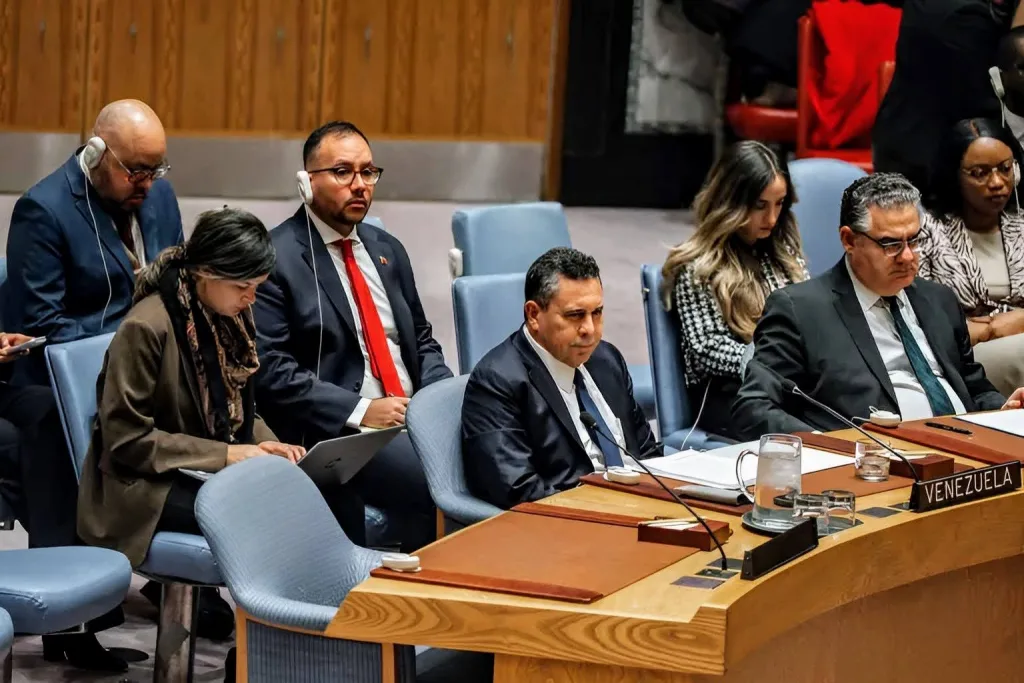
Venezuelan Ambassador to the United Nations in a Security Council meeting on December 23, 2025. Photo: EFE.
Venezuelan Ambassador to the United Nations in a Security Council meeting on December 23, 2025. Photo: EFE.
Caracas (OrinocoTribune.com)—Tuesday, during an emergency United Nations Security Council (UNSC) meeting, Venezuela condemned what it called the “confession of a crime of aggression” by the United States. Ambassador Samuel Moncada detailed US crimes in region, including a declared naval blockade of Venezuela, the theft of four million barrels of Venezuelan oil, and electronic warfare in Venezuelan airspace, all of which constitute violations of international law and threats to peace.
Venezuela noted that on December 16, US President Donald Trump publicly declared the following: “Today, I am ordering a total and complete blockade of all sanctioned oil tankers entering and leaving Venezuela.” Moncada described this as an admission of a “crime of aggression,” with which the US ruler intends to “turn back the clock of history 200 years to establish a colony in Venezuela.” Naval blockades are defined by the United Nations and international law as an act of war.
Ambassador Moncada explained how, on December 10, US military forces violently attacked a legitimate merchant vessel in international waters of the Caribbean, subdued and abducted its crew, and illegally seized a cargo of Venezuelan oil. He described this act as a “robbery carried out by military force,” which sets an “extremely serious precedent for the security of navigation and international trade,” as it constituted and act “worse than piracy.”
Similarly, on December 20, a second incident occurred when another tanker transporting Venezuelan oil was seized by US military forces in international Caribbean waters. The cargo was stolen and the crew kidnapped. Subsequently, US War Secretary Pete Hegseth informed that these types of criminal operations would continue, and President Trump declared that he would keep the stolen oil. Moncada questioned the US government’s right to “seize four million barrels of Venezuelan oil.”
The ambassador noted that naval blockades are a military act and that this blockade aims to establish a state of siege against the Venezuelan nation, degrading its economic and military apparatus, weakening its social and political cohesion, and “provoking internal chaos in order to facilitate aggression by external forces, that is, an armed attack.” Moncada noted that Trump himself is violating the right to existence of the entire Venezuelan people, “deliberately denying them the essential means for their subsistence.”
Moncada also condemned Trump’s November 29th statement that “all airlines should consider the airspace over and around Venezuela as completely closed.” According to the ambassador, this declaration was implemented through an electronic warfare campaign by US military forces in the region. These forces have targeted the navigation instruments of civilian aircraft transiting Venezuelan and Caribbean airspace “in order to provoke a security incident.” These actions nearly caused at least two tragedies involving US passenger aircraft that came within seconds of colliding with US Air Force planes, he said, concluding that the US regime represents a threat to its own citizens, Venezuela, and the entire continent.
The Venezuelan diplomat noted that all these actions, along with unannounced military incursions into Venezuela’s information flight zone, constitute provocations aimed at fabricating an excuse for direct military confrontation by invoking UN Charter Article 51. He warned the world that Venezuela is only the “first target of a larger plan” that seeks to divide and conquer the continent “piece by piece,” a continental ambition expressed in Washington’s recently released National Security Strategy with the restoration of the Monroe Doctrine now accelerated by the “Trump corollary.”
Finally, Ambassador Moncada repudiated this “dangerous manipulation” and assured the world that Venezuela “will not lose its composure in defending the peace of our nation.”
“The threat is not Venezuela,” stated Moncada. “The threat is the United States government.”
Weak response from the US
“The United States will do everything in its power to protect our hemisphere, our borders, and the US people,” responded Washington’s ambassador to the UN, Mike Waltz, repeating the US narrative of an alleged “war on drugs.” However, he offered no explanation regarding the theft of Venezuelan oil and tankers nor regarding the abduction and disappearance of their crews, nor did he address the extrajudicial killings that have claimed the lives of 105 civilians in small boats since September.
Waltz simply repeated that the US will impose “maximum” sanctions on Venezuela and reiterated that Trump has been “very clear” in his intention to use “the full power and force of the US” to confront and eradicate drug cartels despite narcotics trafficking in Venezuela representing only a neglibile proportion of international drug trafficking.
China
The ambassador to the UN of the People’s Republic of China, Sung Lei, urged the US to “immediately” stop its acts of aggression against Venezuela, as they constitute a serious violation of the UN Charter. He called on Washington to respect freedom of navigation in the region, lift unilateral sanctions, and do more to promote peace in Latin America and the Caribbean.
He noted that an increasing number of countries, including those from other regions, have expressed concern and firm condemnation of the acts of war perpetrated by the US.
“China stresses the importance of the recent letter issued by President Maduro. As an independent and sovereign state, Venezuela has the right to independently develop mutually beneficial cooperation with other countries and to defend its legitimate rights and interests,” he added.
Sung emphasized that China opposes all acts of unilateralism and harassment. “We are against the threat and use of force in international relations, as well as against external interference in Venezuela’s internal affairs, and we are against unlawful unilateral sanctions and a jurisdiction that has no basis in international law,” he said.
Russia’s response
Russian Ambassador Vasily Nebenzya also condemned US aggression against Venezuela and expressed his belief that Washington’s “cowboy behavior” intends to erode regional peace by launching military threats on the continent through extrajudicial executions.
“It seems that the White House decided to dust off the old practice of fighting terrorism as a pretext to interfere in the internal affairs of other states, in this case Venezuela,” he said in reference to the US claims that it is prosecuting a “war on drugs.”
Ambassador Nebenzya condemned the statements in which Trump confessed that his plan was to seize Venezuelan oil and in which he claimed, without any basis, that this oil belongs to the US. “We see no point in delving into this matter through pseudo-legal tricks used by the US, which are incompatible with international law,” said Nebenzya. “Today, we see international law being trampled upon. This is about seizing the natural resources of another state by exerting political and military pressure.”
“For several months now, the entire world has had the opportunity to observe the way that the US has been continuing to deliberately foment tensions around the friendly nation of Venezuela under the pretext of combating drug trafficking and the terrorist threat,” added the Russian diplomat. “This artificial smokescreen is concealing the goal of US military groups exerting pressure on an independent state whose policy is not to the liking of Washington.”
Nebenzya emphasized that the US naval blockade against Venezuela constitutes a blatant act of aggression. He also noted that what Washington is doing to Caracas could be done to other Latin American countries.
“Don’t ask for whom the bell tolls — the bell tolls for you,” said Nebenzya. “Washington respects independence only if states tailor their policies to US interests. Otherwise, they will be treated the same way that Venezuela is being treated.”
Other international reactions
Sierra Leone’s ambassador called for preventing an escalation in the Caribbean and near Venezuela and called for maintaining Latin America and the Caribbean as a zone of peace. The Mexican ambassador said that it is imperative to preserve the Latin American and Caribbean region as a space for peaceful coexistence.
The Cuban ambassador condemned the actions of the US as irresponsible, saying, “They seem to have no limits, as they impose the application of the law far from their territory with assault and the appropriation of property.”
Another US extrajudicial killing
Meanwhile, on Monday, the US Southern Command (SOUTHCOM) reported, by way of a social media post, another strike against a “low-profile vessel” in the eastern Pacific, killing one civilian.
“On Dec. 22, under the orders of Secretary of War Pete Hegseth, Joint Task Force Southern Spear conducted a lethal kinetic strike against a low-profile vessel operated by designated terrorist organizations in international waters,” it reported.
SOUTHCOM did not provide details on the exact location of the attack, the alleged criminal organization involved, the name of the victim, or any other relevant piece of information, continuing with its controversial, shadowy operation that has ignited local and international uproar.
With this latest attack, the number of civilian victims assassinated by the US military has reached 105 in 29 strikes since September 2. Despite the US narrative against drugs and Venezuela, the number of attacks and victims in the Eastern Pacific area now surpasses those in the Caribbean Sea. Venezuela does not have territorial access to the Pacific Ocean.
So far, 18 strikes have been launched in the Eastern Pacific vs. 11 in the Caribbean. In total, 54% of the assassinated civilians (57) have been killed in the Eastern Pacific vs. 46% (48) in the Caribbean Sea, according to Orinoco Tribune’s detailed count.
In a contradictory fashion, a video of US Secretary of State Marco Rubio began to go viral on social media networks. This trending video shows Rubio in a state that is being described by many as that of a person who has consumed a great quantity of cocaine.
Special for Orinoco Tribune by staff
OT/JRE/SL