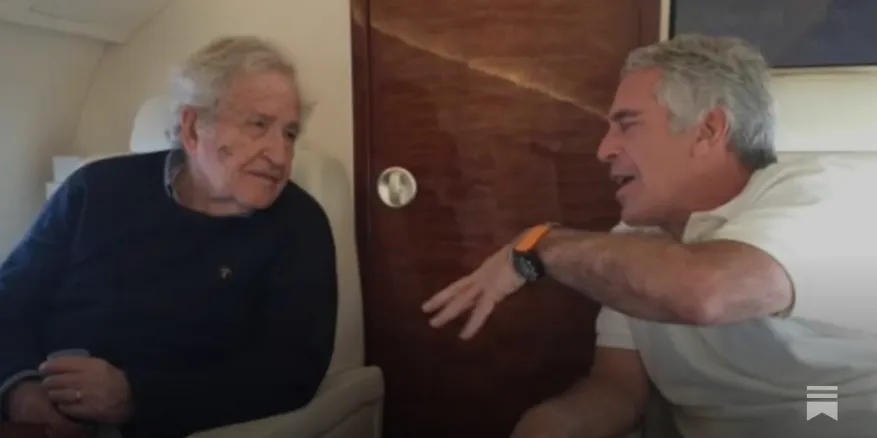
US professor Noam Chomsky pictured on a plane with Jeffrey Epstein. Photo: Epstein Estate/House Oversight/ZUMA Press Wire/Shutterstock.
US professor Noam Chomsky pictured on a plane with Jeffrey Epstein. Photo: Epstein Estate/House Oversight/ZUMA Press Wire/Shutterstock.
By Joe Emersberger – Dec 23, 2025
From bad ideology to disgrace
I discovered Noam Chomsky’s books when I was in my twenties (during the late 1980s) and deeply admired him for decades. The only intellectual I ever admired more than Chomsky was Bertrand Russell, who I discovered at a much younger and more impressionable age.
During the early 2000s, the internet was a shiny new thing, and I was thrilled to join the Znet Sustainer Forum. Forum members could interact directly with Chomsky and other leftist writers. It was one of the many ways Chomsky propped up alternative media, something he had done for decades. Before the internet, Z Magazine was one of the places where I found relief from the suffocating reactionary conformity of the corporate media. Sunday morning political talk shows were especially soul-crushing to watch. Every month I’d look forward to getting Z Magazine in the mail so I could 1) confirm that I wasn’t crazy for being disgusted with establishment news media 2) arm myself with facts and arguments. Needless to say, any alternative news magazine or radio show at the time that featured a contribution by Chomsky would get a big boost.
I noticed that, unlike some writers in the Znet forum, Chomsky did not come off as an arrogant jerk. He was very approachable and generous with his time. Years later, I began interacting with him directly by email and, until about 2011, always agreed with his replies. Later, when we disagreed I never felt belittled or disrespected by him. On the contrary, he was very encouraging of my writing. I should note that a few of Chomsky’s friends, Ed Herman and John Pilger, with whom I never became disillusioned, were similarly pleasant and generous in responding to writers like me who had nothing approaching their stature.
Early warning signs: Haiti
During my time in the Znet forum in the early 2000s I recall Chomsky making a few negative remarks about former Haitian president Jean Bertrand Aristide while Aristide was serving his second term in office.
Aristide’s first term was cut short in 1991 by a U.S.-backed military coup that Chomsky very strongly denounced. Bill Clinton, who Chomsky once referred to in the Znet forum as a “thug”, allowed Aristide to return to Haiti in 1994. Chomsky was scathing in describing the outrageous concessions Clinton had wrung from Aristide: forcing Aristide to accept impunity for the military that had spent three years murdering thousands of his supporters, forcing Aristide to accept that his three years in exile count as time served in office, and forcing Aristide to adopt neoliberal economic policies that were the opposite of Aristide’s winning campaign platform in 1990.
After returning to Haiti in 1994, to a significant extent, Aristide flouted the agreement Clinton imposed on him. Murderers from military junta were prosecuted and the Haitian military abolished. Aristide’s close ally Rene Preval completed a full term as president, then Aristide was elected again in 2000. That same year Aristide’s political allies won a resounding victory in legislative elections.
A U.S.-led vilification campaign against Aristide immediately went into action. Aristide was accused of rigging the elections of 2000 and of arming his supporters to terrorize his opponents. These bogus allegations were repeated not just by the U.S. government and western media but by prominent NGOs like Human Rights Watch, Amnesty International, Christian Aid and Reporters without Borders.
On February 29, 2004 US troops kidnapped Aristide and flew him out of Haiti. He ended up exiled in South Africa for several years as the US made it clear it strongly opposed his return to Haiti. Influenced by Chomsky, and all the NGOs listed above, I had believed there must be significant truth to the allegations against Aristide. Then the 2004 coup happened and I started to doubt what I had casually accepted. The more closely I looked into the allegations, the more I realized they were totally false. Independent researchers Yves Engler and Anthony Fenton quickly produced a short but very effective book that debunked the lies that had facilitated the coup. A few years later, in 2010, Peter Hallward wrote an even more thorough debunking in his book “Damming the Flood: Haiti, Aristide, and the Politics of Containment”. A blurb from Chomsky on the front cover reads “very convincing, a marvellous book”. I totally agree. I thought Chomsky had learned important lessons from the 2004 coup, as I had. I was wrong.
In 2012, when I asked Chomsky if he would add his name to a letter defending Aristide from persecution, he declined. Chomsky said the activists he consulted on Haiti were “uneasy with the depiction of Aristide”. Admittedly, though I agreed to sign, I also had some issues with the letter, but not that it was too flattering of Aristide. After everything that had been done to Haiti and to Aristide since 2004, how could that possibly have been a concern?
I continued admiring Chomsky but concluded he had significant blind spots due to his anarchist ideology. Any government, even one as weak and minimalist as Aristide’s, would always be viewed with suspicion by Chomsky. His fierce denunciations of the US would often be undermined by unfair criticism of governments under U.S. attack. This defect in Chomsky’s thinking was exacerbated by his free speech absolutism.
Nicaragua, Venezuela, free speech absolutism, elite impunity
In his 1989 book Necessary Illusions, Chomsky did a wonderful job documenting the grim details of Ronald Reagan’s terrorist war on Nicaragua. Chomsky described the U.S.-backed Nicaraguan newspaper La Prensa as a propaganda tool of the U.S. as it attacked Nicaragua. He said La Prensa “barely pretended to be a newspaper”. Nevertheless Chomsky insisted that the Nicaraguan government let La Prensa stay open: “Advocates of libertarian values should, nonetheless, insist that Nicaragua break precedent in this area, despite its dire straits…”. In his 1988 book “The Culture of Terrorism” Chomsky also wrote that if “true internal freedom were permitted in Nicaragua, as surely it should be” then its government would bear the huge “burden” of a media terrain dominated by its US-backed enemies, but “none of this implies that the burden should not be borne”.
I’m embarrassed that it took me years to realize what toxic nonsense Chomsky had advocated. La Prensa was helping US-backed terrorists kill Nicaraguans. Chomsky’s free speech absolutism is contradictory and reactionary. Insisting on impunity for La Prensa required ignoring the voices of Nicaraguans that the newspaper silenced forever by getting them killed. Jump ahead to 2021 and La Prensa was still a mouthpiece for US-backed subversives, and Chomsky signed a letter that essentially called on Nicaragua to capitulate to those subversives. The letter also had the audacity to refer to the 1990 election, won by the US-backed candidate thanks to the terrorist war waged on the country, as “free and fair”.
Chomsky’s opposition to libel laws similarly amounts to supporting impunity for the most dangerous (I.e. wealthiest) liars who silence people by using speech to get them killed, driven into hiding, or brought to financial ruin.
In 2007, Venezuela’s government under Hugo Chavez refused to renew the broadcast license of a TV network, RCTV, that had supported a U.S.-backed coup that had succeeded in ousting Chavez for two days in 2002. Chomsky objected to the non-renewal calling it a “tactical mistake”. Remember that at this point, Venezuela had not even shut down RCTV. It was still able to broadcast via satellite,
A reasonable criticism was the opposite of Chomsky’s – that it was a “tactical mistake” on Venezuela’s part not to immediately (not years later) shut down all the TV networks (not just RCTV) that had backed the 2002 coup. However, a concern for any government (unless it is as strong as China or Russia) is western public opinion, especially the opinion of “progressive” elements in the west who might oppose US aggression. A government like Venezuela’s cannot be completely indifferent to how it’s portrayed in the West. Chomsky’s role has been to encourage governments under U.S. attack to be suicidally weak or else face harsh attack from the western left.
In 2011, Chomsky invoked judicial independence and humanitarian grounds to support Venezuelan judge Lourdes Afiuni. She was jailed after letting a businessman who had been jailed for corruption escape Venezuela. Chomsky’s insistence on Venezuela letting a corrupt judge walk did not stop him from, years later, blasting Venezuela’s government for, as he put it “allowing virtually free rein to capital for enrichment”.
On Venezuela, it appears the most reactionary voices ultimately swayed Chomsky the most. During one email exchange with Chomsky, I was shocked that he suggested Boris Muñoz to me as a credible source on Venezuela. In a 2012 article, Muñoz spread a claim that Hugo Chavez’s cancer was a hoax “orchestrated in complicity with the government of Havana”. I explained to Chomsky how damning that was of Muñoz, but I don’t think it sunk in.
At home, Chomsky was similarly contradictory: denouncing elite savagery while also opposing the mildest punishment for the elite. In 1969 Chomsky was so disgusted by glorification of the Vietnam war that he wrote in his book American Power and the New Mandarins “We have to ask ourselves whether what is needed in the United States is dissent – or denazification.”
But in 1969, Chomsky also told MIT that he vehemently opposed Walt Rostow being denied a teaching position. Rostow returned to academia in 1969 after working as National Security Advisor for Presidents Kennedy and Johnson. Chomsky recalled his actions to a sympathetic biographer (Robert Barsky) as follows:
I went to see the President of MIT in 1969 to inform him that we intended to protest publicly if there turned out to be any truth to the rumors then circulating that Walt Rostow (who we regarded as a war criminal) was being denied a position at MIT on political grounds (claims that were hardly plausible and turned out to be utterly false).
In one interview Chomsky said he might have resigned from MIT had Rostow been denied a job. So despite US savagery that prompted Chomsky to call for denazification of the US, he strongly objected to top US Nazis suffering career consequences for their crimes.
Libya, Syria, Ukraine: Chomsky gets worse
In 2011, Chomsky supported the UN Security Council resolution that imposed a no fly zone on Libya but then objected that the resolution was violated by NATO to overthrow Gaddafi’s government. So he objected to the most predictable thing happening as he should have known from his own extensive writing on western duplicity and criminality. Nevertheless he said it would be “rash” to predict the consequences of Gaddafi’s ouster. In fact, Gaddafi’s ouster very predictably led to an ongoing nightmare that western media easily swept under the rug..
In Syria, Obama initiated US support for a dirty war to oust the Assad government that, long after Obama left office, yielded a big victory for the U.S. and Nazi Israel. An Al-Qaada terrorist (who is also a former high ranking member of ISIS) is now the dictator of Syria. In 2016, Chomsky said he didn’t know how Obama’s actions in Syria could have been any better:
And for Syria, … it’s just very hard to think of any recommendations. I mean, I don’t know what Obama could’ve done that’s better [than] what he did do
In 2018 Chomsky signed a letter with numerous other western intellectuals (David Graeber, Judith Butler, David Harvey et al) that called on the US military to bomb Syria in defence of Kurdish anarchists that the authors claimed were the USA’s “leading allies against ISIS in Syria”. The idea that the U.S. was in Syria to fight ISIS was worthy of a rightwing neocon.
It is amazing how controversial it became among western leftists – thanks in no small part to Chomsky’s destructive influence- to defend Assad’s government against what was obviously a joint U.S. and Israeli supported effort to overthrow it.
Today, the situation in Syria is complex as Vanessa Beeley explains. But it’s a chaotic horror show characterized by partition, plunder, and sectarian atrocities that benefits “Israel”.
Chomsky would hit new lows after Russia invaded Ukraine. In a 2022 interview, Chomsky gushed about the “great courage” and “great integrity” of Ukrainian President Zelensky who he called “an honourable person”. Remember that Chomsky could not bring himself to sign a letter defending Aristide in 2012 because he didn’t want to be overly positive about the former Haitian president who was twice overthrown by the U.S. But Zelensky – head of the notoriously corrupt U.S.-backed government that honours Nazi collaborator Stefan Bandera – Chomsky showered with praise.

Chomsky’s Sneaky Zionism
On Palestine, Chomsky’s approach was to win many decent people over with his very detailed analysis of Israeli crimes, but underneath the copious documentation and indignation his position remained Zionist. In a 2014 article for The Nation he advocated the two state delusion, and arrogantly warned Palestinians against pressing for more – even the right of refugees to return to the lands from which they were expelled.
In 2004 Chomsky talked about “the destruction of Israel” like that would be a bad thing:
The call for a “democratic secular state,” which is not taken seriously by the Israeli public or internationally, is an explicit demand for the destruction of Israel, offering nothing to Israelis beyond the hope of a degree of freedom in an eventual Palestinian state.
Given the live-streamed Holocaust in Gaza we’ve been witnessing since Oct 7, 2023 the Zionist nature of Chomsky’s approach has never been so thoroughly discredited. Nazi Israel must be overthrown. Period.
Anti-Stalinism: the original sin of western leftists
It wasn’t until 2023, a few months before the genocide got underway in Gaza that I was willing to say that I no longer respected Chomsky. It took me way too long. Why?
Part of the reason is anti-Marxism. Both Bertrand Russell and Noam Chomsky, the biggest influences on me intellectually for decades, were dismissive of Karl Marx. See this piece by Roderic Day for examples of Chomsky’s dismissiveness towards Marx. It was not until I shrugged off their influence on me that I could undertake a proper study of Marx. It is no accident that prominent western intellectuals tend to be either anti-Marxist or promote a version of Marxism that is compatible with western imperialism. See Gabriel Rockhill’s discussions about that with Nick Estes and Justin Podur. The liberal faction of the western elite has put way more effort than I ever imagined into developing a “compatible left”. Bertrand Russell was part of a CIA-funded anti-Communist front group.
But many of the Marxists I’ve met in my life were also anti-Stalin because they uncritically followed the line the USSR took after Stalin died. I swallowed a consensus that almost everyone from Marxists to every kind of anti-Marxist seemed to take: that Stalin was a great evil and perhaps even comparable to Hitler. As I lost confidence in Chomsky I explored the work of Domenico Losurdo and Michael Parenti who brilliantly refuted that nonsense. It turns out leftists like Chomsky – who can not even defend Jean Bertrand Aristide, Daniel Ortega, Hugo Chavez or Nicolas Maduro – are also not reliable sources on Stalin. Lesson, belatedly, learned.
Vijay Prashad and Noam Chomsky’s The Withdrawal: Book Review
Epstein seduces Chomsky
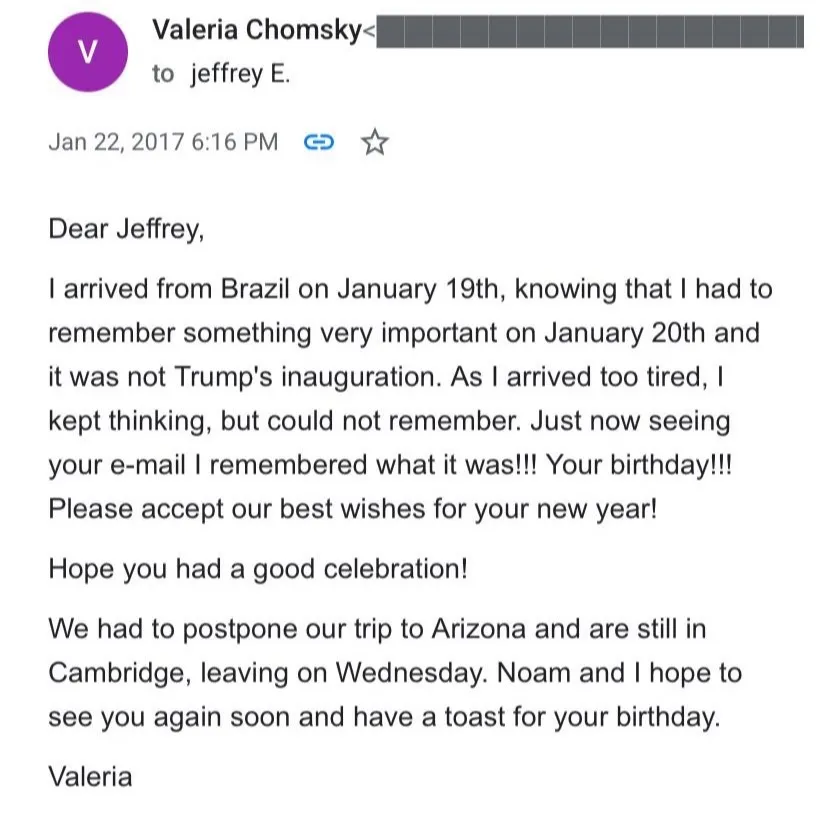
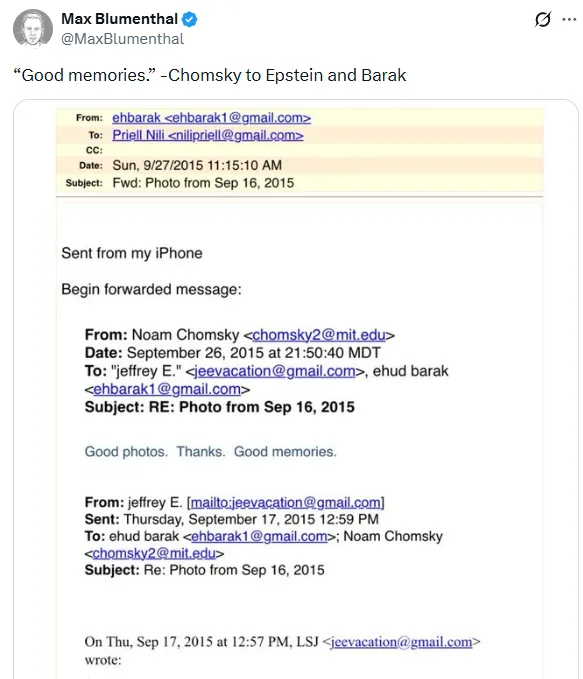
The images shown below speak more eloquently than I ever could about how deeply Chomsky was sucked into Jeffrey Epstein’s world. Are US elites happy to see Chomsky disgraced? The kinds of liberal spooks who cultivate a compatible left are probably not happy.
In her book “The Cultural Cold War”, Frances Stonor Saunders explains that CIA liberals had to keep their activities secret from Republicans who didn’t want any kind of left at all to exist. So I imagine among the US elite reactions are mixed: from displeasure to ambivalence to glee.
As for Chomsky, despite his anti-state rhetoric, his ideology made him comfortable with US power and with Zionism. He was so comfortable he often said things like “It’s a very free country, the United States, maybe the freest in the world”. In the end, he got so comfortable he destroyed his own reputation.


(Substack)
Joe Emersberger is an engineer, writer, and activist based in Canada. His writing, focused on the Western media’s coverage of the Americas, can be found on FAIR.org, CounterPunch.org, TheCanary.co, Telesur English, and ZComm.org.