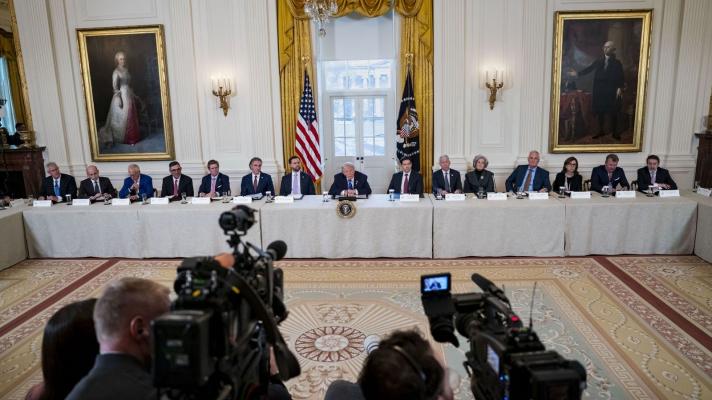
US President Trump's meeting with a group of energy companies from the United States and other countries, including ExxonMobil and Chevron. Photo: EFE.
US President Trump's meeting with a group of energy companies from the United States and other countries, including ExxonMobil and Chevron. Photo: EFE.
From sanctions enforcer, to blockade instigator, to investment broker, Trump plays a dirty game.
A few days ago, Donald Trump held a meeting at the White House with a group of representatives from US, European, and other international oil companies. The focus of the meeting was to discuss “investment opportunities” in Venezuela’s oil sector.
The meeting itself reflects the style and geopolitical agenda of the US president. Although Trump made positive remarks about the current Venezuelan government, no representatives of Venezuela’s government were present. Essentially, Trump personally assumed a role similar to that of a real estate/oil broker, seeking to highlight “achievements” supposedly benefiting “the United States and Venezuela.”
Trump’s maneuvers suggest, however, a longer-term intention to reposition Venezuela as a supplier of raw materials to the Western axis—something that the Venezuelan government has never refused. In reality, Venezuela stopped supplying oil to US and Western companies, and saw its relationship with US and Western companies deteriorate, because of the illegal sanctions imposed on Venezuela’s industries by the US.
One of the most striking anecdotes from the meeting came from Jeff Miller, CEO of Halliburton. When Trump asked why they left Venezuela, Miller replied:
“As a company, we left under the sanctions in 2019. We intended to stay … but when the sanctions came into force, we were asked to leave.”
No formal agreements or binding commitments were announced during the meeting. However, the different positions expressed by the companies suggest a mixed landscape of expectations.
Statements of intent
Trump proposed that companies invest “at least US $100 billion of their own money” (not US taxpayers’ money) to rebuild Venezuela’s oil infrastructure with the goal of rapidly increasing production—possibly within 18 months—and lowering oil prices in the United States to around US $50 per barrel.
Clearly, Trump sees Venezuela as part of his domestic energy strategy: he promised to “bring down” crude prices and has claimed that his administration has delivered “the cheapest gasoline” in the past five years.
ExxonMobil and its CEO Darren Woods described Venezuela as “uninvestable” in its current political and legal condition, citing the need for “significant changes” to commercial, legal, and security frameworks. Woods recalled that his company had already been “affected” by two nationalization processes, in 1975 and 2007.
In a similar tone, a representative of ConocoPhillips expressed concern over legal and commercial risks, without committing to rapid investments. That company also lost assets during the 2007 nationalization.
Mike Wirth, speaking for Chevron, showed interest in a rapid increase in production, as the company currently operates in Venezuela (producing around 45,000 barrels per day). Chevron’s CEO indicated a willingness to invest more, though he did not provide specific figures or firm commitments.
Trump praised the company for having stayed in Venezuela, without mentioning the damage caused to Chevron by his own administration. Chevron had been marketing more than 250,000 barrels per day from Venezuela before Trump himself withdrew the licenses granted under the Biden administration.
Repsol and its CEO Josu Jon Imaz—whose company maintains limited operations in Venezuela—said the firm is “ready to invest heavily” and triple its production within three years. This would mean raising output from the current level of around 45,000 barrels per day.
Other companies—such as Shell and ENI—expressed general interest in increasing investments and production “immediately,” according to US Energy Secretary Chris Wright; again, concrete details were not provided.
Key aspects
Overall, executives praised the “opportunity” offered by Trump, though some injected “a dose of realism” by highlighting security challenges, legal requirements, and “deteriorated infrastructure.”
There is a notable contrast between companies that once operated in Venezuela and now maintain legal claims against the Venezuelan state (ExxonMobil and ConocoPhillips) and Western companies that remain in the country, such as Chevron, Repsol, and ENI. The latter have managed to contimue operating largely because the Venezuelan government has mediated their situation by demanding or negotiating oil licenses with recent US administrations.
Harry Sargeant III of Oil Trading Company attended the meeting, representing a firm that has marketed Venezuelan crude during the sanctions period. It is one of several “smaller companies” that could participate in Venezuela if larger firms do not.
On January 11, Trump said he was “inclined” to leave ExxonMobil out of his plans for Venezuela’s oil sector, accusing the company of “trying to be clever.” This was a response to Woods’ remarks at the meeting.
Another evident element of the gathering is that as an oil portfolio, Trump’s offer is neither truly new nor particularly significant.
Basically, the largest companies at the meeting—the most optimistic ones—are already operating in Venezuela. Others, such as Shell and BP, have engaged with Venezuela in other energy agreements (especially gas), but their activities have been hindered by illegal sanctions and the revocation of licenses.
What exists so far is a reshuffling of the same companies that were already benefiting from Joe Biden’s licensing policy, with the possibility that they may increase their investments. It is also possible that other smaller companies will answer the US president’s call as he acts like a real estate/oil broker.
The investment outlook has other dimensions such as the concession regime that currently favors Chinese companies in many Venezuelan oil fields. Chinese firms face major difficulties investing due to illegal sanctions. Trump has said he will “expel” China from Venezuela and reduce its position, turning it into a buyer of the product instead. Along these lines, he also mentioned Russia as a possible customer for Venezuelan crude “under US commercial control.”
However, control of concessions on the ground still lies with the Venezuelan state, and China would be in a strong position to negotiate with the United States—with Venezuela’s backing—given that it has already managed to persuade Trump in other areas related to raw materials and technologies (chips and critical minerals).
Several US companies may be reluctant to heed Trump’s call, but Chinese companies already operating in Venezuela could contribute enormously to meeting investment targets and increasing the flow of Venezuelan crude to the market, thus aiding Trump’s strategy. At this point, pragmatic negotiations may prevail over Trump’s ideological agenda—though that remains to be seen.
Meanwhile, energy geopolitics and Venezuela’s commercial situation are heading towards a redefinition—away from the distortions created by illegal sanctions—returning to the pre-2019 context, just before Trump himself imposed a total blockade on Venezuela’s oil sector.
US Treasury Secretary Scott Bessent told Reuters that additional US sanctions on Venezuela could soon be lifted to facilitate oil sales. “We are decriminalizing the oil that is going to be sold,” he said.
This would open the door to US traders and customers who, until the end of 2024, had already maintained a relationship with Venezuela via Chevron. Nothing new under the sun.
Such a measure would be clearly consistent with the new “confidence” conditions demanded by companies and with the basic requirements for a business-friendly climate. If sanctions are lifted, it would mark a clear distinction compared to the mere issuance of licenses.
Regarding Venezuelan oil, Washington is retracing its own steps as if it were 2018, but now its strategy is accompanied by heavy pressure, the use of force, and a search for commercial and concessionary advantages for US companies. Yet the objective need for Venezuelan oil has remained intact, just as Venezuela’s governmental structure remains intact following the kidnapping of President Nicolás Maduro.
So far, Trump has chosen to work with the government in Caracas, promoting a new framework for bilateral relations and addressing the critical knots of a partnership that could have always existed—had he not purposefully dismantled it himself in earlier years.
Translation: Orinoco Tribune
OT/CB/SL

Cameron Baillie is an award-winning journalist, editor, and researcher. He won and was shortlisted for awards across Britain and Ireland. He is Editor-in-Chief of New Sociological Perspectives graduate journal and Commissioning Editor at The Student Intifada newsletter. He spent the first half of 2025 living, working, and writing in Ecuador. He does news translation and proofreading work with The Orinoco Tribune.