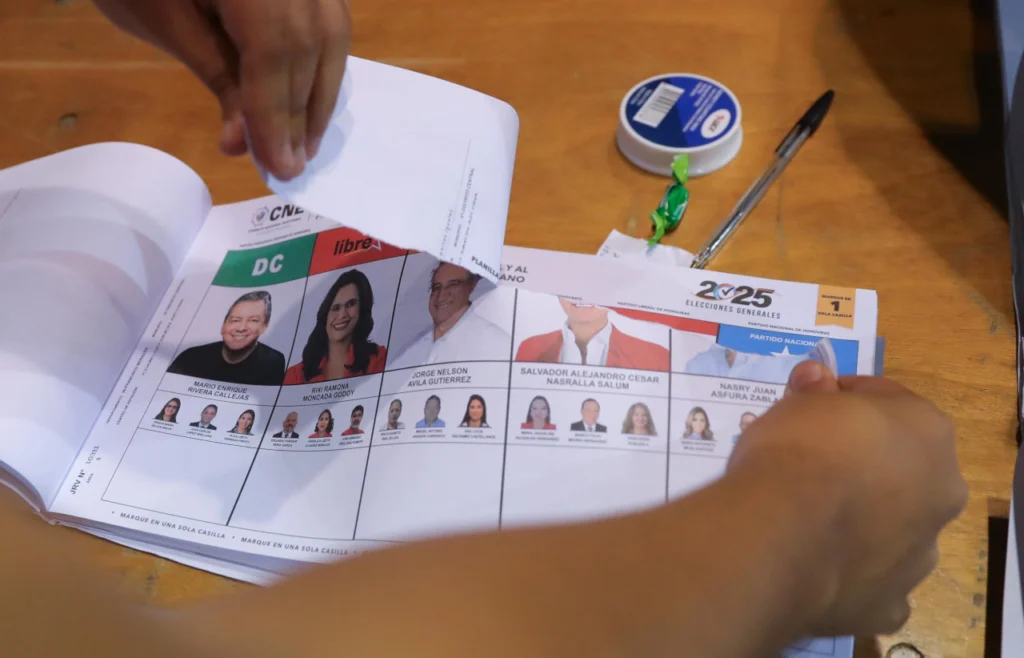
A polling station member tears up unused ballots after the end of voting in Honduras, November 30, 2025. Photo: EFE/Gustavo Amador.
A polling station member tears up unused ballots after the end of voting in Honduras, November 30, 2025. Photo: EFE/Gustavo Amador.
By John Perry – Jan 13, 2025
Donald Trump’s attack on Venezuela and the kidnapping of its head of state have overshadowed his less brazen but possibly more effective regime-change operation in Honduras. No one can be sure if the National Party’s Nasry ‘Tito’ Asfura really won the presidential election on 30 November, but he was Trump’s endorsed candidate and will almost certainly assume office on 27 January.
Since 2021, Honduras has had a left-wing government, headed by the Libre party’s Xiomara Castro. She revitalised a neglected public health service, reduced poverty and curbed gang violence. But presidential power in Honduras is heavily constrained. There is a local story of child being asked who governs the country and replying: ‘The president, the head of the army and the US ambassador.’ Castro’s husband, Manuel Zelaya, elected president in 2005, was ousted in a coup in 2009, led by an army general and with the US embassy’s tacit support.
The left was fraudulently denied power in elections in 2013 and 2017, allowing Juan Orlando Hernández, endorsed by the US, to run Honduras as a narco-state. In 2021, however, Castro’s majority was overwhelming. Unlike Hernández, she has respected the constitutional limit of one term in office.
The Libre candidate, former minister Rixi Moncada, led several opinion polls earlier in the year. When Trump’s ‘armada’ entered the Caribbean in late August, however, Moncada’s two right-wing opponents, Asfura and the Liberal Party’s Salvador Nasralla, claimed that ‘Honduras would be next’ if Moncada, whom they falsely portrayed as a ‘communist,’ became president.
Hondurans’ limited faith in their electoral system was further damaged in late October, with the disclosure of a possible plot to repeat what happened in 2017, when a premature announcement of the US-backed candidate’s victory was immediately endorsed by the US embassy. On 9 November, a trial run of the new electronic voting system partially failed.
For most of November, polls indicated that Moncada’s main challenger was Nasralla, with Asfura trailing a poor third. Four days before the vote, however, Trump denounced not only Moncada but also Nasralla (whom he called a ‘borderline communist’), warning that ‘narcoterrorists’ would run Honduras if either was elected. He then suggested that the US would continue to supply aid to Honduras only if Asfura won. Unverified reports appeared on social media threatening the 1.3 million households which rely on remittances from relatives in the US that their December payments would be blocked if Asfura lost.
Two days before the polls, Trump pardoned Hernández, who had been extradited when his term ended and was serving a 45-year prison sentence for trafficking cocaine to the US while publicly presenting himself as an ally in the ‘war on drugs.’ The pardon could have backfired but instead proved to be an astute boost to Asfura’s campaign, since many of his supporters still idolise Hernández.
By election night, Moncada was trailing in the polls behind both right-wingers. In early voting returns, Nasralla had the advantage over Asfura. There was a break in announcing the results. When the count resumed, Asfura had taken the lead. Trump stepped in again, accusing officials of trying to change the outcome and warning of ‘hell to pay’ if the numbers changed in Nasralla’s favour.
Interruptions and delays in the count stretched over days and then weeks. When Libre claimed that an ‘electoral coup’ was taking place, its representative on the electoral council was sidelined by the other two parties and then personally sanctioned by Washington. The election result was eventually declared more than three weeks later, on 24 December, as Hondurans were celebrating Christmas. Asfura was declared the winner by fewer than 27,000 votes. The army gave its backing to the electoral council’s decision.
Up to 130,000 votes, however, were still to be counted: enough to change the outcome of the election. The Honduran Congress met a few days ago and instructed the electoral council to carry out a complete recount, threatening to do the job itself if necessary. Before it met, a homemade bomb was thrown at a National Party lawmaker, injuring her as she entered the congressional building. The US embassy has threatened ‘grave consequences’ if Asfura’s victory is overturned.
Electoral observers from the Organisation of American States and the European Union disapproved of the delays but found no evidence of fraud. On Trump’s interference they were silent. Xiomara Castro has written to the US president requesting a meeting to discuss what happened. It seems unlikely that she will get one.

John Perry is a writer based in Masaya, Nicaragua whose work has appeared in the Nation, the London Review of Books, and many other publications.