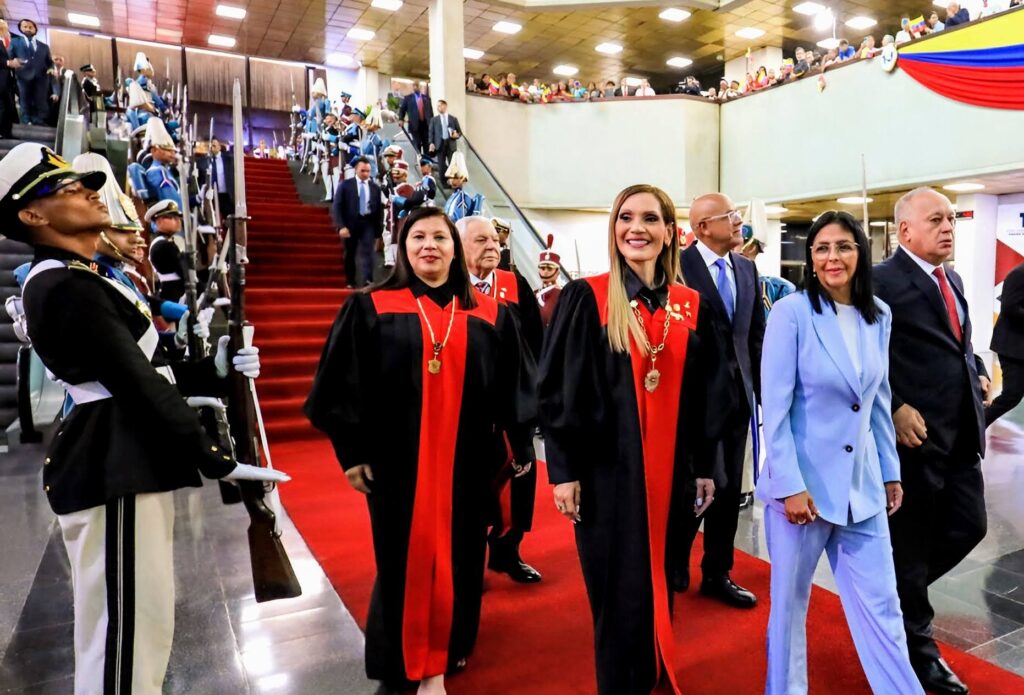
Venezuelan Acting President Delcy Rodríguez, next to the Supreme Court president, Justice Caryslia Rodríguez, and Interior Minister Diosdado Cabello during a judicial ceremony in Caracas on Friday, January 30, 2026. Photo: Venezuelan Presidential Press.
By Andreína Chávez Alava – Apr 23, 2026
Venezuela is facing one of its most challenging periods in history. The country does not directly control its oil revenue, which is held in the US Treasury. This is similar to how Washington has controlled Iraq’s oil revenue since the 2003 military invasion, effectively using it as leverage to influence Iraqi politics and international relations.
In Venezuela’s case, the oil grab followed the US military bombardment and the abduction of President Nicolás Maduro on January 3, creating an unprecedented constitutional challenge regarding governance. Acting President Delcy Rodríguez has guided the nation through this period, balancing new US-Venezuela relations and managing Washington’s neocolonial expectations, while trying to defend sovereignty and peace.
Rodríguez has also committed to ensuring that the incomplete oil revenue Washington disburses ($500 million released in January, although sales reportedly surpassed $1 billion by mid-February) goes to funds destined for social investment, after over a decade of economic hardship caused by US sanctions.
The consensus among the population, government leadership, moderate opposition, business sectors, and analysts across the political spectrum is that the economy is paramount before opening the debate on new presidential elections. For the far-right opposition, the priority is to deny Rodríguez’s constitutional mandate and call for elections before the country has any real chance of improving its economy.
The truth is that Venezuela does not have the capacity to engage in a vote that does not guarantee economic or political stability.
Will Rodríguez finish Maduro’s term?
Following President Maduro’s abduction, Rodríguez, as the vice president, was appointed by the Supreme Court’s Constitutional Chamber to assume the executive for an undetermined period. The decision aimed to ensure administrative continuity and national defense. The ruling was grounded in a teleological interpretation, understood as adapting the law to the current context rather than just its literal text, of Articles 234 and 239.8 of the Constitution.
Article 234 refers to temporary absence, which must be requested by the president through the National Assembly (AN). If approved, it would last for 90 days and be renewable once. Article 239.8 specifies that, in such cases, only the vice president can serve as acting president.
The Supreme Court has interpreted Article 234 by concluding that the events of January 3 were an “exceptional and atypical situation.” As a result, President Maduro’s kidnapping during a foreign military intervention that violated international law led to his “forced absence” and a “material and temporary impossibility” to carry out his functions.
Venezuela’s charter does not contemplate how to respond to a war-like scenario of this kind. Consequently, the Supreme Court of Justice (TSJ) cannot yet provide a definitive legal classification of the presidential vacancy, whether absolute or temporary, in line with Articles 233 and 234, respectively. It also cannot determine whether elections should be called without undermining the country’s stability, as it confronts and adapts to a new reality in which US interference is difficult to avoid.
Can the TSJ interpret the constitutional text to classify President Maduro’s vacancy as “forced” and prevent a power vacuum by means of ensuring continuity through Rodríguez? The answer is yes. Article 335 grants the Supreme Court the highest authority to interpret the Constitution and adapt its application to preserve constitutional order.
Notably, the TSJ ruling did not say that Rodríguez would hold office for 90 days, which would have ended on April 3, nor did it state that this period would be extended until July 3. Rodríguez’s mandate has no expiration date. The high court could modify its ruling in the future. However, as of now, there is no legal basis to declare an absolute vacancy and hold presidential elections within 30 days or at any point in the foreseeable future.
As per Article 233, the absolute vacancy in the presidential office only responds to very specific causes: the president’s voluntary resignation, death or mental or physical incapacity, an impeachment process by the Supreme Court, or by decision of the National Assembly after a temporary absence continues unexplained for more than 90 days. None of these scenarios applies to the current situation.
According to constitutional scholar and elections expert Olga Álvarez, President Maduro’s kidnapping also constitutes an international crime. Treating it as grounds for declaring an absolute vacancy would therefore legitimize the crime and set a dangerous precedent for Venezuela by allowing foreign intervention to affect the constitutional letter.
“Under no circumstances—not even in a new constitutional process—can we consider the kidnapping of a president to be a cause to declare absolute absence. The grounds for that are based only on natural causes or constitutional safeguards within domestic law,” said Álvarez.
Does this mean that Venezuela will not hold elections before 2031, when Maduro’s term ends? It does not look probable. An electoral process is not ruled out, but it would depend on a future, more definite TSJ ruling regarding the extent of Rodríguez’s mandate and, more importantly, the country’s economic progress, as negotiations with the US alleviate sanctions (although through temporary licenses) and Caracas is reinserted in the global financial system.
“It’s the economy, stupid”
In a recent interview with an international outlet, National Assembly president Jorge Rodríguez offered a window into the steps being taken to guarantee that future elections occur in a context of economic stability, dialogue with all opposition sectors—including those living abroad—, within the bounds of the Constitution, and establishing an electoral authority that everyone can trust.
“I could not tell you exactly when or even what the first election will be, because who knows if we will dive right in and start with the National Assembly and then the presidency, or the other way around, or all at once,” Rodríguez told the reporter. This statement makes it very clear that the government knows that elections will be crucial for strengthening the country’s democratic and constitutional order. Still, it will be a carefully planned and people-led decision, rather than rushed by the far-right to use US military invasion threats as leverage.
The parliament head invoked Bill Clinton’s 1992 campaign phrase, “It’s the economy, stupid,” to stress his point. The country has to focus on economic solutions and relief for the working class before a viable electoral process is possible, especially given that elections in Venezuela have historically led to destabilization by opposition factions.
For the anti-Chavista opposition, the longer the wait, the riskier it becomes that the Rodríguez administration will demonstrate it can negotiate effectively with the US and ensure that oil revenue disbursed by Washington is ultimately funnelled into the people’s well-being, even if the neocolonial arrangement is disgraceful. After all, in 12 long years of crippling economic sanctions, Caracas managed to gradually revive the economy, ensure food sovereignty, rebuild crucial infrastructure, manufacture parts it used to import, and revitalize the popular movement. It would make sense that current authorities could also navigate this moment for the country’s benefit.
Acting President Rodríguez has pledged to prioritize the economy. In her speech to mark 100 days of her mandate, she announced that the country’s gross domestic product (GDP) had grown by almost 9 per cent, marking 20 consecutive quarters of expansion. This follows a collapse of around 80% due to a sharp drop in global oil prices at the end of 2014, followed by US sanctions and hyperinflation. The economy only returned to growth in the second quarter of 2021, primarily driven by oil sales to China at large discounts, since intermediaries were needed to circumvent US coercive measures.
“This growth is intended to translate into social well-being, more jobs, better incomes, and real opportunities for the Venezuelan people,” Rodríguez said.
The acting president went on to add that Venezuela currently produces 1.1 million barrels of oil per day (bpd), according to state-run oil company PDVSA. OPEC secondary sources, however, place March’s output at 988,000 bpd. She also noted that the country is taking steps towards gas exports. The aim is to continue recovering the level of oil production before US sanctions crippled the country’s main source of revenue.
Between February and March, the US Office of Foreign Assets Control (OFAC) issued General Licences (GLs) 46B, 50A and 52, authorizing US entities to produce, lift, sell, and export Venezuelan oil and petrochemical products. In April, licences 55, 56, and 57 were granted, permitting negotiations and contracts for investments in the mineral sector, as well as other commercial negotiations and specific transactions involving the Central Bank (BCV) and three other state-run banks. This means that Caracas has returned to the US dollar-dominated international financial system, albeit temporarily.
By facilitating access to foreign currency, Venezuela could stabilize the local exchange rate and improve liquidity. It would also make remittances (a key source of income for Venezuelans) cheaper by enabling more direct and less expensive transfers.
The International Monetary Fund (IMF) and the World Bank have also just resumed dealings with Caracas. This will allow the Venezuelan state to access $5 billion in Special Drawing Rights (SDRs) that have been frozen since 2019, when the IMF stopped recognizing the Maduro government after the US threw its weight behind the opposition “interim government” led by Juan Guaidó. As Caracas regains recognition, it might also seek to recover other assets abroad, including around $4.8 billion in gold held by the Bank of England since 2019.
In a speech on April 19, Acting President Rodríguez stated that “the country is opening its doors to the world, certain of its ability to advance without ever renouncing sovereignty over its resources.” The goal is to achieve economic stability and repay the social debt to the people after enduring a US-induced crisis, rather than surrendering sovereignty “on a silver platter” for the exclusive benefit of the US.
From April 19 to May 1, Rodríguez will undertake a nationwide pilgrimage to raise awareness of the impact of US sanctions and foster national unity. The aim is to build a national consensus in favour of lifting all sanctions, emphasising that OFAC licences provide only temporary solutions while hindering long-term foreign investment and economic recovery.
In short, these OFAC licences are insufficient and are not a gift. Through diplomacy, Caracas is pursuing the complete removal of US sanctions, presenting itself as a direct negotiator with US officials and demonstrating national unity.
The country cannot hold elections while the US retains the leverage to influence the electorate by cutting off access to oil revenue illegally held in the US Treasury, because doing so would deny people real choice—just as sanctions have done in past electoral cycles and in countries worldwide under US regime-change measures.
A stable electoral process where political inclusion and respect can coexist will be achieved through real economic solutions and by strengthening the country’s response to the US.
The far-right mess and its bid for elections
In recent days, Venezuela’s far-right opposition, led by María Corina Machado, has launched a media campaign demanding that Washington impose presidential elections as quickly as possible. They argue that President Maduro’s abduction qualifies as “absolute vacancy” under Article 233, disregarding the TSJ ruling that explicitly says it does not.
Speaking to Reuters, Machado explained that she intends to urge the Trump administration to accelerate plans for “free and fair elections,” for which she would return to the country before the end of 2026, warning that Venezuela was on the brink of “anarchy.” This statement hides several lies and contradictions.
The concept of “free and fair elections” is an illusion in a country that has been under US sanctions for years, creating harsh economic conditions to influence voters, incite mass migration, and diminish the government’s popularity. This is why economic stability is key. Furthermore, electoral processes have been marked by far-right boycotts and post-electoral coup attempts, as it happened in 2013 (after Hugo Chávez’s death), 2018, and 2024.
Machado’s call for elections is a glaring contradiction after announcing to the world that her candidate, Edmundo González, had won the July 2024 elections, revealing the fragility of the victory claim. Machado refused to provide the Supreme Court with evidence of this alleged landslide victory during the electoral result review. Interestingly, she never said that González would return to Venezuela, only that she would.
Why is Machado so insistent on holding elections as soon as possible? For the far-right camp, this is a matter of survival. It has been fading into irrelevance due to its lack of a strong popular base in Venezuela. Machado, who fled Venezuela in December after failing to challenge the outcome of the presidential elections, led a large rally in Madrid on April 19 with Venezuelan migrants alongside Spain’s People’s Party (PP) and the far-right Vox party. The rally saw the crowd chant racist slurs targeting Acting President Rodríguez. Machado urged the crowd to return to Venezuela, acknowledging them as her remaining base of support—a perfect example of what kind of government she would have.
The far-right hopes that Washington will force elections and use its leverage over oil revenue to hijack people’s decisions. However, regardless of how much Machado continues to court the Trump administration for more intervention, Venezuela is continuing along its constitutional path with a clear, mapped-out trajectory: improving the economy and defending sovereignty.
Venezuela wants peaceful elections and economic stability, with inclusion for all sectors of society. There is a consensus on this among government officials, moderate opposition groups, and the grassroots. It is the Venezuelan people, not far-right ambitions, who set the agenda.
Andreína Chávez Alava is a Caracas-based Venezuelan journalist with over a decade of experience reporting on Venezuela's political landscape and its stance against US intervention. She has contributed to anti-imperialist narratives while working and colaborating with news outlets like Telesur, Venezuelanalysis, and Orinoco Tribune.