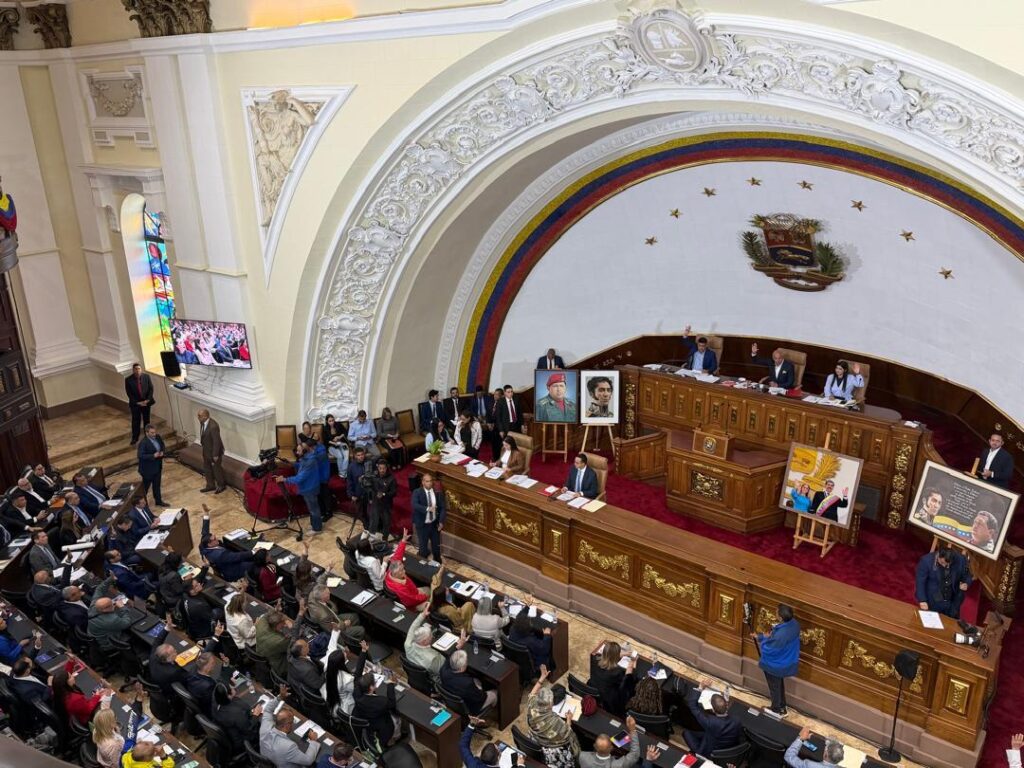
Venezuelan National Assembly debates the Hydrocarbons Law reform bill, January 22, 2026. Photo: X/@Asamblea_Ven.
Venezuelan National Assembly debates the Hydrocarbons Law reform bill, January 22, 2026. Photo: X/@Asamblea_Ven.
The National Assembly of Venezuela approved the 2026–2027 Legislative Plan and the Partial Reform Bill of the Organic Law of Hydrocarbons in first discussion.
During the plenary session on Thursday, January 22, the president of the National Assembly, Jorge Rodríguez, underscored the need to adapt the legal framework to current economic realities. He emphasized that the new legislative plan will prioritize laws that protect citizens’ income and ensure price stability amid market fluctuations.
Deputy Orlando Camacho, chairperson of the Standing Committee on Energy and Oil, presented the statement of purpose for the hydrocarbons bill, noting that the regulations in place since 2006 require updating in light of the “accelerated energy transition” and high global competitiveness.
#ENVIVO | Diputado Orlando Camacho: “Este proyecto de reforma es un paso audaz hacía la modernización del sector energético” pic.twitter.com/MKsCEmMoyX
— teleSUR TV (@teleSURtv) January 22, 2026
The reform introduces a structural change by formalizing Productive Participation Contracts (PPCs). Under this model, operating companies assume full responsibility for project management at their own risk and expense, which allows operational activity to be streamlined without the state incurring debt or direct financial obligations.
The PPC mechanism enabled the country to reach a production of 1.2 million barrels per day in 2025 and attract nearly $900 million in investments, as recently detailed by Acting President Delcy Rodríguez.
With regard to expanding production, the reform includes specific incentives for “green fields,” that is, unexplored deposits. Since these deposits require massive capital investments to begin exploration, flexibility in the tax regime and royalty payments has been proposed, seeking an economic balance that would be attractive to national and international investors.
Similarly, the legislative proposal places particular emphasis on strengthening legal certainty within the energy sector. To this end, the possibility of resorting to independent mediation mechanisms for dispute resolution has been incorporated, ensuring a predictable and fair investment environment, always in strict compliance with the principles established in the Constitution of the Bolivarian Republic of Venezuela.
Finally, this new reform seeks to formulate a strategic alliance between the public and private sectors. The central objective is to achieve an increase in crude oil production, recognizing that joint efforts by both sectors are the most efficient way to modernize the industry and ensure that oil continues to be the primary engine of the nation’s economic development.
Venezuela To Launch Website for Public Monitoring of Oil and Mining Revenues
Sovereignty and economic recovery
Deputy Jesús Faría emphasized that this reform responds to the successful practices already evaluated under the Anti-Blockade Law, aimed at consolidating national independence and recovering the country’s principal industry.
The approval of the reform, however, is only the first stage. The project will now advance to the phase of consultation and second discussion for final enactment, with the aim of strengthening oil as an engine of economic development by the end of 2026.
Amid threats from the United States, which has expressed its intention to seize Venezuelan oil, the Venezuelan government has reaffirmed that the country’s energy wealth belongs exclusively to its people.
The legal reform acts as a shield against the blockade, allowing Venezuela to maintain its 19-quarter streak of sustained growth and an 8.5% growth in its gross domestic product (GDP).
The government of Venezuela “is here to guarantee the happiness of our people; we are here to safeguard our territorial integrity, our sovereignty, our freedom, and our independence,” said Delcy Rodríguez during a social outreach event at the Hugo Salas Socialist Mission Base in La Vega parish of Caracas, the Venezuelan capital.
During Thursday’s plenary session of the parliament, the Draft Bill on the Protection of Socioeconomic Rights was also approved in first discussion. It is part of the government’s 12 legislative proposals, and its main objective is to protect workers’ wages.
In addition, the Organic Bill for the Acceleration and Optimization of Administrative Procedures and Formalities of the Public Administration was approved by a qualified majority in its first discussion.
(Telesur)
Translation: Orinoco Tribune
OT/SC/SH