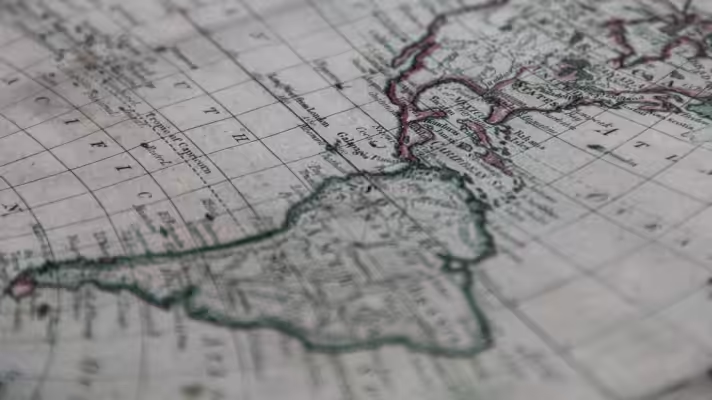
Map of Latin America. Photo: Leon Overweel.
Map of Latin America. Photo: Leon Overweel.
By Misión Verdad – Jan 26, 2026
January 3 marked a breaking point in the recent political history of Latin America. The military action carried out by the United States against Venezuela was a large-scale operation with dense doctrinal content and inaugurating a new phase of open intervention in the region.
This event starkly exposes a shared responsibility: the passivity of Latin American governments, the absence of a common strategic vision, and the inability to build effective consensus to deter illegal actions of this nature.
Countries that today condemn the aggression—such as Brazil, Chile, and Uruguay—have chosen silence, ambiguity, or political distance for years, relinquishing any defense of the principle of regional sovereignty.
Regional fragmentation
The fragility of the regional framework had already become evident in 2023 during the South American Presidents’ Summit, convened by Brazil.
At that event, which initially seemed promising, President Nicolás Maduro issued an explicit call to move beyond sterile ideological disputes and advance toward real mechanisms of integration grounded in a state-centered and long-term vision.
“Let us set aside this ideologization and take steps forward, with a vision of statecraft and responsibility, so that this initiative… becomes the beginning of a new stage—hopefully one of true unity,” said President Maduro at the time, clearly anticipating the risks of a fragmented region facing external pressure.
That suggestion, however, collided with a political reality marked by ambiguity and timidity.
While Brazilian President Luiz Inácio Lula da Silva oscillated between gestures of rapprochement and statements that downplayed the nature of Venezuela’s political system, he stated:
“Our region has allowed ideologies to divide us and interrupt efforts at integration,” said Lula. “We have abandoned our channels of dialogue and existing mechanisms of cooperation. As a consequence, we have all lost.”
Others, such as Gabriel Boric of Chile, opted for public disagreements that were more infantile than strategic.
“I respectfully expressed that I had a disagreement with what President Lula said yesterday, in the sense that the human rights situation in Venezuela was a narrative construction,” Boric said during the meeting.
These positions—detached from an understanding of the geopolitical chessboard—ultimately revealed the lack of preparation of certain leaderships to confront global-scale power dynamics. The result was incomplete, declarative, and fragile integration, incapable of providing effective backing in critical moments such as those that unfolded during the first year of the Trump administration.
The same logic was reproduced in the broader multilateral arena.
Brazil’s decision to veto Venezuela’s entry into the BRICS was a strategic error of far-reaching consequences, aggravated by the way it was executed.
Lula, unable to travel to Kazan for health reasons following a domestic accident that led to his hospitalization, could not personally assume the political cost of the decision and was forced to delegate the operation to his technical and diplomatic team.
From that position, the Brazilian government blocked Caracas’s inclusion in BRICS. The argument was previewed by Brasil’s special advisor for international affairs, Celso Amorim, who told CNN that the BRICS “needs countries that can contribute,” a direct and explicit reference to Venezuela, ignoring the country’s economic and commercial constraints under sanctions and blockade.
Brazil chose to prioritize a narrow reading aligned with Western balances rather than closing ranks with its resource-rich neighbor.
This action signaled regional disengagement that weakened Latin American cohesion and facilitated the subsequent advance of the US strategy, as it sent a signal of regional vulnerability that Washington quickly capitalized on.
Reactions on the day of the attack
On the day of the attack, Latin American governments’ reactions revealed a wide spectrum of positions:
Mexico: President Claudia Sheinbaum “strongly” condemned the US attack, noting that it violated the UN Charter and urging the UN to “act immediately” to preserve peace.
Honduras: President Xiomara Castro referred to the operation as a “military aggression” and described the abduction of the president and first lady as an affront to the sovereignty of Latin American peoples.
Cuba: Miguel Díaz-Canel labeled the attack “criminal” and called for an urgent response from the international community. Like those of Mexico and Honduras, his statement was direct.
Argentina: President Javier Milei celebrated the attack, calling it “excellent news for the free world,” showing explicit alignment with the Trump administration.
Chile: Newly elected José Antonio Kast described the attack as “great news for the region” and emphasized the need to coordinate the safe return of Venezuelans.
Ecuador: President Daniel Noboa limited himself to saying that “all narco-Chavista criminals eventually get what’s coming to them,” framing the attack within a domestic anti-Chavista narrative without acknowledging its illegality or the violation of sovereignty.
Peru: President José Jerí welcomed a “new era of democracy and freedom” in Venezuela and announced measures to facilitate the return of Venezuelan migrants.
It took a full 20 days after the aggression for President Lula, markedly out of sync, to publicly express his indignation over the US intervention in Venezuela and the abduction of President Nicolás Maduro and First Lady Cilia Flores.
Taken together, these statements showed a mix of rhetorical acrobatics, functional neutrality, outright rejection, or explicit alignment with the Trump administration—highlighting the inability of several governments to adopt a firm, cohesive regional stance in defense of sovereignty against US aggression.
The ‘Trump Corollary’ in a fragmented continent
Exactly one month after the publication of the 2025 National Security Strategy (NSS), the United States carried out its first major military action in the Americas.
The January 3 attack was the operational debut of a doctrine formally announced and politically embraced by the Trump administration—a direct translation of a strategic framework into practice, sending an unmistakable signal to the continent about a new phase in the exercise of US power.
The NSS explicitly redefined US security and foreign policy priorities. It formalized the Trump Corollary to the Monroe Doctrine and justified the alignment of military, economic, and coercive instruments to neutralize “threats,” displacing international law as a regulatory framework.
In this new scheme, the classical notion of state sovereignty is replaced by a functional sovereignty, measured by the degree of alignment with Washington’s strategic priorities.
Thus, an asymmetric and conditional sovereignty is introduced in which the United States reserves for itself the status of the only fully sovereign subject in the continent, while the rest of the nations are treated as derivative, subordinate, and revocable sovereignties.
Colombian President Gustavo Petro spoke directly to this reality: “I know perfectly well that what Donald Trump has done is abhorrent. They have destroyed the rule of law at the global level. They have urinated bloodily on the sacred sovereignty of all of Latin America and the Caribbean.”
In practice, each state’s validity becomes subject to technical assessments of risk, governability, and geopolitical utility.
The text itself states that the destiny of the hemisphere must be controlled exclusively by the US and thus must exclude both extra-hemispheric powers and multilateral institutions. This formulation turns the continent into an expanded zone of strategic jurisdiction.
Within this framework, the attack on Venezuela functioned as a founding act of this new doctrinal phase—a show of force aimed even at gauging regional reactions.
That this debut occurred in a fragmented continent, without effective mechanisms of collective defense and with governments unable to articulate a common response, was no accident. The political balkanization of Latin America—born of short-sighted decisions and inward-looking readings—created the ideal scenario for this strategy to be applied without immediate regional costs.
Conclusion
What happened sets a precedent that redefines the rules of the Latin American game and exposes the accumulated cost of regional fragmentation.
It is a continent marked by governments that failed to grant due historical and strategic importance to the schemes of integration and cooperation repeatedly proposed by Venezuela—conceived not as ideological alignments but as mechanisms of collective protection against external aggression.
As with Gaza, the condemnation by regional leaders arrives late, when the damage has already been done, and the precedent established.
History repeats itself: only after open aggression does indignation emerge—an indignation that could earlier have been translated into political and diplomatic containment.
“Surely unity is what we lack to complete the work of our regeneration,” Simón Bolívar once said. 200 years later, his words still carry a tragic truth.
US Militarization of Latin America is Expanding at Breakneck Speed
Translation: Orinoco Tribune
OT/CB/SLUs

Cameron Baillie is an award-winning journalist, editor, and researcher. He won and was shortlisted for awards across Britain and Ireland. He is Editor-in-Chief of New Sociological Perspectives graduate journal and Commissioning Editor at The Student Intifada newsletter. He spent the first half of 2025 living, working, and writing in Ecuador. He does news translation and proofreading work with The Orinoco Tribune.