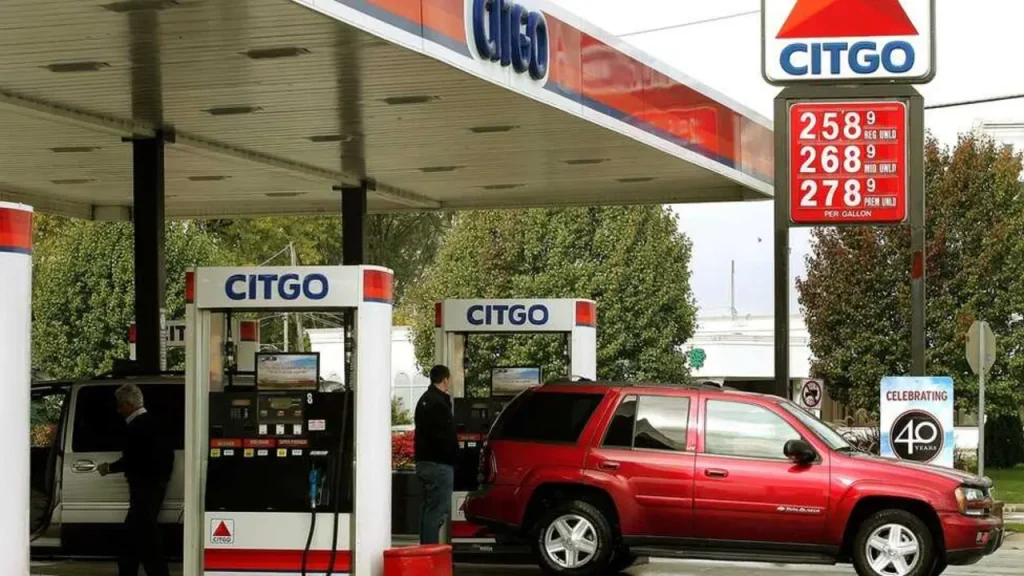
A CITGO gas station on October 24, 2005, in Niles, Illinois. Photo: Pete Stocco/Getty Images/file photo.
A CITGO gas station on October 24, 2005, in Niles, Illinois. Photo: Pete Stocco/Getty Images/file photo.
By William Serafino – Jan 23, 2026
A few days ago, a viral video was posted on the White House TikTok account which showed President Donald Trump walking and making his typical unpleasant gestures while the screen becomes saturated—until it is completely covered—with reports of gasoline prices at less than US $3/gallon in several states and cities across the US.
The post, tailored to the Republican president’s narcissism, was accompanied by the globally renowned song “Gasolina” by Daddy Yankee, a musical icon of Latin culture who symbolizes reggaeton’s resounding global impact in the first decade of this century. Hence, the inevitable success of this post on social media.
The goal of stabilizing gasoline prices below US $3 has been intensely pursued by Trump since his return to the White House in 2024. It was one of his most important campaign promises, making that price ceiling a general barometer of the US public’s assessment of the economic performance of his second term.
Unable to control the inflation curve as he would like, curb the rise in health insurance costs, or contain a string of electoral victories for the Democratic Party—driven by pressure on the cost of living for the average US citizen—Trump is waging that lowered fuel prices can overcome the arduous challenge of the November midterms.
Disapproval of the Republican’s economic management continues to rise, dangerously reaching 50% in public opinion polls, foreshadowing what could be an electoral cataclysm.
The anxiety to project economic strength led the White House last October to celebrate as a resounding success the drop in the average price of gasoline to US $2.98 a gallon. A few cents makes all the difference for a government that is prioritizing power, both domestically and internationally, over its ability to manage risk and control consequences.
Dilemmas, decisions, costs
In terms of energy, the US is a colossus that emerged a few years ago with the peculiar condition of producing less than it needs to function internally.
The world’s largest producer and largest consumer of crude oil coexist in a single country, creating a strategic imbalance between the country’s (new) export role and its dependence on external supplies for its refineries. This imbalance has created a paradox where there is no middle ground between losers and winners.
Higher global crude oil prices mean greater incentive for the productive capacities of the fracking industry, but at the same time, they imply higher costs for crude oil imports that are passed on to the final value of gasoline.
On the other hand, US oil is mostly light and is not compatible with refineries designed to process heavy crude like that from Venezuela, Mexico, Canada, and West Asian countries.
In the hydrocarbon sector, the premise that abundance is synonymous with self-sufficiency does not hold true in the United States. Trump has linked the military attack against Venezuela on Jan. 3 to the broader objective of reducing the price of gasoline and crude oil in general, directing his post-bombing coercive advantage to bolster the Venezuela’s oil production with large flows of US investment, to the benefit of US energy requirements.
Many energy firms and experts doubt that Venezuelan oil, whose production is not expected to increase significantly in the short term, will have a decisive impact on gasoline prices. Fuel costs have already been decreasing since November, currently standing at 20% below last year’s prices, a trend that has not been altered by the military intervention.
However, more barrels produced from the Venezuelan’s oil fields, which would feed the refineries on the Gulf Coast of Mexico, thirsty for Venezuelan heavy crude after years of suffocating sanctions from the US government, is undoubtedly an incentive for Trump’s goal of keeping global oil prices around US $50 a barrel.
From Texas, part of the Permian Basin responsible for half of the crude oil produced in the US (about 6 million barrels per day), oil operators have highlighted concerns that a reduction in profits will prevent them from covering costs, sustaining jobs, and expanding drilling activity, with the danger of structurally affecting the economy of the southern state.
Steering-wheel turn
With a break-even point of between 62-70% to operate, a barrel at US $50 condemns the fracking industry to reduced production in order to optimize capital. “Dale mas gasolina” (“give me more gasoline”) has tactically replaced “Drill, baby, drill,” the slogan of the drilling expansion campaign that Trump promised to carry out in order to increase US oil production.
On the other hand, increased Venezuelan oil production does not solve the bottleneck on the strategic West Coast, where approximately 30% of US oil demand is concentrated.
The geological challenge of the Rocky Mountains has prevented the region from fully integrating into the Permian Basin oil boom, reinforcing its dependence on imported crude oil.
The West Coast, ironically, has become an isolated and dependent enclave within a country that produces more than 13 million barrels of oil per day. In states such as California, gasoline prices have not fallen enough for Trump to claim a national economic victory. There, prices continue to resist dropping to the level the Republican desires.
Trump’s short-term calculation looks risky, as it strains relations with his oligarchic donors in the energy sector and depresses the growth prospects of the Permian Basin, which already shows signs of exhaustion and slowdown solid enough to speak of a decline on the horizon of US energy dominance.
The armed assault on Venezuela starkly reveals the violent way in which an energy giant with feet of clay exports the irresolvable contradictions that lie within its borders. In an attempt to alleviate the structural pressure exerted on its domestic economy and politics, the strategy of colonizing the sovereign resources of other countries has reappeared as a temporary emergency measure.
The political consequences of “dale mas gasolina” are also complex, since Trump has invested a good part of the potential return of his only economic achievement in a stable Venezuela governed by Chavismo, a bitter pill that the neoconservative architects of regime change, with Marco Rubio at the helm, will hardly accept as an irreversible reality.

William Serafino in a Venezuelan political scientist, graduate of the Central University of Venezuela (UCV). Researcher, writer, and analyst specializing in geopolitics. Winner of Venezuela's Simón Bolívar National Journalism Prize, Research category (2019).