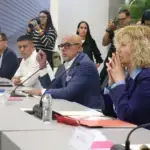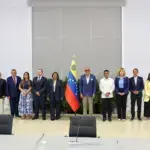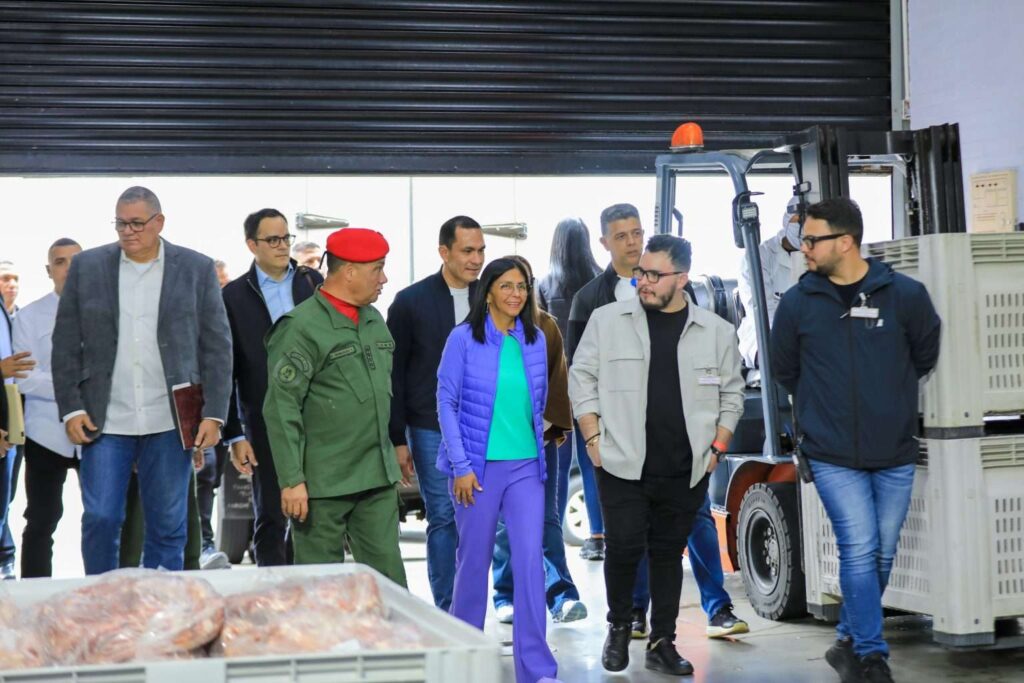
The acting president of the Republic, Delcy Rodríguez, visited the L’Prado Food Processing Plant this Monday, February 9. Photo: Presidential Press.
The acting president of the Republic, Delcy Rodríguez, visited the L’Prado Food Processing Plant this Monday, February 9. Photo: Presidential Press.
Venezuela broke a record by producing 125,325 tons of processed meats in 2025. The acting president called for respect for agreed prices to prevent speculation.
Acting President Delcy Rodríguez also reported Monday that consumption in Venezuela grew by more than 32% in January 2026 compared to January 2025. While further details were not provided, the figure serves as an indicator of how the Venezuelan economy has behaved in recent weeks.
“This is the path we are seeking for our country. That Venezuela does not stop, that Venezuela moves forward, that Venezuela grows and grows with economic peace, with political peace, with social peace,” she said.
From the Río de Oro L’Prado Food Plant, located in the municipality of Baruta in Miranda state, the acting head of state reported that in 2025, Venezuela broke a production record in the processed meat sector.
She detailed that Venezuela produced 125,325 tons of processed meats in 2025, “and I have no doubt that this plant (L’Prado Food Processing Plant) contributed its grain of sand to that growth.”
She emphasized that these achievements have increased thanks to the economic dialogue that exists within the National Council of Productive Economy, a meeting space where ideas are debated to strengthen the country’s economy.
She recalled that Venezuela recorded 19 quarters of sustained growth, achieving an 8% increase in gross domestic product (GDP) in 2025.
Respect for agreed prices
Rodríguez highlighted that what was observed at the Río de Oro L’Prado Food Processing Plant constitutes an example for Venezuela to follow in 2026 by demonstrating the potential of national production.
Rodríguez indicated that the prices agreed upon with national industry must be respected, ensuring that there is no speculation that is harmful to the Venezuelan people.
“That there be no speculation against the people of Venezuela: this must be part of the agreements of the economic and social dialogue that the Program for Democratic Coexistence and Peace has put in place,” said Acting President Rodríguez. “It is dialogue to come together, but it is also to come together in the diversity of sectors—the economic sector, the political sector, the social sector—and to keep moving forward to guarantee the future of Venezuela, independence, and sovereignty.”
Rodríguez also noted, regarding the control of permits, that industry was listened to and conclusions were reached about the measures that needed to be adopted—policies for protection, sanitary control, and support for national industry.
“Record growth [was recorded] in the processed meat sector over the last 10 years, but it was also thanks to the economic dialogue that exists in the National Council of Economy, where we listened to the sector, [and] saw the problem—there was a lot of imported processed meat entering without permits, without any type of sanitary control—and immediate measures and protection policies and support for national industry were adopted, and here is the result.”
Minister of National Industry and Commerce Luis Villegas highlighted that technical roundtables have been maintained for the meat sector with the aim of eliminating obstacles in procedures and thus protecting national industry.
“We are integrated—the Bolivarian National Armed Force, the Ministry of Food, the Seniat, the Ministry of Industry and Commerce—so that we do not allow the entry of all these processed meats that also do not meet the quality standards of the industry,” said Villegas.
Open-air markets
During the event, Minister of Food Carlos Leal Tellería reported that more than 23,000 tons of food are distributed weekly to the Venezuelan people through open-air markets.
He also said that the agrifood sector is growing and emphasized that Venezuela has food reserves for 116 days stored in warehouses and silos to ensure the country’s food security.
Leal Tellería highlighted that there is currently a strong harvest, which allows for permanent supply and the availability of all products with great variety on shelves—across all supermarkets, grocery stores, in private and public redistribution—which “is being strengthened with the Venezuelan Food Production and Distribution Company (Pdval) and mercales and open-air markets.”
The Venezuelan company Pdval was founded in 2017 by two young Venezuelan entrepreneurs. It has dedicated itself to the production and marketing of processed meats and meat products, offering high-quality products to the domestic market. Today, they market under their flagship brand L’Prado and have the entire productive value chain in place.
Juan Lenzo: ‘We Need To Integrate the Communal Economy To Face the Capitalist Maelstrom’
Translation: Orinoco Tribune
OT/CB/SL