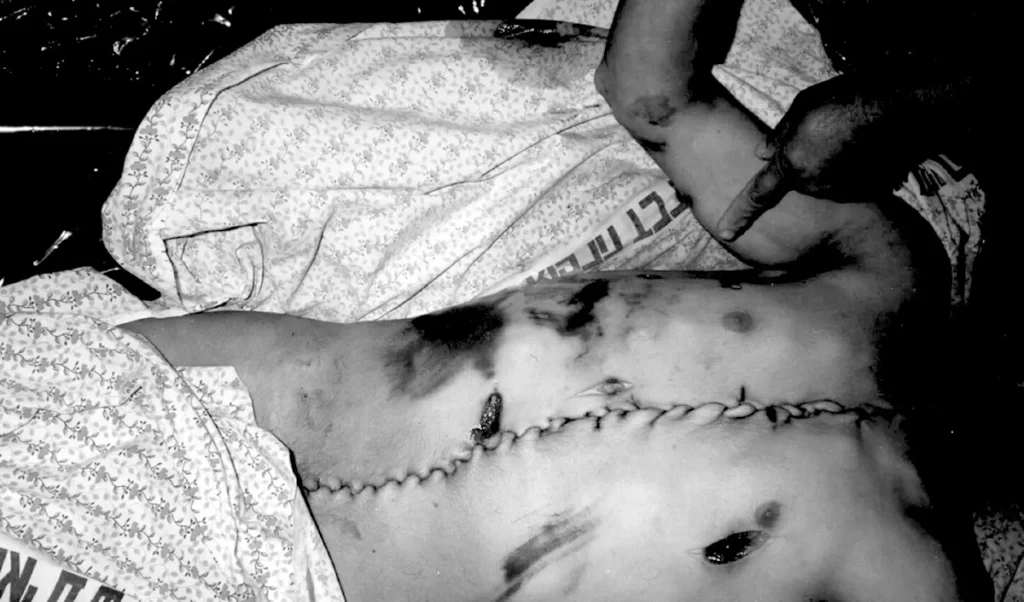
Body of a Palestinian prisoner, stitched from the chin to the abdomen, returned by the Zionist entity, in 1992. Photo: Donald Böstrom.
Body of a Palestinian prisoner, stitched from the chin to the abdomen, returned by the Zionist entity, in 1992. Photo: Donald Böstrom.
By Sally Nasser – Feb 7, 2026
“Our sons are used as involuntary organ donors,” said the families of young Palestinian men to Swedish journalist Donald Boström when they saw their dead bodies stitched “from the abdomen to the chin.” Israeli soldiers had returned their bodies days after they disappeared from Gaza and the West Bank during a 1992 organ donation campaign in occupied Palestine, launched by Ehud Olmert, then Israel’s minister of health.
More than three decades later, the same suspicions have resurfaced. Last month, more than 1,000 kidney donors gathered for a group photograph during a ceremony celebrating 2,000 living kidney donations in occupied Palestine. The event was organized by the Israeli nonprofit Matnat Chaim (gift of life) which applied to the Guinness World Records for official recognition.
The application was not initially welcomed. In December 2025, when Matnat Chaim first contacted Guinness to register the record, it was rejected for “political reasons.” In a statement at the time, Guinness said it was aware of “just how sensitive this is at the moment,” adding that it had stopped processing applications from the Palestinian Territories or Israel since 2023, except for those submitted in cooperation with a UN-affiliated humanitarian relief agency.
According to Israeli media, the position of Guinness has since changed following legal pressure to resume submissions from Israel. While the annual record-keepers of the “greatest of human achievements” have not yet officially certified Israel’s record, zionist media have promoted the ceremony as evidence that organ donation rates inside the settler population are now among the highest in the world.
Taking into consideration the religious restrictions over organ donations and the small settler population of Israel, this issue poses questions over the accuracy of such a milestone. So where do all of these donations come from?
Dr. Munir Al-Bursh, Director-General of the Palestinian Ministry of Health in the Gaza Strip, has called for an independent international investigation rather than international accolades.
“The same authority withholding Palestinian bodies for years now boasts unprecedented ‘donation’ figures,” Al-Bursh said. “Did this generosity appear overnight? Or are there silent bodies excluded from the celebration? The occupation has stolen organs from the bodies of Palestinian martyrs.”
These accusations intensified during the ongoing genocide in Gaza. Medical teams and rescue workers tasked with exhuming bodies from mass graves reported signs of organ removal. At Nasser Medical Complex in Khan Younis, out of the 392 bodies found, 165 disfigured bodies remained unidentified.
“The bodies arrived stuffed with cotton, with gaps suggesting organs were removed. What we saw is indescribable,” a doctor at Nasser Medical Complex said, calling it a “violation of the sanctity of the dead and human dignity.”
Euro-Med Monitor has documented similar cases across the Gaza Strip. It reported that the Israeli army confiscated bodies from Al-Shifa Medical Complex, the Indonesian Hospital, and areas along Salah al-Din Road, a route designated for displaced civilians heading to the central and southern parts of the strip. While the organization said dozens of bodies were later transferred via the International Committee of the Red Cross for burial, it warned that Israeli forces continue to withhold many others.
Medical examinations of some of the returned bodies revealed signs of organ removal, including “missing cochleas and corneas as well as other vital organs like livers, kidneys, and hearts,” confirmed the organization.
The allegations first surfaced during the First Intifada. In 1990, Dr. Hatem Abu Ghazaleh, then chief health official in the occupied West Bank, told reporters that organs, particularly eyes and kidneys, were being removed from the bodies of Palestinian martyrs. At the time, international media ignored the testimony from Palestinian medical officials, a pattern that will repeat itself in the years to follow.
The issue resurfaced in 1999 when US anthropologist Nancy Scheper-Hughes launched an investigation into organized “transplant tourism.” Her research led her to Yehuda Hiss, a pathologist and forensic specialist at Israel’s Forensic Institute Abu Kabir.
In a July 2000 interview, Hiss admitted to harvesting skin, bones, corneas, cardiac valves, and other tissues from bodies undergoing autopsies. He acknowledged that consent was only required for autopsies, while families were never informed of the organ harvesting that was conducted during autopsy. “Whatever was done here was off the record, highly informal,” Hiss said. “We never asked permission from the family.”
Following the release of the taped interview in the occupied territories, Israeli officials acknowledged that organs had been harvested from the bodies of both Palestinians and Israeli settlers throughout the 1990s, while claiming the practice ended in 2000. Hiss later denied everything.
His protégé, Chen Kugel, was more explicit. “Organs were sold to anyone; anyone that wanted organs just had to pay for them,” he said. Asked whose bodies were used, Kugel replied that organs were taken “from Jews and Muslims, from soldiers and from stone throwers, from terrorists and from the victims of terrorist suicide bombers, from tourists and from immigrants,” adding that Palestinians were the easiest targets because “if there were any complaints coming from their families, they were the enemy and so, of course, they were lying and no one would believe them.”
In 2009, Donald Boström published an article in Aftonbladet detailing an illegal money laundering and organ trade scandal involving rabbis, politicians, and civil servants. One central figure later arrested for his crimes, Rabbi Levy Izhak Rosenbaum, described his role plainly. “You could call me a ‘matchmaker’,” he said, in reference to his work buying and selling kidneys from the occupied territories on the black market.
The policy of withholding Palestinian bodies continues today. As of January 27, 2026, the National Campaign for the Recovery of Martyrs’ Bodies and Disclosing the Fate of the Missing reported that the Israeli occupation was holding the bodies of 776 Palestinians, including 77 children under the age of 18 and 10 females. These figures include only those killed during the ongoing genocide, excluding many more bodies withheld for decades. Just last Wednesday, Israel proved once again the validity of organ theft allegations, as it returned 54 decomposed bodies and 66 boxes full of human remains to Gaza via the International Committee of the Red Cross (ICRC).
As long as Palestinian remains are confined to Israeli morgues and so-called cemeteries of numbers, families are denied the right to properly bid farewell to their loved ones. For Palestinians, celebrations of organ donation records cannot be separated from a long and brutal history of Israel’s occupation of death itself.