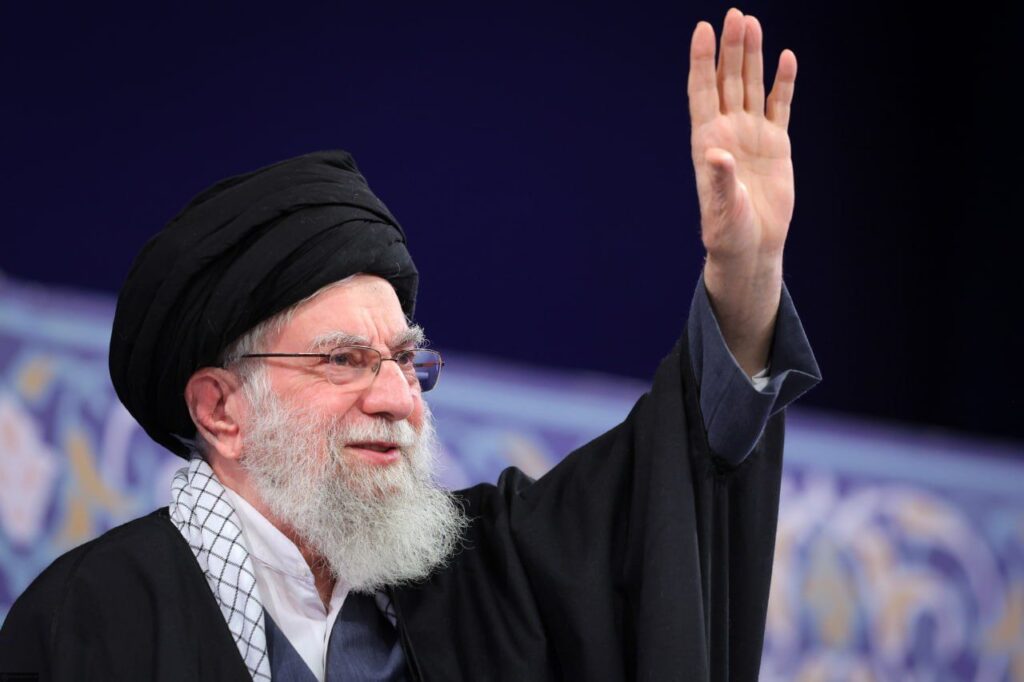
The martyred leader of Iran, Sayyed Ali Khamenei. File photo.
The martyred leader of Iran, Sayyed Ali Khamenei. File photo.
The leader of the Islamic Revolution and the Islamic Republic of Iran, Sayyed Ali Khamenei, has been martyred in the US-Israeli aggression on Iran.
Iranian state television reported that Supreme Leader Sayyed Ali Khamenei was martyred at his workplace at the Leadership House, where he fell while performing his duties in his office during the joint US-Israeli attacks in the early hours of Saturday, February 28.
According to Iranian state television, Sayyed Khamenei’s martyrdom at his workplace once again refuted claims by “outlets linked to the Israeli regime and regional reactionary currents that the leader was in a secure and undisclosed location,” affirming that he remained present on the frontlines of responsibility among his people.
Aged 86 at the time of his martyrdom, Sayyed Ali Khamenei has guided the Islamic Republic of Iran from the early days of the post-revolutionary era through decades of struggle and transformation. After taking part in the 1979 Revolution that overthrew the oppressive, US-backed Pahlavi monarchy, he served as president throughout much of the 1980s before being appointed as the Leader of Iran in 1989 following the death of Sayyed Ruhollah Khomeini.
In that position, he became the highest authority in Iran’s political and religious system, shaping domestic policy, overseeing national institutions, and directing Iran’s strategic orientation for nearly four decades.
During his leadership, he maintained Iran’s sovereignty in the face of international pressure, steered the country through regional conflicts, and fostered alliances with movements and governments across the Middle East and the world.
His tenure also oversaw significant developments in Iran’s nuclear program and the expansion of the Islamic Revolution Guard Corps as a central element of national defense and regional influence, making him one of the most significant figures in contemporary Iranian and regional history.
Iranian institutions mourn Sayyed Ali Khamenei
The Iranian Revolution Guard Corps (IRGC) expressed its deepest condolences, describing Sayyed Ali Khamenei as a towering religious scholar and “leader of the martyrs of the Islamic Revolution.” The organization hailed him as a uniquely virtuous and courageous figure, whose martyrdom at the hands of “malicious terrorists and oppressors” underscores the righteousness of his leadership and the value of his lifelong service.
The IRGC affirmed that Sayyed Khamenei’s martyrdom “would not halt his path, but rather strengthen the Iranian people’s determination to continue his legacy,” and vowed that “the IRGC, armed forces, and Basij would carry forward his mission in defense of the nation.”
The Supreme National Security Council of Iran said Khamenei’s martyrdom would be a catalyst for a “great uprising against global tyrants.”
The Iranian government announced 40 days of national mourning for the martyrdom of the leader.
The Iranian Presidency stated that until his final moments, Sayyed Khamenei guided the Islamic nation in confronting forces of disbelief and tyranny, and called him a symbol of selfless service, resistance, and hope for the oppressed and the free.
The Iranian Presidency affirmed that the leader’s murder would not go unanswered and that his sacred blood would inspire continued struggle against injustice, emphasizing that Iran, relying on divine support, would navigate this crisis united and with pride.
US-Israeli aggression against Iran
The United States and “Israel” launched a “joint military operation” on Febbruary 28 targeting Iran in the middle of nuclear talks, in what Israeli Prime Minister Benjamin Netanyahu claimed was a necessary action to eliminate what he called an “existential threat.”
Netanyahu said that the US-Israeli operation against Iran aims to reshape the region’s strategic landscape, as coordinated strikes and retaliatory attacks pushed tensions sharply higher.
The announcement followed reports of coordinated attacks in multiple Iranian cities, marking a significant escalation. Netanyahu said that the operation is intended to alter strategic realities in the region and directly challenge Iran’s leadership.
He reiterated that the joint US-Israeli action would create the conditions for the Iranian people “to take their fate into their own hands,” adding that “Iran must not be allowed to arm itself with nuclear weapons.”
The cities of Tehran, Qom, Tabriz, and Khorramshahr were struck by multiple missiles on Saturday, leading to the murder of at least 200 Iranians, including children. Iranian and regional airspace closures were implemented shortly afterward, disrupting civilian and commercial flights.
The Public Prosecutor’s Office in Hormozgan province, southern Iran, confirmed that 108 children were martyred in an Israeli strike targeting Minab Elementary School for Girls. Another 90 students were injured at the Shajareh Tayyebeh School in the same city.
In Fars province, also in southern Iran, the Zionist entity killed 20 women volleyball players in a strike on a sports hall in the city of Lamerd.
The Iranian Red Crescent places the overall death toll from the US-Israeli offensive at more than 200 killed and 747 wounded since the attacks began Saturday morning.
‘Israel’ Launches Aggression Against Iran ‘In Coordination With US’
Iran launches retaliatory strikes
In response, Iran has invoked Article 51 of the United Nations Charter, affirming its legitimate right to self-defense.
In a statement, the Iranian Foreign Ministry characterized the airstrikes as a violation of Article 2(4) of the United Nations Charter, which prohibits the use of force against the territorial integrity or political independence of any state. The ministry reiterated that Iran would use all its capabilities to deter aggression and confront its enemies.
Shortly after the US-Zionist strikes began, Iranian authorities announced retaliatory measures, with dozens of ballistic missiles launched toward “Israel.” Impacts were reported in Tel Aviv and other areas across the occupied Palestinian territories.
Nournews confirmed the launch, reporting that multiple missiles were fired, with targets including Haifa and areas in northern occupied Palestine.
The Israeli military reported that it had detected a barrage of missiles launched from Iran. Israeli media outlets also reported the detection of missile launches directed at Tel Aviv.
In parallel, Iranian state television announced that Tehran was preparing what it described as a “crushing” retaliation against the Zionist entity, asserting that attacks on Iranian sovereignty would not go unanswered.
Additionally, Iranian missiles strikes targeted US military bases across several Gulf Arab states, including Saudi Arabia, the United Arab Emirates, Bahrain, Kuwait, and Qatar. Agence France-Presse reported loud blasts in Riyadh as Iran carried out retaliatory strikes on US bases across the Gulf. 14 US military bases across West Asia have been targeted by Iran so far, a military source announced on Saturday.
(Al-Mayadeen English) with Orinoco Tribune content