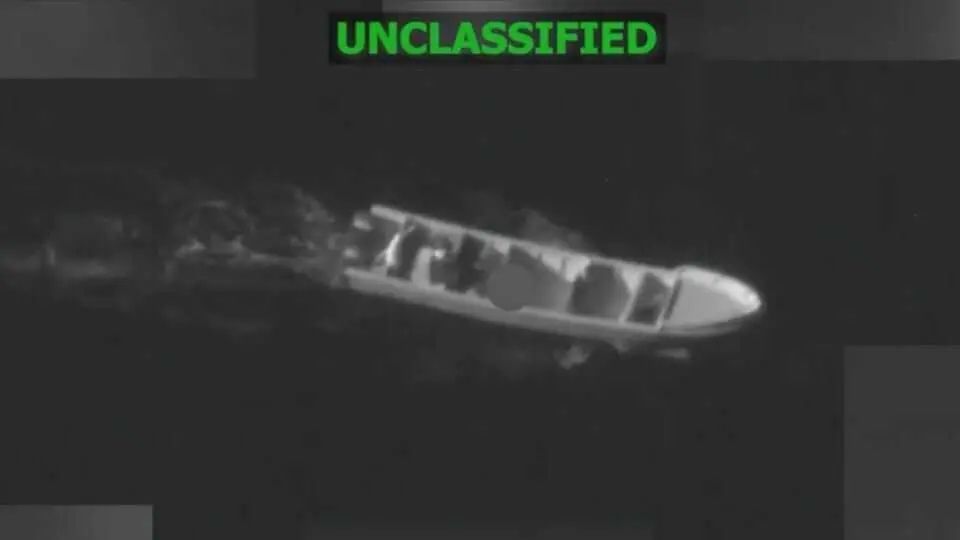
Image of a targeted boat released by SOUTHCOM. Photo:X/@Southcom.
In three attacks carried out two days apart, the US killed seven people. The US armed forces conducted a new operation, ordered by General Francis L. Donovan, head of Southern Command (SOUTHCOM), against another civilian vessel allegedly linked to organizations classified as terrorist groups. Two more people were killed as a result of this strike.
Applying total systemic friction on the cartels. On April 13, at the direction of #SOUTHCOM commander Gen. Francis L. Donovan, Joint Task Force Southern Spear conducted a lethal kinetic strike on a vessel operated by Designated Terrorist Organizations. Intelligence confirmed the… pic.twitter.com/zZQKEPiSoI
According to the authorities, the vessel was traveling along known drug trafficking routes in the eastern Pacific and was allegedly involved in illicit activities, again without any evidence being offered in this regard.
SOUTHCOM had previously killed five people in attacks on boats in the Pacific
Five men were killed on Saturday following a series of attacks carried out by US military forces against two vessels in Pacific waters, according to SOUTHCOM.
Applying total systemic friction on the cartels.
On April 11, at the direction of #SOUTHCOM commander Gen. Francis L. Donovan, Joint Task Force Southern Spear conducted two lethal kinetic strikes on two vessels operated by Designated Terrorist Organizations. Intelligence… pic.twitter.com/sRXTFYCWXu
According to the official version, one person survived the attack on the first boat, which had three crew members on board. The agency indicated that the Coast Guard was notified to activate a search and rescue operation. On the second boat, also with three occupants, all three died.
The statement released is accompanied by a black-and-white video showing the destruction of both vessels by explosions at sea.
The actions are part of Operation Southern Spear, launched last September, with which Washington, under the pretext of combating drug trafficking, has intensified the use of lethal force in operations that violate the international legal framework.
Since then, at least 157 people have been documented as killed in similar attacks on small boats, many of them identified by organizations and analysts as possible extrajudicial executions.
Trump warns he could ‘stop by Cuba’ after conflict with Iran, increasing international tension
US President Donald Trump issued a new warning against Cuba, suggesting his administration could take action against the island once the current conflict with Iran is resolved. The statement came amid escalating international tensions, marked by military decisions and unilateral measures implemented by Washington. This move opens a new front in US foreign policy and has generated reactions from various international actors.
— Commentary: Trump Truth Social Posts On X (@TrumpTruthOnX) April 13, 2026
The statement comes as the United States maintains an active confrontation in the Middle East, with actions that have heightened global tensions and put pressure on strategic energy routes. In this context, the possibility of extending pressure toward Cuba suggests a broadening of the scope of US actions beyond a single conflict. This type of stance increases uncertainty about the direction of US foreign policy.
In his remarks, Trump reiterated his critical stance toward the Cuban government, pointing to structural problems in its political and economic system, while also linking his discourse to sectors of domestic support. This narrative has been a constant feature of his administration, characterized by a hard line toward Cuba. The statements also reflect a domestic political component amidst a complex international context.
The president’s proposal comes amid a context in which Washington has intensified measures against Cuba, including economic restrictions and pressure on energy supplies. These actions are part of a sustained pressure strategy that combines economic tools with high-impact political messages. The possibility of escalating to other types of actions is generating concern internationally.
Faced with this scenario, the Cuban government has reiterated its stance of defending national sovereignty, in a context of growing tension. Recent statements reflect a hardening of rhetoric between the two nations, at a time marked by simultaneous conflicts in different regions. This exchange once again places Cuba on the global geopolitical agenda.
Finally, Trump’s reference to Cuba, coinciding with an active conflict in another region, reveals a strategy that combines simultaneous pressure in different international arenas. This approach has raised questions about the risks of escalation and the potential impact on regional stability. How this situation develops will depend on the decisions made in the coming days.