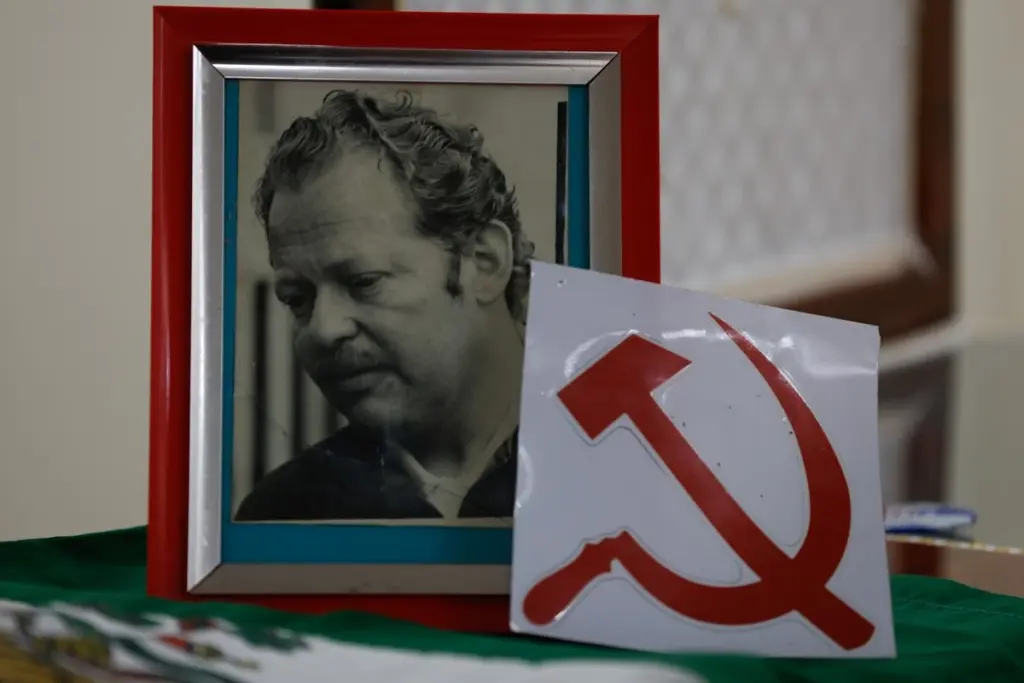
A framed photo of Antonio Gershenson Tafelov, leader of the Mexican left. Photo: Víctor Camacho.
A framed photo of Antonio Gershenson Tafelov, leader of the Mexican left. Photo: Víctor Camacho.
By Luis Hernández Navarro – Jun 7, 2026
Antonio Gershenson Tafelov was 25 years old when, in November 1967, he was arrested by the police. He was sentenced to 25 years in prison for a series of crimes, including conspiracy and criminal association. He was imprisoned in the N wing of the Lecumberri prison for six years, until he was released in 1973.
He was part of a clandestine political-military project in which three forces associated with the struggle of education sector workers, the peasantry of Morelos, and the labor-union workers converged. In the first, Othón Salazar and members of the Revolutionary Teacher’s Movement (MRM) participated until their incorporation into the Mexican Communist Party (PCM); in the second was part of the high command of Jaramillismo, including Major Félix Serdán; and in the third, members of the Mexican Communist Workers’ Front (FOCM), formed in 1961 by Juan Ortega Arenas.

In 1965, 21 unions associated with the Front created the Independent Trade Union Movement, of which Gershenson was one of the leaders, and in 1966, the first Mexican Workers’ Party. Gershenson also had editorial responsibilities in La Verdad Obrera, the spokesorgan of this movement, which was published for almost two decades.
In his autobiography Nadie puede ser amigo de todos (“No One Can Be Friends with Everyone”), Gilberto López and Rivas, Gershenson’s comrade in those struggles, recounts:
In 1967, the ‘Physicist’ was arrested for his alleged indirect participation in an attack on the Bolivian embassy following the assassination of Che Guevara, with one of the explosives, which I ultimately left for safekeeping in a safe house in Morelos.
He did not ‘sing’ or out his comrades-in-arms, and even years later, we greeted each other with great propriety and never mentioned the thousands of meetings where we had discussed ways to establish an armed revolution in Mexico. Finally, in 2003, when he was the district chief of Tlalpan, I decided to bring up the topic, thanking him for his courage in not exposing us despite the torture and imprisonment.
In the file prepared by the Directorate of Investigations for Crime Prevention (DIPD) in 1976, with all the inaccuracies that police records usually have, it was said of him: “Responsible for dynamite attacks in the Federal District during the year 1967, in which he placed and detonated several explosive devices, including one at the statue of Miguel Alemán Valdés in Ciudad Universitaria and a device placed at the Colombian embassy, which exploded in the DIGEPOT Laboratory. He currently works as a nuclear physicist and his activities are checked sporadically.”
From a wall of a cell in the N wing, with Che’s gaze upon them, the political prisoners who were incarcerated there in those years turned the Black Palace into a university and a balm to face adversity. According to what Gershenson wrote in La Jornada, drawing on the notes of his life partner, Ruxi Mendieta:
There, disciplined, showcasing abstraction, many comrades and companions were with us.
First of all, Víctor Rico Galán, who, with incredible patience and will, took on the role of rector of that N wing turned into “the fruitful prison,” keeping in mind, of course, what Commander Fidel Castro described in his book of the same name.
There we were, studying and writing; asking, answering, and assimilating what was happening to us. Our discreet clandestine little school, within what we called Free Territory of Lecumberri, yielded results. One of them was that, in truth, we were free there. Or, at least, many of us expressed it that way.
The N wing was also a territory where figures very close to Rafael Galván, the leader of the democratic electricians, would arrive, and where his magazine Solidaridad could be read. The reflection on the Mexican Revolution, revolutionary nationalism, and socialism was the “bread and butter of our daily life.”
The combination of Galvanism and electrical unionism with the political authority of journalist Víctor Rico Galán would be key to providing Antonio, now free, with a long-term political horizon. His participation in the project organized around the mass workers’ newspaper La Unidad, his support for the struggle of the Democratic Tendency of SUTERM and the National Front for Popular Action (FNAP), and his undeniable leadership in the Single Union of Nuclear Industry Workers (alongside Arturo Whaley) made him a fundamental reference in the workers’ insurgency of the 70s and 80s of the last century.
US Conspiracy Against Mexico and President Sheinbaum Underway
From there, alongside figures like Rolando Cordera, Arnaldo Córdova, and Carlos Pereyra, Gershenson was key in the construction of the political platform Popular Action Movement (MAP), which soon joined the initiatives for the unity of the leftist parties, giving rise to the Unified Socialist Party of Mexico (PSUM). Representing that party, he was elected as a federal deputy in 1982 and was a member of the commissions for Energy, Oversight of the Office of the Comptroller General of the Treasury, and Labor.
He also served as an advisor to the Energy Commission of the Chamber of Deputies from 1994 to 1997. Thereafter, with Cuauhtémoc Cárdenas’ victory in the Federal District (Mexico City), he served as the director of Public Lighting of the Federal District from 1998 to 2004; by then Andrés Manuel López Obrador was the chief of the Federal District. Over the years, Gershenson continued to participate in politics within the ranks of Democratic Revolutionary Party (PRD) and Movement for National Regeneration (MORENA).
Gershenson, founder of La Jornada, wrote a weekly column (in recent years accompanied by Ruxi Mendieta), with orderly and clear prose, following the maxims of José Antonio Mella’s course for worker correspondents of El Machete: truth above all; brevity and conciseness; accessible texts that reflect the struggles, injustices, and daily life of the proletariat. And another maxim: one idea, two pages, three examples.
Antonio Gershenson was, throughout his life, a dignified and committed leftist activist. Neither repression, nor prison, nor his political responsibilities, nor public recognition, altered his vocation to serve the workers. The simplicity in his demeanor contrasted with the greatness of the emancipatory missions he took upon himself and his human quality. May he rest in peace.
Translation: Orinoco Tribune
OT/SC/SH