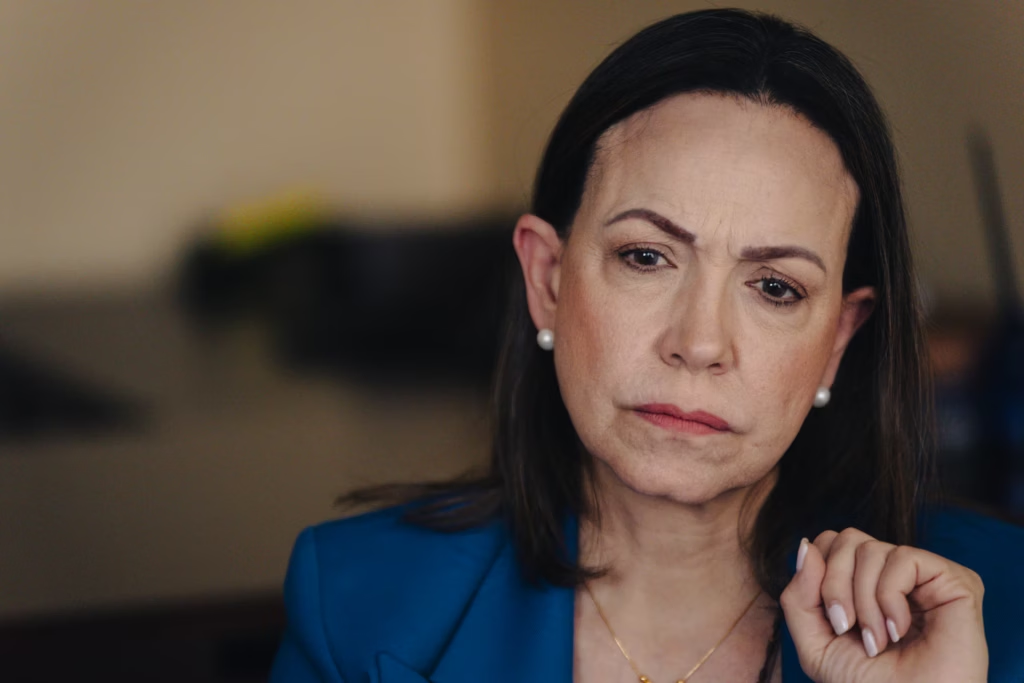
Far-right Venezuelan politician Maria Corina Machado. Photo: Maansi Srivastava/El País/File photo.
Far-right Venezuelan politician Maria Corina Machado. Photo: Maansi Srivastava/El País/File photo.
By Misión Verdad — Jul 30, 2026
Following the events of January 3, María Corina Machado and Edmundo González Urrutia projected themselves to be the natural heirs to assume power after the kidnapping of President Nicolás Maduro, assuming a controlled handover would take place.
They celebrated the violation of national sovereignty and called on their followers to remain vigilant until the “transition is complete,” asserting that Edmundo González Urrutia “should immediately assume” the presidency. “The time has come for popular sovereignty and national sovereignty to govern our country,” the Nobel Peace Prize laureate promised in a statement. “We are going to restore order, free political prisoners, build an exceptional country, and bring our children back home.”
However, relations between Venezuela and the US empire have gradually resumed without the vetting of the opposition sector led by Machado. So far, diplomatic and trade relations have been restored, and Washington maintains direct communication with Acting President Delcy Rodríguez, who has met with high-level US representatives in Caracas.
Months have passed, and reality is not aligning with the extremist opposition’s plan or timeline. In August, a round of talks will begin with opposition sectors that exclude this group, primarily due to a Washington-led decision.
This comes despite the fact that, at the end of May, Machado, González, the Democratic Unitary Platform (PUD), and other opposition representatives signed the Panama Agreement, a roadmap intended to negotiate with the Venezuelan government toward presidential elections.
From ‘leading’ the political transition to nothing
The far right-led Panama Agreement included the construction of a “great national agreement.” “We express our determination to promote a serious, firm, and responsible political negotiation with the interim regime to restore democracy in Venezuela with the accompaniment of the US government,” the text claims.
According to the proposal, negotiations were to be led by Machado “in her role as leader of the country’s democratic process,” alongside the PUD and in consultation with Venezuelan civil society organizations.
Among other responsibilities, Machado was tasked with appointing the negotiating team. She used the opportunity to project herself as an undisputed leader and announced that she would return to the country before the end of 2026 to run for president in the upcoming elections.
The manifesto proposed building a “Great National Agreement,” inviting a wide range of sectors from Venezuelan society to participate, but in which Chavismo would hold no significant role. Ultimately, what prevailed was the arrogance of trying to seize power by any means necessary, without a concrete plan and on their own timeline, even if it meant overriding the decisions of their allies and entering a dead end where the stakes were all or nothing.
“Maintaining a single, coherent, and coordinated message to the world, in close alignment with democratic allies,” stated one of the points of the agreement. However, their recent actions have blatantly undermined this principle, and complaints from her supporters regarding the lack of concrete progress toward a political transition are becoming increasingly evident.
In a recent interview with the Spanish newspaper El País, Machado stated that while change has occurred in the country, it has not been substantial because political transformation has not materialized. She projected a catastrophic scenario that she claims can only be resolved through elections. The leader of Vente Venezuela has hinted on numerous occasions that the political transition in the country depends on her rightful leadership.
When asked about Donald Trump’s opinion that Venezuelans are “really happy,” Machado spoke on her growing anxiety “that this [regime change] is taking too long, because for many people every day is existential. The way to prevent this from turning into a chaotic process is to assure people that we will be able to uphold the will of the people through elections.”
Although Trump and US Secretary of State Marco Rubio proposed a three-phase plan for Venezuela following Maduro’s kidnapping—focusing on oil control, market opening, and political transition—Washington has primarily concentrated on overseeing oil exploitation and marketing, giving no indication of pushing for political shifts beyond current arrangements.
Contrary to the opposition’s expectations, Trump has praised Acting President Delcy Rodríguez and, for now, ruled out elections. This suggests that the political transition advocated by Machado is not a priority for Washington and that no single leadership exists to unify the country around that idea.
During the interview with El País, the journalist pressed Machado on when she would return to Venezuela: “In Madrid, you announced your return in a matter of weeks. You said the same thing two months ago. When? May, June, July?” After outlining a schedule that included meetings with heads of state, creditors, and investors, Machado admitted that the stance of the US empire and other allies heavily influenced her decision to return.
On June 30, a New York Times report titled “US Blocks Maria Corina Machado’s Return to Venezuela” noted that “the Trump administration has repeatedly rejected her requests and made it clear to the opposition leader that she has become a distraction.” The report added that “not even Machado’s unprecedented gesture of giving Trump her Nobel Peace Prize medal—despite the Nobel committee’s opposition—has been enough to convince him.” This made it evident that she no longer controls her own political trajectory.
Irreconcilable break
The New York Times argued that the breakdown of Machado’s long-standing alliance with the US government followed months of escalating tensions over how Venezuela should be governed post-Maduro. US imperial officials cited in the report indicated it is now unclear whether the Vente Venezuela leader will be able to repair her relationship with the Trump administration.
Once a protégé praised by the Republican establishment in Washington—which contributed to her national and international prominence—Machado is now being viewed as a destabilizing factor for the empire’s ability to exploit Venezuela for its own interests.
Trump’s doubts regarding Machado’s governing capacity surfaced as early as January 3 itself, the day of the US invasion of Venezuela, when he stated she was not in a position to guarantee governability.
When asked if she would sit down to negotiate directly with Venezuelan authorities, Machado claimed it depended on the terms. “We have offered, publicly and privately, our willingness to move forward with a negotiated transition,” she stated. “What we will not accept is another farce.”
This demonstrates that Machado operates from an assumed position of power she does not possess. In her view, dialogue remains impossible, even though seven months after President Maduro’s kidnapping, the country continues to function under the administration of Acting President Delcy Rodríguez, despite the additional impact of the two June earthquakes. Machado remains reliant on her victory in the 2023 opposition-exclusive primaries, failing to recognize that current circumstances require broad consensus.
Her political mediocrity is evident as she continues pressuring Washington to accelerate a transition without recognizing that stabilization and economic recovery—the primary phases outlined by Trump and Rubio—take precedence. Washington recognizes that Chavismo retains effective control in the country, making Machado’s demands unrealistic in the eyes of US strategists.
Displaced from the transition process
Recently, the US colony promoted a different opposition figure to lead new dialogue rounds in Venezuela: Dinorah Figuera, a legislator and president of the 2015 National Assembly. Figuera has returned to Venezuela and met with government representatives to establish a working agenda.
Figuera stated that she accepted the role at the invitation of the US State Department “to take on the challenges that will resolve differences,” effectively side-stepping Machado’s central position within the opposition.
After a few days of silence, Machado reappeared on social media to confirm that she will not participate in the meetings promoted by the Trump administration between the opposition bloc and representatives of Chavismo.
She released a statement, also signed by Edmundo González, in which they claim to be “an expression of Popular Sovereignty manifested with votes in the primaries of October 22, 2023 and in the presidential elections of July 28, 2024,” and reiterated that all of the country’s problems would be solved with a change of government to their leadership.
With the addition of the 2015 National Assembly representative, Machado and Edmundo González are excluded from the Trump-Rubio circuit in the negotiations that could lead to a supposed political transition in Venezuela, and the announcement that they are withdrawing from said dialogue further distances them from a process they always planned to lead.
The decision to appoint someone other than María Corina Machado was fueled by her clumsy actions. Pressuring the White House to hold early elections; projecting herself as an extremist figure for political change, even disregarding Washington’s interests; showing sympathy for certain Democratic Party figures like Chuck Schumer, Senate Majority Leader since 2021 and a political enemy of Trump; among other actions, all contributed to her being deemed incapable of assuming political power in Venezuela, or even participating in a process of political opening.
Translation: Orinoco Tribune
OT/JRE/AU
Misión Verdad is a Venezuelan investigative journalism website with a socialist perspective in defense of the Bolivarian Revolution