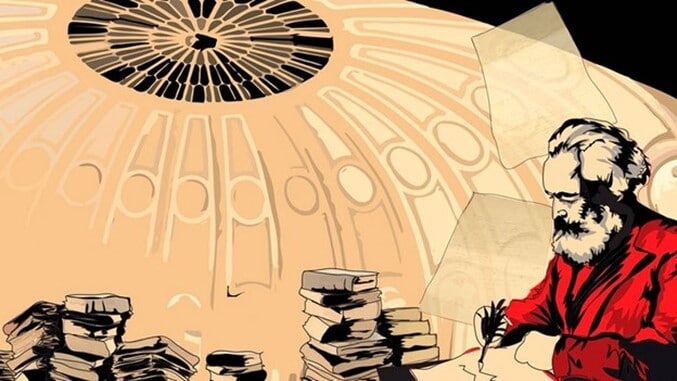
Marcello Musto, Karl Marx’s Writings on Alienation. New York: Palgrave Macmillan (2021). 164 page
Marcello Musto, Karl Marx’s Writings on Alienation. New York: Palgrave Macmillan (2021). 164 page
By Carlos L. Garrido

Stemming primarily from Marx’s analysis of the fetishism of commodities in Capital Vol I, Georg Lükacs’ 1923 text, History and Class Consciousness, reintroduces the theory of alienation into Marxism through his concept of ‘reification’ (verdinglichung, versachlichung). For Lükacs, reification described the “phenomenon whereby labor activity confronts human beings as something objective and independent, dominating them through external autonomous laws” (4-5). However, as Musto notes, and as Lükacs rectifies in the preface to the 1967 French republication of his text, “History and Class Consciousness follows Hegel in that it too equates alienation with objectification” (5).
The equation of alienation and objectification is the central philosophical error which creates the grounds for the ontologizing of alienation. For Marx, objectification is simply “labor’s realization,” the process wherein labor gets “congealed in an object.”[8] When human labor produces an object, we have objectification. Only under certain historically determined conditions does objectification become alienating. As Marx writes in the EPM,
The alienation of the worker in his product means not only that his labor becomes an object [i.e., objectification] an external existence, but that it exists outside him, independently, as something alien to him, and that it becomes a power on its own confronting him; it means that the life which he has conferred on the object confronts him as something hostile and alien.[9]
Social wealth confronts labor in more powerful portions as an alien and dominant power. The emphasis comes to be placed not on the state of being objectified, but on the state of being alienated, dispossessed, sold; on the condition that the monstrous objective power which social labor itself erected opposite itself as one of its moments belongs not to the worker, but to the personified conditions of production, i.e. to capital.[10]
The bourgeois economists are so much cooped up within the notions belonging to a specific historic stage of social development that the necessity of the objectification of the powers of social labor appears to them as inseparable from the necessity of their alienation vis-à-vis living labor… [But] the conditions which allow them to exist in this way in the reproduction of their life, in their productive life’s process, have been posited only by the historic economic process itself… [These] are fundamental conditions of the bourgeois mode of production, in no way accidents irrelevant to it. [11]
From this historical and objective understanding of alienation, Marx formulates in the EPM four ways in which alienation occurs in the capitalist form of life: 1) alienation of the product, wherein the object of labor confronts the laborer as something hostile and alien; 2) alienation in the process of production, i.e., in the social relations through which the work takes place; 3) alienation from the ‘species-being’ of man as an animal with the unique ability to consciously, creatively, and socially exert mental and physical labor (as a homo faber and sapien) upon nature to create objects of need and aesthetic enjoyment; and 4) alienation from other humans and their objects of labor. Apart from the Feuerbachian essentialism in the language of number 3 (e.g., species-being, species-essence), the pith of this 1844 formulation of the theory will be enriched in his later work, especially in the Grundrisse, where it is given its most systematic consideration.
Along with what Kaan Kangal has called the ‘Engels debate,’ the 1960s debate around the EPM depicted the great bifurcation that existed in Marxism.[13] On the one hand, the Western humanist tradition “stress[ed] the theoretical pre-eminence” of Marx’s early work. On the other, the Eastern socialist (and Althusserian) tradition downplayed it as the writing of a pre-Marxist Marx, still entrapped by Hegelian idealism or a Feuerbachian problematic (18).[14] Both of these traditions create an “arbitrary and artificial opposition” between an “early Marx” and a “mature Marx” (15). Those who held on to the early writings as containing the ‘key’ to Marxism were, as Musto rightly argues, “so obviously wrong that it demonstrated no more than ignorance of his work” (16). However, those who dismissed these early writings often landed in a “decidedly anti-humanist conception” (e.g., Althusser’s theoretical anti-humanism) (ibid). These two sides mirror one another on the basis of an artificial and arbitrary division of a ‘young’ and ‘mature’ Marx.
RELATED CONTENT: Democracy Is In Crisis. Karl Marx Can Help
Musto rejects this dichotomy, and in line with the Polish Marxist Adam Schaff (along with Iring Fetscher, István Mészáros, and others), provides a third interpretation which identifies a “substantive continuity in Marx’s work” (20). This continuity, however, is not based on a “collection of quotations” pulled indiscriminately from works three decades apart, “as if Marx’s work were a single timeless and undifferentiated text” (ibid). This tendency, which dominated the discourse around the continuum interpretation, is grounded on a metaphysical (in the traditional Marxist sense) and fixated understanding of Marx’s life’s work. It finds itself unable to tarry with a difference mediated understanding of identity, that is, with the understanding that the unity of Marx’s corpus is based on its continuous development, not an artificially foisted textual uniformity. It would be a Quixotic delusion to read the youthful Manuscripts of 44 as identical to the works which were produced as fruits of Marx’s laborious studies of political economy in the 1850-60s. The comprehensive, concrete, and scientific character of Marx’s understanding of political economy and the capitalist mode of life achieved by the 1860s makes the indiscriminate treatment of these works seem all the more foolish.
Instead, the continuity interpretation sees what a careful reading of Musto’s anthology shows, namely, that the theory of alienation constantly develops, sharpens, and concretizes beyond the limitations inherent in the ”vagueness and eclecticism” of its initial stages (21). As Schaff and Musto argued, “if Marx had stopped writing in 1845-46, he would not – in spite of those who hold the young Marx to be the only ‘true’ one – have found a place in history,” and if he did, it would probably be in a demoted “place alongside Bruno Bauer and Feuerbach in the sections of philosophy manuals devoted to the Hegelian Left” (ibid).[15]
It is impossible to stamp out hard and fast ‘stages’ or ‘epistemological breaks’ in Marx’s thought; he was constantly evolving his thinking according to new research and new concrete experiences.[16] Such a stagist approach can only lead to a confused nominalist reading of Marx, for every time he read or wrote something new, a ‘new’ Marx would have to be postulated. Marx’s life work must be understood as a dynamic, evolving unity, wherein, as Schaff argued, “the first period is genetically linked to the later ones.”[17] The same could be said, in my view, of his theory of alienation. As his understanding of political economy and the capitalist mode of life concretizes, his understanding of the phenomenon of alienation does as well.
If anything has been lost in this process, it is only that some parts of the specifically philosophical phraseology of the Manuscripts have been replaced by a more concrete phraseology, and in this sense, a more exact and stronger one. What occurs here is not a loss of concepts but only the loss of a few terms connected with these concepts. For me this is so unquestionable that all the problems of the early works are actually rendered more fully later, and moreover, in a more definitive form. It is quite obvious that the process of the “human alienation” under the conditions of an unhindered development of “private property” (in the course of its becoming private-capitalistic) is viewed here more concretely and in more detail.[19]
The Manuscripts can be a help in the text of Das Kapital itself in scrutinizing those passages that could otherwise be overlooked. If such passages are overlooked, Das Kapital easily appears as an “economic work” only, and in a very narrow meaning of the term. Das Kapital is then seen as a dryly objective economic scheme free from any trace of “humanism” – but this is not Das Kapital, it is only a coarsely shallow interpretation.[20]
For the time being, it is impossible to give a definitive answer to that question… Possibly the reason lay in Marx’s wish to present Capital as a ‘ dialectically articulated artistic whole’. He may have felt that, in such a totality,’ ‘Chapter Six’ would be out of place, since it had a double didactic function: as a summary of Volume 1 and as a bridge between Volumes 1 and 2.[23]
The general exchange of activities and products, which has become a vital condition for each individual – their mutual interconnection – here appears as something alien to them, autonomous, as a thing. In exchange value, the social connection between persons is transformed into a social relation between things.[25]
The realm of freedom really begins only where labor determined by necessity and external expediency ends; it lies by its very nature beyond the sphere of material production proper. Just as the savage must wrestle with nature to satisfy his needs, to maintain and reproduce his life, so must civilized man, and he must do so in all forms of society and under all possible modes of production. This realm of natural necessity expands with his development, because his needs do too; but the productive forces to satisfy these expand at the same time. Freedom, in this sphere, can consist only in this, that socialized man, the associated producers, govern the human metabolism with nature in a rational way, bringing it under their collective control instead of being dominated by it as a blind power; accomplishing it with the least expenditure of energy and in conditions most worthy and appropriate for their human nature. But this always remains a realm of necessity. The true realm of freedom, the development of human powers as an end in itself, begins beyond it, though it can only flourish with this realm of necessity as its basis. The reduction of the working day is the basic prerequisite.[27]
[4] For more on the Young Hegelians see: Lawrence S. Stepenlevich, The Young Hegelians: An Anthology, Humanity Books, 1999.
[5] My video for Midwestern Marx, “Alienation – Feuerbach to Marx,” describes the concept’s transition from Feuerbach to Marx’s Manuscripts of 44.
[6] The Feuerbachian influence which the younger Engels was under is usually understated. I would direct the reader to Engels’ 1843 review of Thomas Carlyle’s Past and Present (written before The Conditions of the Working Class in England), where this influence is as, or if not more, evident then than in the writings of the younger Marx.
[7] I would add to the list Max Scheler’s 1913 book Ressentiment and Edmund Husserl’s 1936 book, The Crisis of European Sciences and Transcendental Phenomenology, which expands on the arguments of his 1935 lectures on “Philosophy and the Crisis of European Man.”
[8] Karl Marx, Economic and Philosophical Manuscripts of 1844, Great Books in Philosophy, 1988., pp. 71.
[9] Ibid., 72.
[10] The Grundrisse is an unfinished manuscript not intended for publication, in passages like these, where editing could’ve improved what was said, its manuscript character shines forth.
[11] Karl Marx, Grundrisse, Penguin Books, 1973., pp. 831-2.
[12] Adam Schaff, Marxism and the Human Individual, McGraw-Hill, 1970., pp. 16. I was excited to see Musto’s frequent usage of Schaff, a thinker far too undervalued in our tradition.
[13] I use ‘depicted’ instead of ‘produced’ because the split originated well before the 1960s debate, the debate simply manifested what was already a previous split. For more on this split see Domenico Losurdo, El Marxismo Occidental, Editorial Trotta, 2019.
[14] ‘Feuerbachian problematic’ is how Althusser describes it in his essay “On the Young Marx.” For more see Louis Althusser, For Marx, Verso, 1979., pp. 66-70.
[15] Schaff, Marxism and the Human Individual., pp. 28.
[16] To see how this was done in his later years see: Marcello Musto, The Last Years of Karl Marx, Stanford, 2020. For a shortened version of some of the points made in this text, my review article might be helpful.
[17] Ibid., pp. 24.
[18] Evald Ilyenkov, “From the Marxist-Leninist Point of View,” In Marx and the Western World, ed. Nicholas Lobkowicz, University of Notre Dame Press, 1967., pp. 401.
[19] Ibid., pp. 402.
[20] Ibid., pp. 404.
[21] Schaff, Marxism and the Human Individual., pp. 21.
[22] Ibid., pp. 15-16.
[23] Marx, Capital Vol 1, Penguin Books, 1982., pp. 944.
[24] Ibid., pp. 165.
[25] Marx, Grundrisse., pp. 157.
[26] Marx, Grundrisse., pp. 172.
[27] Karl Marx, Capital Vol III, Penguin Books, 1981., pp. 958-9.
[28] John Bellamy Foster, Marx’s Ecology, Monthly Review, 2000., pp. 158.
[29] For all the flaws Bukharin’s Historical Materialism textbook has, chapter five on “The Equilibrium between Society and Nature” provides a laudable reintroduction of Marx’s concept of metabolism and metabolic rifts.