By Lucas Koerner – March 3, 2020
Latin America stands at an uncertain crossroads. The regional right-wing counter-offensive continues apace, most recently with the US-backed ouster of left-wing Bolivian President Evo Morales. Progressive governments have lost power in El Salvador and Uruguay, while Venezuela and Cuba remain under murderous imperial siege.
But, as always, the landscape is contradictory, and recolonization is far from a fait accompli.
The hemorrhaging of Washington’s regional hegemony has deepened under the Trump administration. Mass anti-neoliberal rebellions began to shake the region in late 2019, threatening to unseat US client regimes in Chile, Ecuador, Haiti, and Colombia. Meanwhile, Lula da Silva is now a free man, and Peronism returns to the Casa Rosada, raising tentative hopes of a new progressive cycle.
What is clear is that the (global) capitalist crisis has shattered political teleologies on both the Latin American left and the right, namely the inevitability of progressive advance and, subsequently, the inexorability of counter-revolutionary restoration.
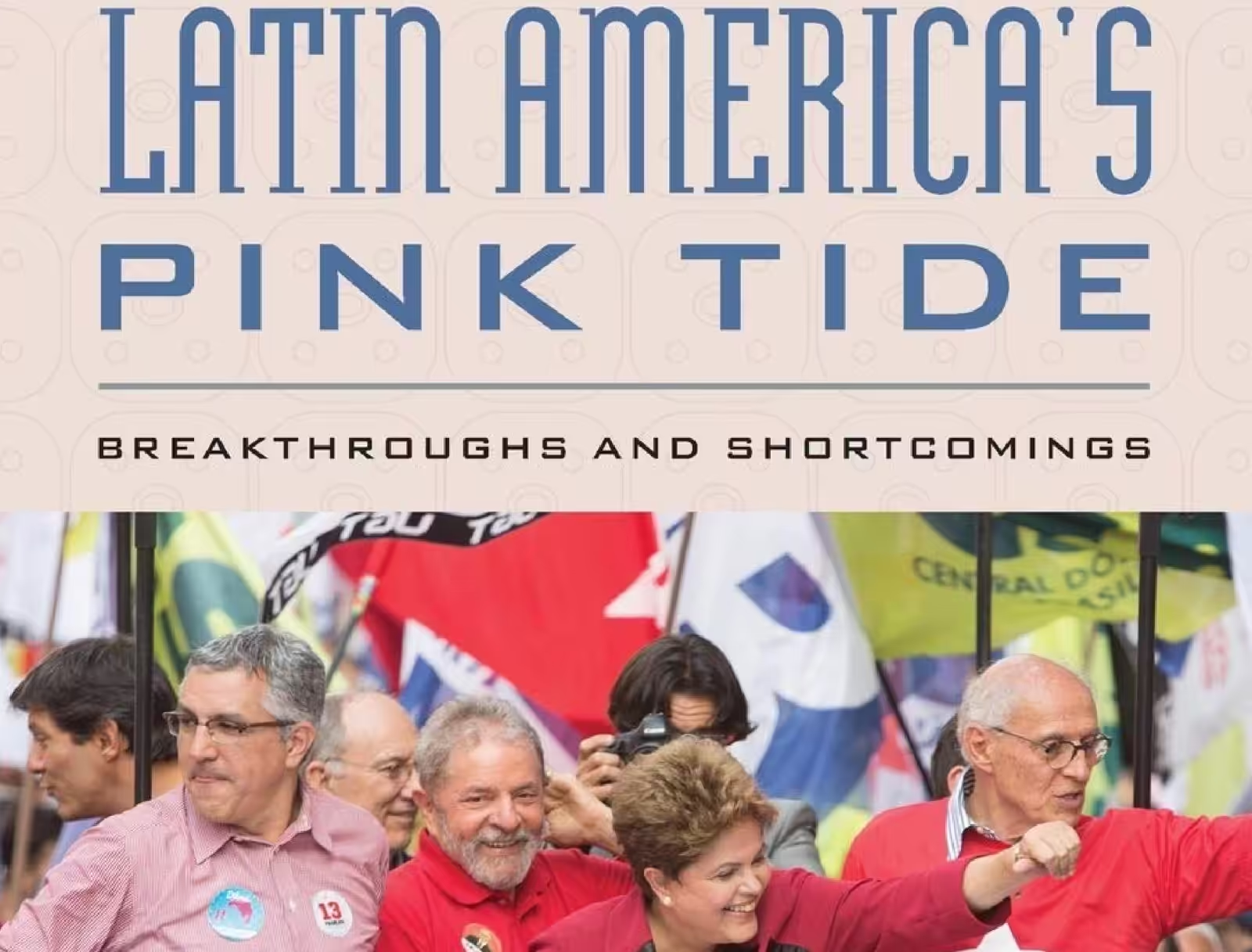
This crisis compels us to grapple with the complex and heterogeneous leftist experiments that have defined Latin America over the past two decades, which is the subject of Latin America’s Pink Tide: Breakthroughs and Shortcomings.
Edited by Steve Ellner, the book offers a range of diverse, richly-layered perspectives on the region’s leftward shift. But more crucially, the text provides indispensable keys regarding how we should read these progressive experiences.
That is–and while this is perhaps not the preconceived objective–the text invites us to participate in methodological and even epistemological debate over how we as global North activists and intellectuals are to position ourselves relative to revolutionary-reformist processes in the region and global South more generally.
Towards an anti-imperialist methodology
Steve Ellner opens the volume with a foundational proposition:
A critical evaluation of progressive or “Pink Tide” governments from a leftist perspective needs to place their performance in political and economic contexts. A logical starting point is an assessment of the degree of aggressiveness and hostility originating from opposition groups.
As Ellner and many other authors in the anthology emphasize, these contexts are intrinsically international.
It is no secret that the United States and other Western states have to varying degrees supported the opposition arrayed against Latin American progressive governments; the former almost invariably led by traditional political and economic elites.
Following Ellner’s methodological lead, our balance sheet must take into account the structural fact of empire, namely the modalities by which US, Canada, and other Western states have repeatedly attempted to co-opt, obstruct, and/or annihilate progressive governments across the region over the past two decades.
Too often, imperialism is conceived as “intervention” or “interference,” which regardless of its regularity, is fundamentally exogenous to the social formation of peripheral countries in Latin America and the global South generally. The danger of this perspective is that it tends to reify the nation-state as a hermetically enclosed space of class relations, minimizing or altogether ignoring the ways that core states and supra-state structures participate in regulating them in the interest of Northern accumulation.
Rather than viewing the subjectivity of Western imperial states as one contingent variable among others, the challenge is to holistically integrate it into our analysis, not in order to reductively explain away every phenomenon under the rubric of an abstract “imperialism” but in order to systematically grapple with its far-reaching political and economic consequences.
The stakes are quite high as scholars’ failure to contextualize the errors and deviations of “Pink Tide” administrations can lead to what Ellner terms a “‘plague on both your houses’ approach,” which equates progressive governments with their right-wing opposition, “detract[ing] from the effectiveness of [international] solidarity.”
Breakthroughs
Many authors in the volume offer an attentive analysis of the strengths and weaknesses of “Pink Tide” processes within the context of their geo-politically circumscribed structural limits.
For instance, in their chapter on Argentina, Mabel Thwaites Rey and Jorge Orovitz Sanmartino identify the Kirchner governments’ resistance to US hegemony–in alliance with Brazil and other leftist neighbors–as one of the conditions of possibility for its “greater relative autonomy” vis-à-vis “bourgeoisie factions” at home. Kirchnerism’s “independent foreign policy” helped open “[a]n opportunity… for the deployment of a mode of governmental power with greater margins of action with respect to the dominant sectors, against which the state could assert its arbitral power and mediating role with respect to the working population” (pp. 144).
The authors ultimately conclude that Christina Kirchner’s 2011 reelection victory represented a “missed opportunity” to go on the offensive, which was in part borne of the administration’s lack of a long-term strategy for implementing political transformations, such as a constituent assembly, as well as structural economic changes (pp. 151). They admirably contextualize this failure, noting that the “autonomy and the growing infrastructural power of the state to drive reformist public policies (Mann, 2004) clashed with the typical structural limitations of peripheral countries, which are overly dependent on the prices of raw materials and have a subordinate role in the international division of labor” (pp. 153). Nonetheless, Thwaites Rey and Orovitz Sanmartino might have clarified that these structural constraints are inherently political: as world-systems theorists have argued, Northern core states extract surpluses from Southern countries like Argentina via unequal exchange and debt peonage, fueling financial speculation that simultaneously functions as a mechanism of imperial looting. As the authors mention, the case of the “vulture funds” is key, illustrating the way in which financial capitalists in league with the US judicial apparatus managed to block the Kirchner government’s effort to normalize access to international credit, “upending the Argentine economic strategy” (pp. 148).
In his chapter on Venezuela, Steve Ellner argues that the Venezuelan government’s “populist” social policies and pragmatic tactical alliances with “friendly” capitalist factions represented a “response to attempts at destabilization and regime change” spearheaded by the US-sponsored opposition (pp. 163). This perspective is invaluable insofar as it delineates the political and economic effects of imperialist siege: backed into a corner by an insurrectionary, foreign-backed opposition, the Chavista governments were compelled to implement policies that succeeded in consolidating their base and neutralizing coup efforts but which had negative repercussions that proved difficult to correct down the road.
While stressing the intractability of right-wing hostility, Ellner does not minimize the role of the Chavista leadership, observing that both Chavez and Maduro did not adequately seize on their victories over the opposition in order to radicalize the revolutionary process, combating corruption and bureaucratization, prioritizing economic objectives, and rectifying unsustainable “populist” policies. While beyond the scope of Ellner’s chapter, the reasons for these shortcomings are complex and manifold, including a mistaken strategic calculation that oil prices would remain high indefinitely as well as the distortions inherent to Venezuela’s petro-state, which as the locus of national capital accumulation, systematically generates corruption, obstructing efforts at structural transformation. However, we cannot underestimate the “ideological collateral damage” borne of unrelenting imperial assault, which helps to close avenues for democratic debate within the revolutionary movement, empowering “endogenous right-wing” elements that obstruct further radicalization paradoxically in the name of “anti-imperialism.”
In another example of sophisticated, contextually situated analysis, Hilary Goodfriend shows how El Salvador’s FMLN was forced to moderate its transformative program in the face of unceasing pressure from the far-right opposition, the bureaucracy, and the United States – effectively tabling any real challenge to the country’s neoliberal accumulation regime. The Supreme Court, the Public Prosecution, the legislature, and the private media attempted to block both administrations’ policy maneuvers at every turn, while the US government leveraged economic aid, among other threats and coercive actions, as a blunt instrument to exact concessions.
Notwithstanding these structural limitations shaped by El Salvador’s peripheral insertion into the world capitalist-imperialist system, the FMLN could possibly have made different tactical decisions. Goodfriend observes that the party “might have made better use of its legislative power during the 2009–2012 term to prioritize radical social movement priorities” in addition to “advanc[ing] a left cultural hegemony… to counter the decades of reactionary official discourse and right-wing media monopolies” (pp. 311-312). Nevertheless, given the extent of the enumerated challenges, the fact that the former guerilla movement managed to remain in government for a decade and achieve significant social reforms is nothing short of remarkable.
Shortcomings
A few chapters in the volume, while offering vital insights into the “Pink Tide” processes in question, do exhibit some analytical blind spots when it comes to grappling with the structural contours of imperialism.
Marcel Nelson examines the more “radical” experiences in Ecuador, Bolivia, and Venezuela through the lens of Nicos Poulantzas’ strategic-relational theory of the capitalist state. Following the Greek Marxist theorist, he likens governing from the left to “‘walking a tightrope’ between pursuing a transformative program while managing challenges from dominant classes that retain their structural power by virtue of the persistence of capitalist forms and the existence of political liberties” (pp. 60). Interestingly, however, Nelson does not discuss the concept of “imperialist chain” that Poulantzas relied on to understand how countries’ position in the capitalist world-system conditions the particular form their state apparatuses take in order to reproduce class relations.
Nelson astutely notes that while unsuccessful in partitioning Bolivia, the US-backed eastern separatists’ 2008 coup effort did have the effect of limit[ing] the degree to which Bolivia’s state economic apparatuses and social relations could be altered” (pp. 70). He goes on to emphasize the MAS’ subsequent embrace of a strategy of “improve[ing] the material well-being of its base not by redistributing wealth but by expanding hydrocarbon production and focusing agricultural production on monoculture” (pp. 70). Both Nelson and Linda Farthing in her chapter argue that the post-2009 period was a “missed opportunity” for the MAS to take the offensive against the dominant classes, but they omit the context of continued US-led destabilization–including USAID support for the CIDOB as part of the 2011 TIPNIS protests–as well as the increasingly adverse regional correlation of forces after the 2013 death of Evo Morales’ strongest international ally, Hugo Chávez, and the subsequent escalation of regime change efforts targeting Caracas.
In the case of Ecuador, Nelson sympathetically writes of the Lenin Moreno administration “correcting problematic governance practices such as the concentration of power within the executive and the use of corruption as a means to consolidate power” (pp. 67). As Patrick Clark and Jacobo García detail in their own chapter, this description is a serious mischaracterization that brushes over Moreno’s dangerous role in undermining the democratic institutions built under Correa, including adopting the right-wing opposition’s neoliberal program and witch-hunting Correista dissidents. In another omission of the context of the “imperialist chain,” Nelson ignores the Moreno administration’s international realignment towards Washington and its reactionary allies, including renewed military cooperation with the US, withdrawal from Latin American integration initiatives like UNASUR and ALBA, and abandonment of its political asylum obligations to Julian Assange.
In his chapter on Nicaragua, Héctor Cruz-Feliciano offers a multi-layered evaluation on the Sandinistas’ policy of pragmatic alliances with dominant class fractions, which allowed the party to return to government but constrained its historically radical program. While the FSLN has made some impressive anti-neoliberal advances, he argues that it failed to harness its considerable pre-2018 political capital to attempt more far-reaching structural transformations.
However, Cruz-Feliciano’s discussion of the Ortega government’s heavy-handed response to the 2018 protests lacks crucial contextualization: he ignores the fact that US-funded NGOs played a key role in “laying the groundwork for insurrection” and implicitly attributes the several hundred deaths to state security forces despite numerous well-documented cases of opposition violence. The author critiques the FSLN’s verticalist political culture, which he in part attributes to its origins as a military organization, concluding that the party “must disassociate itself from Ortega… [and] find a leader that can re-enchant lost militants and conquer the hearts and minds of those who suffer the consequences of government repression.” While renewal of leadership is always necessary, such an injunction may prove idealistic in the near term, given that Ortega, remains highly popular–as even Cruz-Feliciano recognizes–and Nicaragua faces escalating US aggression.
Solidarity and left critique
Reflecting on the legacy of the “Pink Tide” governments, FARC-EP leader Jesus Santrich remarks, “We have to understand their achievements and failures without losing sight of our own failures.”
While our position as global North activists and intellectuals is radically different from that of the Colombian guerrilla commander, the self-reflexive imperative is the same.
In accessing the successes and dire limitations of Latin America’s progressive cycle, we must simultaneously recognize the anemic weakness of our own anti-systemic movements in the core states, which have proven incapable of offering real opposition to imperial predations in a way that could (have) broaden(ed) the maneuvering room available to “Pink Tide” governments.
Given this globally adverse correlation of forces, we might echo sociologist René Rojas’ observation that the region’s progressive governments “failed to move toward more substantial restructuring not out of overriding obligations towards business elites. Rather, they failed to deepen reforms that might have secured the backing needed to stay in power because they felt unable to take that more challenging route—and were correct in that assessment” (quoted by Goodfriend, pp. 312).
Minor shortcomings aside, Latin America’s Pink Tide is, without exaggeration, the richest and most complete overview of the region’s leftist experiments to date. The volume is an essential starting point for debate on progressive governments’ legacy and strategic lessons for counter-hegemonic processes everywhere. Quite simply, it is required reading for anyone interested in the recent past, present, and future of Latin America.
Source URL: Canadian Dimension

Lucas Koerner
Lucas Koerner is a journalist and political analyst based in Caracas, Venezuela. He currently serves on the editorial board of Venezuelanalysis.