By Arnold August – Dec 23, 2021
This article contains the following sections:
The Biden December “Democracy Summit”: Ominous Message for Cuba?
Manufacturing Dissent
Repression, Suppression, Intimidation and Detention: Universal Values?
If Not “Repression,” How About “Revolution”?
Conversations with Cubans: Why Did 15N Fail?
Canadian-Cuban Archipiélago Coordinator Confesses: Revolution and Not Repression
The Biden December “Democracy Summit”: Ominous Message for Cuba?
Two days after the failed subversion effort on November 15, Yunior García, leader of the Archipiélago Facebook group that organized it, fled to Madrid in “order to escape repression.” There is more than meets the eye about the buzzword “repression,” which we deal with extensively in two sections: Manufacturing Dissent and Repression, Suppression, Intimidation and Detention: Universal Values?
From Madrid, Yunior called for “an alliance of opponents from Cuba, Venezuela and Nicaragua to confront the ‘same dictatorship.’” Furthermore, on November 30, came the following: “In the wake of the Cuban regime’s actions targeting peaceful demonstrators on November 15, the [US] Department of State … imposed visa restrictions on nine Cuban officials.” In addition, the White House-sponsored “Summit for Democracy” took place on December 9, with a selective list of countries invited from around the world. Taking into account only the Western Hemisphere, the orientation of the Summit can be determined by the fact that invited guests included right-wing pro-US imperialist governments such as Canada, Colombia and Brazil. Excluded from the Summit were Cuba, Venezuela and Nicaragua.
There is a direct link between the failure of 15N in Cuba, the Democracy Summit and other international events running through to 2022, with the common denominator being “repression” in Cuba. Yunior provided the outline for this in his call for an alliance of “opposition” in Cuba, Venezuela and Nicaragua, while also affirming that he intends to continue his activities against the Cuban government. At Biden’s Democracy Summit, the stage was set when Juan Guaidó was invited as the representative of Venezuela. At this point, Rosa María Payá, another Cuban dissident who had supported 15N, was catapulted onto the scene from the US (Washington and Miami) where she is mainly based.
These stages are (conveniently for the US and its allies) much closer to the centre of anti-Cuba counterrevolutionary power than Madrid. Just who is this Payá personality? In this video, during a meeting with the then-President Trump, she said: “July 10, 2020, the promoter of Cuba Decide, Rosa María Payá asked President Trump to directly help the Cuban people and designate the Communist party, the G2 [intelligence] and the Cuban military as a terrorist organization.”
She was invited to attend the Democracy Summit as part of the Venezuelan delegation. As we can see on Guaidó’s imaginary “government stationery” below, Payá was designated as one of “10 honorable men and women fighting for liberty in Venezuela, Cuba and Nicaragua.”
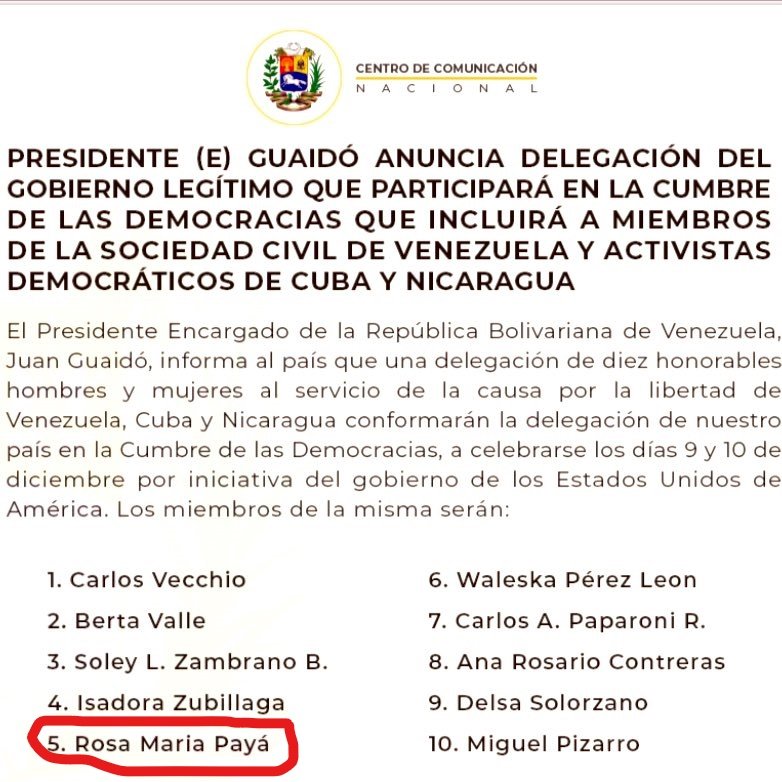
Payá declared in a tweet that “it was an honour to be part of the Venezuela delegation,” while deploring the fact that the Cuban counterrevolutionaries [in Miami] were not invited to represent the Cuban delegation. In another tweet, she thanked Secretary Blinken for mentioning Cuban “political prisoners in his address to the Summit,” reiterating her complaint that “Cuban dissidents were not invited,” but expressing the view that it would be “crucial that this behaviour be corrected for the next Summit of the Americas.” The US-sponsored Summit of the Americas is organized every few years, with the next one (the 9th) to be held in summer 2022 in the US, due to the pandemic).
It’s necessary to go back to the seventh Summit of the Americas, to understand Payá’s desires. It was held in Panama in 2015, taking advantage of the massive international media presence, dissidents from Cuba tried to take over the civil society meetings being held in parallel, but as “representatives” of Cuba, a move that was opposed by the revolutionary Cuban representatives who had also travelled to Panama, and resulting in clashes.
This type of media-enhanced conflict is already on the agenda for the ninth Summit in 2022. This plan-in-the-making constitutes yet another indication that the US and its allies have not abandoned their regime change objective for Cuba, despite the 15N flop.
RELATED CONTENT: July 11 Protests in Cuba: A Personal Narrative of Events
As part of the research for this piece, I held several interviews online and by phone with some of my colleagues in Havana. The interviews, which took place from November 15 to 25, are interwoven into this article. One of the colleagues is the multiple-award-winning journalist and author Luis Toledo Sande (scroll down to Toledo Sande). It is notable that the exchange with Toledo Sande took place prior to Yunior’s appeal for “an alliance of opponents from Cuba, Venezuela and Nicaragua” and the belated statement from the State Department on November 30. Here is an excerpt from the transcript (my translation from Spanish):
Arnold August: Can you please explain, expand on, the following two mentions of “naivety” from your article on “Cuba: From July to November,” one of them being: “did their farces end with the departure for Madrid of their most visible vernacular ringleader, helped by the complicity of Spanish authorities? It would be another act of naivety to think so. The enemies of the Cuban nation, even when they know they are historically doomed to failure, will not be satisfied without getting Cuba to wear itself out by responding one by one to their maneuvers, and neglect the work it should continue to do for the good of the people and their quality of life.”
Luis Toledo Sande: God forbid! [ironically] Even honest atheists will say this in the face of this danger. The Empire does not sleep, it does not cease, not for a single moment does it stop plotting traps. It is an insatiable and giant tarantula, in decline, yes; but with a survival power that can still be prolonged. Cuba knows it. And it is essential to know that, although deep down the Empire – US imperialism – knows that it has no possibilities to triumph in its aspirations to crush Cuba, to overthrow the Revolution and erase its example, as long as it is what it is and it will not cease in its desire to harm this country, to lead it to respond to successive specific aggressions, to distract it from its duty to continue advancing and developing for the good of the people. Not knowing how the imperialist machinery works – still today with enormous economic and military resources, with the power of the media that allows it to manufacture and sell lies after lies as if they were truths, with financially sound international allies and with mercenaries at its service – would be perhaps the greatest imaginable naivety. God save us!”
What can we learn from this? The current post-15N situation confirms Toledo Sande’s apprehension as expressed before the 15N defeat, namely that, even if the US still had no chance to triumph, it will not cease in its desire to harm Cuba. For example, the latest statements by Yunior, the State Department and the Democracy Summit in December have unveiled more provocative actions already being planned from now through 2022. They point to the danger of entertaining any naive views on Yunior and his allies as being fostered by middle-of-the-road Cuban “experts” on the island and abroad who sympathize with him and the colour revolution.
Nevertheless, to get a better understanding of the current situation and its implications for the future, let us delve into the context that led to Yunior setting up his headquarters in Madrid and the convergence of events and statements in December. On November 27, 2021, as the photos show, a massive march took place in Havana on the occasion the 150th anniversary of Cuba’s iconic anti-colonial cause, that is, the assassination of eight medical students by the Spanish colonialists. The 200,000-strong march in Havana was not of course recognized by Western governments or their media. At the other pole of the political spectrum, November 27 was also the first anniversary of the so-called artists’ “San Isidro November 27 Movement,” on the issue of the Cuban government’s Decree 349 on culture.
US Secretary of State Antony J. Blinken issued a supportive statement on the anniversary. The “San Isidro Movement” was the antecedent to Archipiélago’s aborted November 15, 2021 mega-spectacle, regime-change colour revolution, with the same actors, including Yunior García. However, for the vast majority of Cubans, the annual November 27 march took on a completely different dimension in 2021: it was their victory lap, completely overshadowing the 15N march, which failed to materialize. Numerous revolutionary bloggers and journalists were quick to take the opportunity to rub this in the noses of the US and its anti-Cuban allies. Nevertheless, some important words of caution were also expressed. For example, on December 12, Iroel Sánchez wrote an article on his blog—which was republished in Granma, the official organ of the Communist Party—with the ominous title “Excessive enthusiasm is a difficulty when facing frustrations”:
“[It is not triumphalism that should guide the work of Cuban revolutionaries after this 21st century Bay of Pigs… Not to rest in the battle for the truth, [we must] face decisively in confronting inequality where the disadvantages for the humblest have accumulated very significantly. [We must] create and enhance new economic, social, legal and cultural instruments against any inequality and discrimination, to intensely involve the people, and especially the youth, in the new and old fights. [That] has been the Fidelista response of the revolutionary leadership to the challenges of the present. And it has done so by listening to many, accepting criticism and speaking modestly, while working with intensity and transparency… So only the broadest culture and the most intense work can be our vaccines against an empire that, in its decadence, and worried about losing its hegemony at the global level, wants to gain a foothold in a territory it considers its backyard.”
Manufacturing Dissent
On November 14–15, as soon as it was evident that the march was to be a monumental failure, as nobody would show up, the US government and international mainstream media provided the main buzzwords as to the cause of the failure: repression, suppression, intimidation and detention. The US set the tone by manufacturing the narrative. For example, there is the Statement by National Security Advisor Jake Sullivan on Cuba’s November 15 Protests, November 15, 2021 on intimidation and detention. We also have the Head of Latin America at the US State Department, Brian Nichols, speaking on November 16 and enunciating the keywords suppression, detention and intimidation. Secretary of State Antony J. Blinken on November 14 pointed to intimidation and repression. State Department spokesperson Ned Price on November 16 referred in his statement to intimidation, repression and detention. All of these US officials singing the same song in unison!
This narrative was taken up by the international mainstream media. The right-wing Spanish-language outlets in Madrid and CNN in Spanish led the charge by targeting their audiences in Spain, the US (the Latino communities) and Latin America. In English, there was, of course, the Miami Herald. However, as far as the English language, the most effective of the evils was CNN’s Havana correspondent Patrick Oppmann. His role was (and is) to flesh out the “repression, suppression, intimidation, detention” keywords by “reporting” from the ground. Every word he wrote bristled with these accusations. Examples of his posts include:
“..unlike the 11th of July, authorities are ready today. Any small group of protesters will likely be arrested very quickly.”
“The street where Yunior García Aguilera lives has been closed off. Cuban police have surrounded his block and a group of men just hung a large flag over his window. He said earlier he would march by himself today but not clear if he will be allowed to leave.”
Oppmann posted the position of the local authorities in Spanish, rather than laying out in English the constitutional and legal basis of the refusal to march, as I have done here: On the Cuban Authorities’ Decision to Prohibit Marches. This is not an insignificant caveat, since the entire international drama leading to November 15 was based on this refusal. Of interest, the following July 29 post is still pinned to the top of his Twitter feed at the time of writing: “After historic protests, defiant Cubans face mass trials.” Oppmann did not even unpin it after his own November 17 post, in which he confirmed that, far from being repressed and a prisoner in his own home, “Yunior García Aguilera and wife have arrived in Spain after the Cuban government thwarted his attempt to hold island wide protests.”
CNN and conglomerate media ignore all the evidence of US direct involvement through their agents. This US subversive engagement has been pointed out by many commentators in the West, such as in my piece here in The Canada Files, “Inside Cuban dissidents’ November 15 plot,” and from the US Mint Press’s Alan MacLeod, “The United States is Organizing a Color Revolution in Cuba for November 15.”
Repression, Suppression, Intimidation and Detention: Universal Values?
US-centrism is the outgrowth of Eurocentrism, adapting the latter to the conditions of the US. This US-centric outlook is historically based on the premise of God-given privilege that the US has assumed from the time of the 17th-century Pilgrims as the chosen people and the “beacon on the hill” to bring light to the peoples of the world. Thus, by its very nature, this superiority complex is multiplied manyfold since this elite in the US is based on the current white supremacist state as a vestige of the genocide of Indigenous nations and then expanding this state to incorporate slavery.
From this vantage point of the biblical hill, the principal targets are the peoples of the south. Therefore, ipso facto, this “light” is defined exclusively by the ruling circles. Their concepts are presented as universal truths that cannot be challenged. Perhaps the most notorious example is “democracy.” In my 2013 book dealing with a comparative study of democracies in the US versus Cuba, Venezuela and Bolivia, I drew heavily on the foremost expert on Eurocentrism, the late Samir Amin (1931–2018), whose warning is perfectly applicable to the current Cuban situation:
“The issue of Eurocentrism and its offspring, U.S.-centrism, is very complex and ingrained, operating, as Samir Amin warns, ‘without anyone noticing it. This is why many specialists, historians and intellectuals can reject particular expressions of the Eurocentric construct without being embarrassed by the incoherence of the overall vision that results.’ For example, while certain academics may distance themselves from some of the most grotesque features of Eurocentrism and U.S.-centrism – such as their claims to be the defenders of a superior political and economic model for the world – they may still fall prey to the main ideological and political underpinnings of the U.S-centric model.” (pages 7–8)
If this is true for the preconceived views on “democracy,” it is infinitely more valid as applied to the current highly-charged controversy swirling around Cuba regarding “repression” “suppression” stories. Is Amin’s cautious warning of an incoherent — pick-and-choose cherry-picking — appreciation of US-centrism, much more applicable to the current Cuban “repression” controversy in comparison to the “democracy debate?” I believe so.
Both “suppression” and “democracy” are of course linked, based on the US-centric optic. A country that is tagged as being “undemocratic” is ipso fact one that exercises “repression.” One can assert that in the case of Cuba, the US has distilled and refined “repression” from the cauldron of democracy to hammer away at “suppressive Cuba.”
There is no denying that “democracy” as a universal value is highly controversial. However, it is a positive affirmation with which everyone “agrees” as being desirable. Ten countries have “democratic” as part of their name, such as People’s Democratic Republic of Algeria, Democratic Republic of the Cong, and Democratic Republic of Timor-Leste.
At the same time, the international image of the US as a democratic country has been increasingly questioned both inside the country and abroad. Even The Economist, a typical mainstream media, has challenged the US as a judge for democracy in the context of Biden’s Democracy Summit. While it is the increasingly discredited US democracy that prompted Biden to hold his Democracy Summit in the first place, its very deliberations backfired to a large extent, as The Economist testified.
On December 15, 2021, Friends of Socialist China was invited by the International Department of the Communist Party of China to participate in a virtual meeting entitled “Democracy, Justice, Development and Progress.” Co-editor Carlos Martinez presented:
“In recent years, the idea of the socialist countries being ‘backward’ or ‘undeveloped’ has started to lose any of the resonance it once had, even among people in the West. The People’s Republic of China in particular has emerged as a powerhouse in science and technology; it is among the world leaders in 5G, in artificial intelligence, in quantum computing, in nanotechnology, in space research, and more. China’s successful campaigns to suppress Covid-19 and to eliminate extreme poverty have caught the world’s attention, and the ‘backward’ label just does not stick….As a result, the propaganda campaign against socialism has had to shift somewhat. Its emphasis has moved away from questions of development and progress, and towards questions of democracy and justice. This is consistent with the Biden administration’s attempts to differentiate itself from Donald Trump, who had a negative impact on the image of the US as the upholder of ‘liberal democratic’ values.”
This appreciation of the evolution of socialist countries also applies to Cuba to a certain extent, but not of course, given the unprecedented 60-year-old blockade, limited natural resources and other factors, as spectacularly as China. Today, the alleged violation of democratic norms against Cuba does not deal with elections and governance. It is rather concentrated on the activities in the streets such as allegations that the Cuban government and its millions of supporters arbitrarily “represses” and “supresses” opponents, “intimidates” them in front of their homes and detains them in jail “with no legal justification or rights.”
On the one hand, unfortunately this idea of “repression” and “suppression” finds a certain resonance among some on the left and academics both in and outside of Cuba. On the other hand, the US accusation of “democracy” is largely discredited among these same individuals. This “soft on repression” constituency is actively sought by the US. For example, Yunior, playing the repression card, specifically appealed to “the left worldwide” to support their cause. Thus, we are obliged to deal with “repression” as a concentrated expression of alleged violation of democratic norms.
Do these friends of Cuba, some on the left and certain academics, notice this intrusion? It brings to mind Samir Amin’s justified apprehension of how Euro- and US-centrism take hold in the mentality, as he says, “without anyone noticing it.” Thus, to break out of the narrow confines of the one-size-fits-all “repression,” requires an effort and some uncomfortable soul searching. Just as democracy, “repression” is weaponized by the US to serve its interests.
Thus, to remain within the confines of “repression” serves only the interest of the US. It invariably results in debating the extent to which the Cuban state and the revolutionaries are “supressing,” thus, inadvertently or not, to play into the US game plan. The talking point “Cuba is not as repressive as the US” reduces it to a question of degree, a sliding scale of repression, and thus unwittingly obscures the reason why November 15 failed; even worse, the acceptance, even unconsciously, of the “repression” framework negligently provides credibility to the US-led narrative on “repression.”
Keep in mind that none of these conglomerate media that ridiculed the Biden Democracy Summit would challenge the US on the “repression” accusation thrown against Cuba. This allegation gets a pass from the ruling circles, while they are increasingly dubious about the US democracy credentials, in the US itself and internationally, as the self-proclaimed “beacon on a hill.” These are some of the ideas that weigh heavily on the movement to support Cuba against the US and its colour revolution allies.
If Not “Repression,” How About “Revolution”?
The July 11 protests were “organized by the counterrevolutionaries and confronted very little planning or apprehension from the revolutionary forces,” as related by Luis Toledo Sande in our interview. Right after July 11, the government activated virtual daily activities, many featuring the President of Cuba, Miguel Díaz-Canel. These involved meeting and exchanging with the people in the streets about their concerns. The seed of this, which is not unprecedented in Cuba’s political history, was actually July 11.
On that day, the President, having heard about the demonstrations in the small town of San Antonio de los Baños, west of Havana, went to meet with the people in the streets. However, very significant is the work of Gerardo Hernández, one of the Cuban Five heroes who was jailed in the US for having infiltrated terrorist groups in Miami planning attacks against Cuba. Since released in 2014 as part of the US–Cuba deal to re-establish diplomatic relation and reopen embassies, Gerardo (as he is affectionately known by Cubans) has held various positions. In September 2020, he was elected as the new National Coordinator of the neighbourhood mass organization Committees in Defence of the Revolution, or Comite de Defensa de la Revolución.
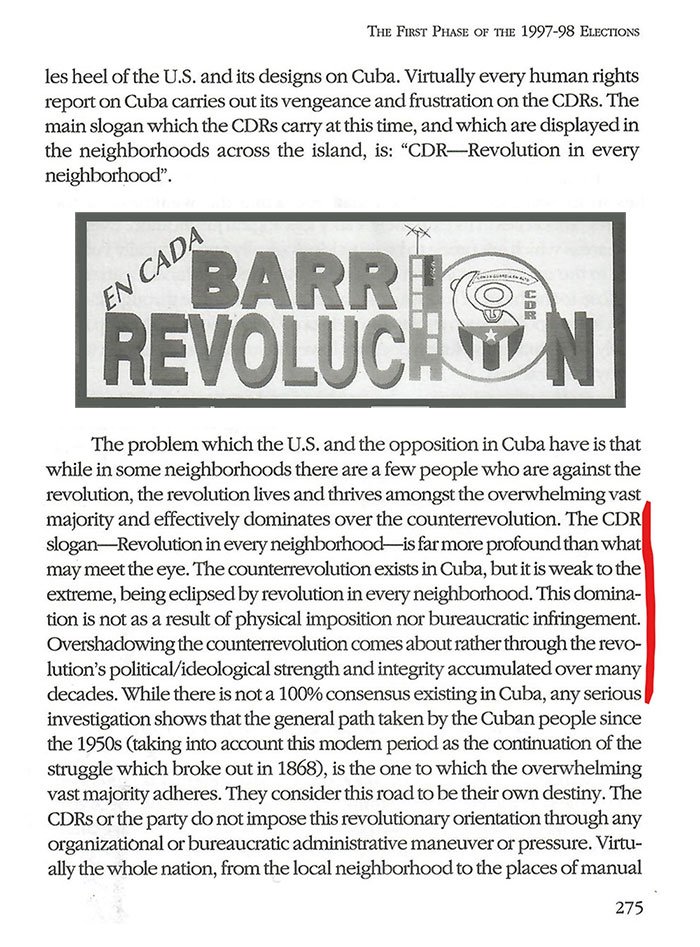
What are they? Based on the research I carried out when I lived in Cuba (on and off for a year and a half during 1997–1998 to witness all the steps of the elections and the political system), the CDRs are local committees comprised of citizens living within a few square blocks, about 100 to 150 people. However, what is significant for our purposes here is their role at the time in combating counterrevolution, though the Revolution’s political and ideological strength and integrity, as my 1999 book points out:
These neighbourhoods and their corresponding block-based CDRs are stable and change very little over time. In fact, in a November telephone conversation with Elena Martínez, who headed the local CDR where I lived in 1997–1998, she confirmed that the basic structure and population remain the same today where she still serves as the head of that CDR. The vast majority of Cubans own their own homes or apartments. As result of this and other factors, there is very little mobility in cities. They are often very tightly knit neighbourhoods, ideal for combatting counterrevolution.
So, what has changed since 1997–1998? The counterrevolution has vastly increased its capacity to subvert the Revolution with the help of powerful social media (which did not exist in 1997–1998), both inside Cuba and abroad. What happened in November 2021? Let us dive into the present day CDRs.
From the Gerardo Hernández Twitter feed, the following constitutes just a few examples (translated from Spanish), especially during the days leading up to November 15. It is pertinent to point out for non-Cubans that the counterrevolutionaries live in these neighbourhoods like any other citizens, and thus were aware of what was occurring.
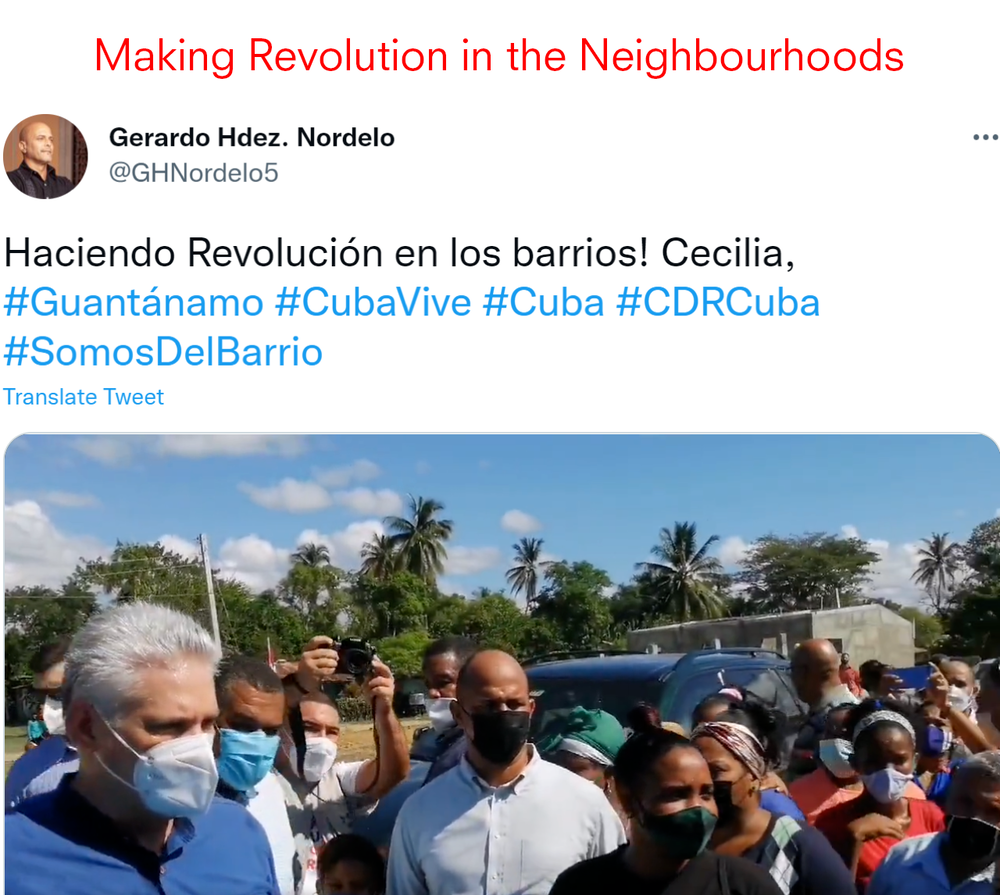
This tweet by Gerardo reflects the tone, posted on November 11, “Making Revolution in the neighbourhoods” with this hashtag #SomosDelBarrio (We are from the neighbourhood), implying that Revolution represents the neighbourhood and not the counterrevolution and featuring a video of President Miguel Díaz-Canel mingling and exchanging with the people in the streets. All of his posts contain #SomosDelBarrio. On November 9, Gerardo posted a video and pictures showing students receiving medical donations and handing them over to the CDR.
In a November 10 post, Gerardo features a video from a small town west of Havana with residents dancing a congo, chanting “Yo Soy Fidel” (I am Fidel) clogging its main street. Also on the same day, with photos of crowds in the same small town with Gerardo in the very centre of this, his post challenging “watch out anti-Cuba disinformation media, have a look today, we are all the CDR militants,” taunting “you know why I say this…: #SomosDelBarrio.”
A November 11 post was dedicated to a meeting of the local municipal government in the same small town convened to underline the 45th anniversary of People’s Power in Cuba. In 1976, the current political and electoral system was established, and, despite its shortcomings, the local municipal level remains its foundation. This is an important point. According to Iroel Sánchez in his July 26, 2021 panel presentation on Cuba (for which The Canada Files was the media sponsor), for more than one and a half years, almost all local grassroots organizing was put on hold as result of the pandemic. This virtually froze the normally vibrant local social and political fabric in the neighborhoods. However, according to a recent telephone conversation with my colleagues in Havana, these activities started to function again in early November as part of the reopening of the country after successfully combatting the pandemic. This opening reignited the neighborhood activities, thus contributing substantially to the CDR momentum cited above.
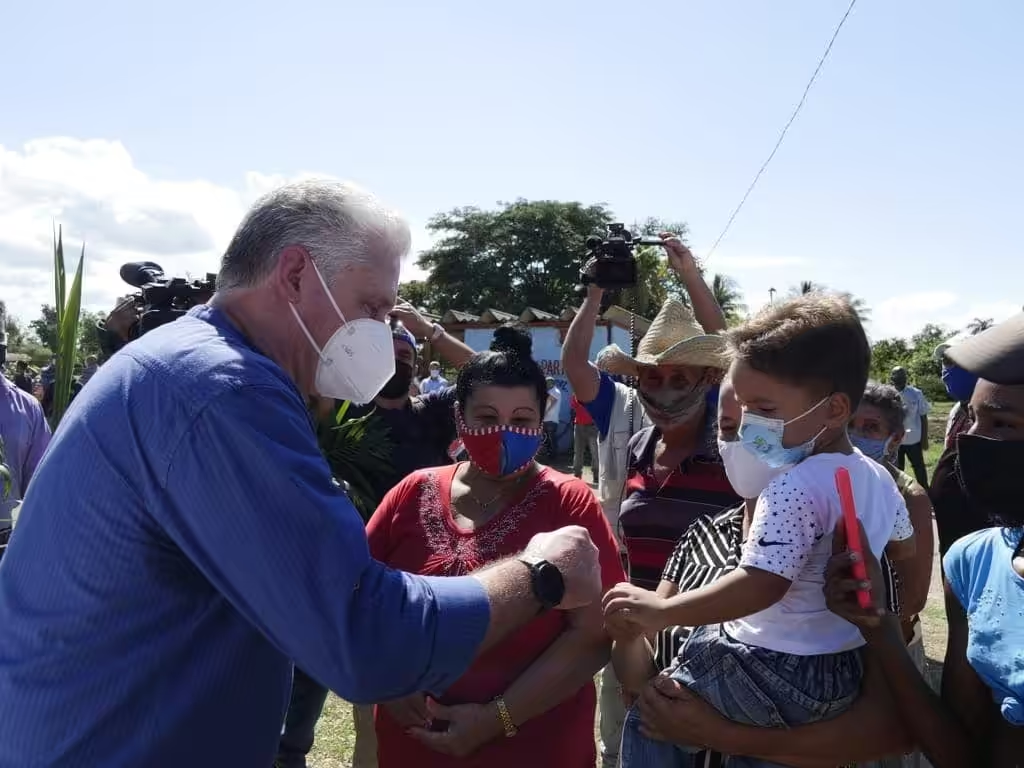
Continuing on the path of Gerardo and others, on November 11, Gerardo tweeted the following with a video: “The President and his people” in neighbourhoods at the other end of the country, in Bayamo, the eastern province of Granma. As November 15 was approaching, the Cuban government crafted the slogan “No one is going to spoil our party,” referring to the long-awaited November 15 full return to classes for all students after more than a year and a half of online classes. Gerardo added that “this was made clear in the exchanges between the citizens and the President” in a neighbourhood in Granma, a barely veiled message to the counterrevolution. A look at this video reveals yet another glimpse of the Cuban Revolution from the inside, this one in Cienfuegos (central/southern Cuba) and where Gerardo mocked the Biden comment that Cuba is a “failed state,” with the Cuban President getting out of the car to mingle freely with the people, implying that his could never happen in the US. All this was also broadcast by Cuban TV and newspapers.
The movement at the grassroots level through the CDRs was picking up steam. Yet another factor came into play, this one spontaneous. A Facebook group comprised of youth called “red scarf” issued a sort of manifesto: “Today I also wear the #pañuelorojo [red scarf] to accompany the eternal anti-imperialist cause, to protest against the blockade and the war against us. To protest against bureaucratism and idleness, to protest against any attempt at capitalist restoration, whether it comes from declared enemies or from those who call themselves friends.” They started a sit-in located in one of Havana’s main squares, Parque Central, picked up by one of its activists whose November 13 video showed Gerardo with a red scarf in the middle of the crowd and the slogan “Long Live the Revolution!” On November 13, Gerardo posted a video of himself with the red scarf among the young activists and yet another with more youth activists.
All of these activities confirm the importance of concentrating on the “battle for the streets,” and its accompanying litany of “repression,” etc.
This is speculation, however, news reports indicate that Yunior started to negotiate with Spain for his unceremonious flight to Madrid several days before November 15. These back-channel discussions may very well have been taking place around November 11–13, when it was clear that the colour revolution was up against a wall of moral resistance. Moreover, the forces of the Revolution seemed to have adopted a wide variety of inspirational mobilizing tactics. On November 13, one of Cuba’s most popular musical groups, Buena Fe, joined the musical sit-in with Gerardo, as did another classic group (enjoy their music in this video) Moncada and their musicians. On November 15 at 9 a.m., Gerardo tweeted with confidence that “our 15N” has arrived with photos of schoolchildren on their way to school.
In a complicated and controversial situation such as the reason for the failure of 15N to achieve anything like a soft coup, let us look to the classics for much-needed assistance. In the course of striving to document and conceptualize the Cuban resistance, Karl Marx came to mind, even if in a different context. He wrote, “Theory … becomes a material force as soon as it has gripped the masses.” In the concrete conditions of the Cuba nation, whose political outlook is based on the leading role of the Communist Party of Cuba, Marxism-Leninism reflects itself (among many other features) in defence of the Cuban Revolution.
This ongoing political program includes all the social, economic and ethical features that provide the Revolution’s underpinning. In addition, the CPC’s principle of sovereignty and national dignity, which also includes the heritage of José Martí, is an integral part of Cuba’s project. My experience in Cuba has shown me that the vast majority of Cubans are fully conscious of all these facets, including the attempts to overcome their own shortcomings. It is a highly politicized society.
All the features mentioned above existed in the minds of Cubans before the July 11 protests, but were not put into play. In the period from October 12 when Archipiélago announced it was going ahead with the march on November 15, despite it being declared illegal, resistance to the colour revolution spiked. It culminated in the series of neighbourhood activities described above. They proved to emerge as a sort of “mini revolution” within the Revolution.
The ideas were sharpened and became more vocal, determined and widespread throughout the country. This especially occurred in the Havana neighbourhoods as the epicentre of the battle between counterrevolutionary forces and the Revolution. As conversations with my colleagues in Cuba revealed below, an atmosphere of the Revolution being rekindled became part of the political landscape.
The official Cuban narrative at the time was that the country was being “reborn” again after the epidemic with the return to normal life on November 15. However, based for example of the work and related tweets by Gerardo cited above and what my colleagues related, one could also affirm that the Revolution was “reborn,” at least at the neighbourhood, level as result of this movement. If this is the case, the seed of this rebirth was sown on July 11 when the President went to discuss with the population in San Antonio de los Baños, followed up by what seemed to be almost daily meetings by the President at the grassroots level across the country.
This experience in the weeks and days leading up to November 15 was palpable, according to the email exchanges and telephone conversations with some of my colleagues, about which I elaborate in the next section. This is what Marx described as theory, or in our current Cuban context, “ideas becoming a material force.” Add to this the fact that the dissidents live in the neighbourhoods, face to face with the Revolution’s moral cause. In November 2021, it was ideas converted into matter that created the condition for the November 15 victory over the counterrevolutionary forces. This is why the hoped-for crisis and resulting chaos, designed as a pretext for further US intervention, did not take place. It had nothing to do with physical “repression,” “intimidation,” etc. It was a battle of ideas, and the Revolution won.
Conversations with Cubans: Why Did 15N Fail?
As is customary in my work on Cuba, I always test my ideas with the views of Cuban colleagues. I asked several of them about my views presented above, namely that it was the Revolution and not repression or suppression that defeated the 15N subversion effort, with sub-questions on some occasions. Some answered directly and others did not; however, this latter response is as telling, if not more, than the direct responses. In fact, as will be explained, it confirms my view. Here are the unedited transcripts in full of the email and telephone conversations.
Jesús García Brigos, researcher and author, Institute of Philosophy, Havana
JGB: What is certain, clearly, is that there would have been confrontation had we resorted to force, as we were entitled. We turned to “moral force,” distributed via the media, about the nature of these provocateurs. I also think that showing a lot of what was being done about neighbourhood material issues helped. Gerardo Hernández is making a very good effort to revitalize the Committees for the Defence of the Revolution (CDR), and people respect and like him.
AA: And physical force?
JGB: We could use legal force. Because, according to the Constitution and our penal code, everything that guy and his “followers” were doing amounts to punishable criminal offences. That’s why I told you in an earlier conversation that all of them, legally, could have been put in prison some time ago for collaborating in the destruction of our society.
I would say that moral force was what quashed the attempt of those who once again showed their mercenary nature: a mercenary does not dare to confront anything that might cost him his income. And that’s what happened to these people, especially the ringleader, who surely is now devoting himself to spreading whatever lies he likes now that he’s outside Cuba… until he’s no longer useful to his enemies, because that’s how it is in the end. Finally, for now, I think we dealt with the attempt successfully. But the struggles will continue. They won’t stop.
Dr. Juan Azahares, Professor of Philosophy at the University of Havana, active member of the CDR in his neighbourhood in East Havana
JA: The proposed march had been completely discredited among the people prior to November 15 because of the dissemination on Cuban news on their connections to notorious counterrevolutionary figures outside of Cuba. Key operators in the eastern provinces had withdrawn from participation As a result, the expectation prior to November 15 was that no counterrevolutionary march would take place on November 15. So, the CDRs did not plan any action for November 14 or 15; the members went about their normal activities on these days. They were simply on alert for any possible phenomenon.
Frank Miló, Documentarian, Cuban Union of Writers and Artists (UNEAC)
FM: I believe what you think is right. Your ideas are correct. In general, November 15 was much ado about nothing, as they say. As I told you before, it was more hullabaloo than anything. I also told you there wouldn’t be a march. Only a few people in Cuba are dissidents, not the majority. For example, my family is totally revolutionary, and doesn’t agree.
AA: Could you explain?
FM: How could their leader leave the country in 24 hours? It was all orchestrated. Nonetheless, the economic situation, services and infrastructure in the country are problematic here. Principles above all at the defining moment was the cause of their defeat. In the days before, the television was talking more about November 15 than people were. Word in my circle was that there wouldn’t be any march.
Liset García, Journalist, Bohemia
LG: I think your interpretation of the facts is along the right lines. The Revolution lives through its people. There was an awakening among the country’s leaders of the necessity to take care of people more at a micro level. The pandemic forced a shift to deal with the health emergency and organizations that were demobilized.
As I explained, what I saw was people struggling to survive. Average people didn’t place any importance in the movement. They were not thinking about what might happen. The effect was the opposite: that day, everything was quieter than ever. I was surprised to go out in my busy neighbourhood and not see anyone in the streets. At the bank and the ATM [cash exchange outlets], where there is always a huge lineup, there were three people. I commented on it to the bank employee, and he set me straight. I asked, “People stayed home?” A friend said that, in her neighbourhood, there was no line at the bank either. And, later, I went to Bohemia [where she works as a journalist], and the buses were empty.
AA: Has the Cuban government improved its credibility since July 11?
LG: Although we have shortcomings, many problems piled up, and there are unhappy people, people are fundamentally anti-imperialist, and they know that internal problems get fixed internally. I think our communication won out. We are gaining space and credibility. We’re informed about everything, good and bad. Díaz-Canel has developed a solid method for communication with people. And he’s seen with his team in the street and with people. Not all together but spread out across the provinces. He himself is in two or three places daily, and everything is published. This is a preferred technique. Explain, guide, listen. The Fidel method. In my opinion, consensus in favour of the Revolution has strengthened. Despite everything.
On Monday [November 15], the only thing that was the same in my neighbourhood was the bread line. There have always been lineups for bread, but the pandemic has made it worse. There’s no rice to buy freely, just the normal ration, and other supplies are limited. So, people eat more bread. You know, here rice and beans are the main dish on the table. And the ration isn’t enough. People are anxious to buy anything. And bread is the only thing there’s no shortage of. I’ve stood in line up to seven hours to buy bread for my dad. I bring it to his house. He’s 85 years old. This worries people. Along with the fear of catching COVID. And the vaccination was a success. The scientists are heroes. And this has raised people’s self-esteem.
Luis Toledo Sande
LTS: I fully agree with you that the Revolution, the strength of the masses and understanding were decisive in the failure of the counterrevolutionaries. This case was very different from July 11, which was organized by the counterrevolutionaries, and we had very little planning, no warning from the revolutionary forces. This meant those who staged the July 11 protests were mobilized by the American empire and by a few people who are dissatisfied with material issues, power blackouts, food scarcity, lineups, the anxiety of the pandemic. All of this spurred confused people to join in the protests, although I think in quite a few cases – more than confused – people were hostile to some extent toward the Revolution, or insufficiently ideologically prepared.
Remember that July 11 had its antecedents in November 27 and other events later on associated with that day. The counterrevolutionaries came and prepared the ground and, gaining momentum and mobilizing, and letting it be seen that they could rebel and do what they wanted, and nothing happened to them. I think that’s essentially what happened on July 11. However, this was a serious warning. This time there was meticulous informational and ideological preparation. The Cuban people knew who was planning the allegedly peaceful November 15 march, where they were organizing, getting their funding… Ample information was deployed.
AA: Was there intimidation?
LTS: You ask if there was intimidation. I think so: the worms got cold feet, Yunior García chickened out and fled to Madrid. No one turned out on the streets or with the little white flower in their hand. After, it was said that there had been police threats. However, it was neighbourhood women and young people who went and told them, “You’re a counterrevolutionary, and we’re not going to allow you to attack our homeland,” and they backed off. There was intimidation because the annexationists were intimidated. They don’t have the ideological or moral strength to face a people who were prepared. They weren’t afraid of a beating, because the revolutionary force was ready and knew that they shouldn’t attack with balows. Unless it was in self-defence, of course.* If the worms attacked you in the street, you had to defend yourself. But let’s keep in mind that on July 11, it was the police who were assaulted not the demonstrators. The order was to not use arms against the demonstrators. Recall that, not long ago, in 2019, the people voted by a very wide margin to approve the Socialist Constitution in order to guide the country. They voted for socialism. This is clear. This vast majority embraced our political project, despite the difficulties. Is there disenchantment? How could there not be disenchantment, disgust, sadness, anxiety after a 60-year-long blockade put in place to create just that?
AA: Was there a preparatory ideological and information campaign?
LTS: Yes. The revolutionaries, anti-annexationists, anti-imperialists and sensible people in general, knew and know – and understood better because of the ideological and information campaign based on truth and documentation – that it wasn’t a peaceful protest. It was announced, directed and designed to create an atmosphere of unrest that would provide the enemies of the Cuban nation, the United States and lackeys of whatever nationality – Cuban, American, wherever – a pretext to intervene in Cuba. This remains clear. So, no one turned out to protest because of blackouts, although now there are fewer, or because of lineups. They didn’t come out to protest because there is little to eat, even though scarcity continues. In Cuba, there is no hunger or famine, but there are shortages. It’s hard to get food. But people knew the protest wasn’t to get food or to vaccinate Cubans, because Cuba is in an advanced stage of vaccination. The protest wasn’t about confronting the pandemic, because Cuba has dealt with it better than many countries, better than the United States, for example, and has children vaccinated, unlike other countries.
AA: How do people see November 15?
LTS: People know that this demonstration wasn’t about making demands. None of that. It was about creating an environment ripe for US intervention. The disgust toward the United States, the bitterness toward its leaders and mercenaries – especially as witnessed in Miami – faced with the failed march, and the cowardice of the protesters, what it revealed is that the project to have pretexts to intervene in Cuba didn’t work. And who was leading the call from Miami to mobilize? Terrorists, assassins, vile people.
AA: Are the Cuban people homogeneous?
LTS: The Cuban people, the large majority, what we could call the Cuban people – are not homogeneous, but they do share a series of common traits, like defence of the homeland – they knew exactly what was being cooked up. And the delinquents knew the oven wasn’t for cookies. Things weren’t so that they could launch into the streets and commit atrocities, then go unpunished. Some who committed misdeeds and acts of vandalism on July 11 are paying for their delinquency, and those who may have been planning something similar on November 15 thought better. What is certain is that there was peace in Havana and across the country. And there are many pictures of the disappointment of the counterrevolutionaries in Miami and elsewhere, including ones of that guy Sullivan from the United States Embassy in Havana, showing how anxious he was to see protests in the city’s streets.
I venture to say that Toledo Sande’s comment in response to my question (which purposely intended to provoke his well-known sense of journalistic irony and ability to use terms intended to damage Cuba into its opposite) (i.e. “There was intimidation because the annexationists were intimidated. They don’t have the ideological or moral strength to face a people who were prepared. They weren’t afraid of a beating because the revolutionary force was ready and knew that they shouldn’t attack with blows. Unless it was in self-defence, of course”) means that the revolutionary resistance in the neighbourhoods constituted “intimidation,” because the counterrevolution was too cowardly to stand up for its views. Ironically, the fact that some of my colleagues who did not answer my queries directly also amounts to a confirmation of my supposition. For revolutionary Cubans, the strength of collective ideas in defeating counterrevolution is a natural quality of the Revolution. While I had to resort to Marx to establish that more fully, it is second nature for Cubans. However, there is no regret in drawing from the classics; on the contrary it deepens our understanding, as some who had reviewed this article before publishing mentioned.
Canadian-Cuban Archipiélago Coordinator Confesses: Revolution and Not Repression
As mentioned in my previous article, I applied to become a member of the Archipiélago Facebook group in order to reveal, for the first time anywhere, its real nature by means of a series of screenshots. Surprisingly, it was accepted no doubt due to the fact that that they were desperate to increase the number of members. My article deconstructing Archipiélago was widely disseminated in English, Spanish and French from the time of its publication right up to and including November 15. However, the inevitable took place. One of the coordinators, a Canadian-Cuban, Giselle González García, spotted me and thus I was expelled from the group. (The screenshots, on the other hand, are preserved forever.)
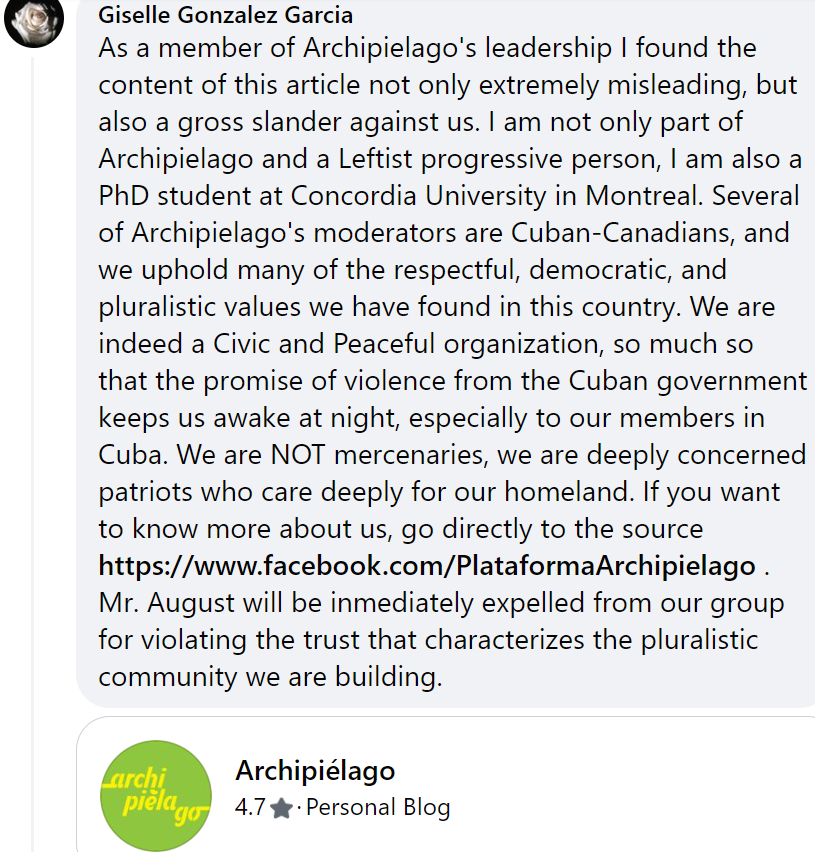
In rebuttal to the expulsion, three points:
1. In the first article, I showed how the US and its media allies, such as CNN, portray Archipiélago as “left” in order to win over supporters from the left among others in Cuba, the US and Canada (with a certain amount of success, it must be admitted). In her post above, we must thank García González for confirming what some may have doubted about my allegation concerning an appeal to the left.
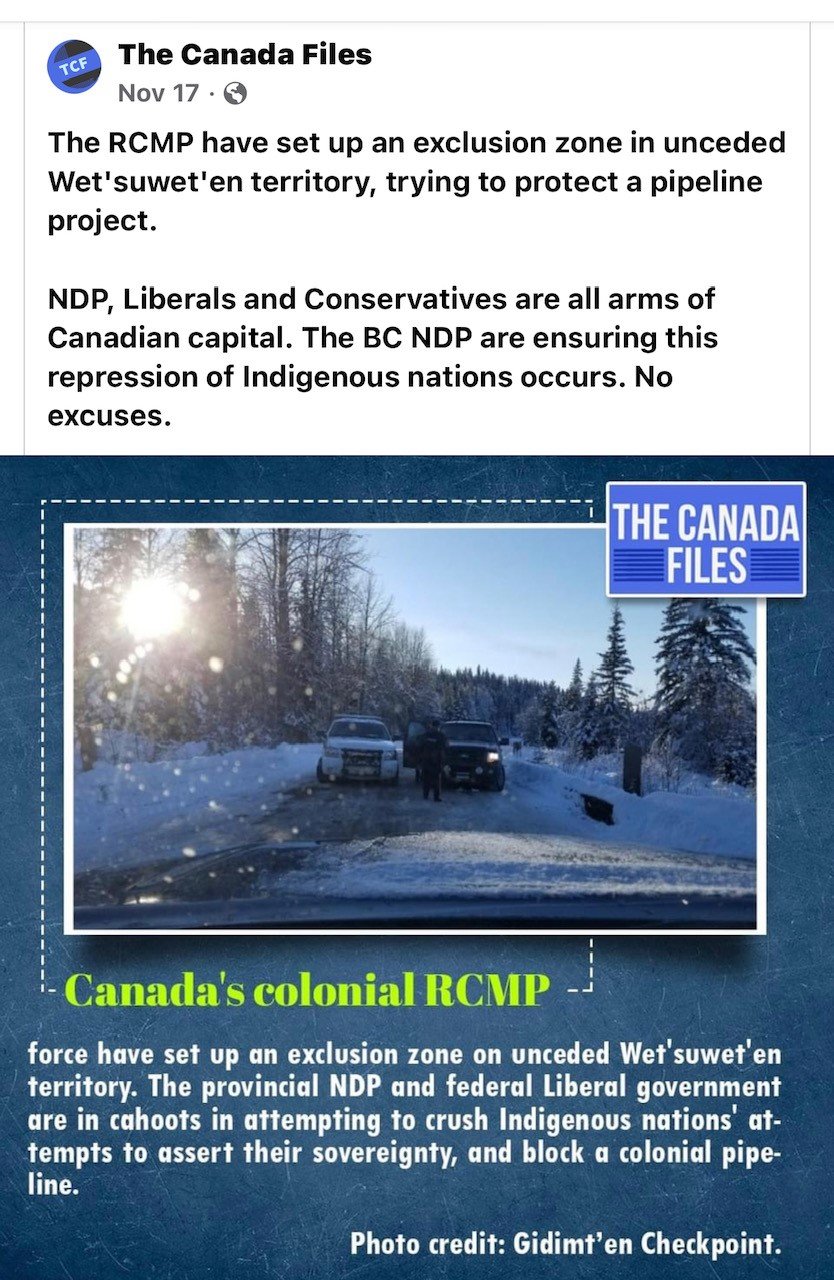
2. While the fatal attraction by dissidents to the “American Dream” is well known, the Canadian Dream remains largely in the shadows. Thanks for exposing the “Canadian Dream.” However, we ask the Archipiélago coordinator how the Canadian Dream matches up to this, yet more proof of an ongoing genocide against Indigenous nations:
3. Seeing Canada as offering pluralistic values, how do you deal with the fact that when it comes to Cuba, the mainstream media only quote the Cuban dissidents, residents here in Canada or Canadian and US “experts” who repeat the buzzword “repression” in order to be cited and thus solidify their academic careers? On the other hand, many Canadians—such as myself, with over two decades of experience on Cuba, including living there—are never consulted.
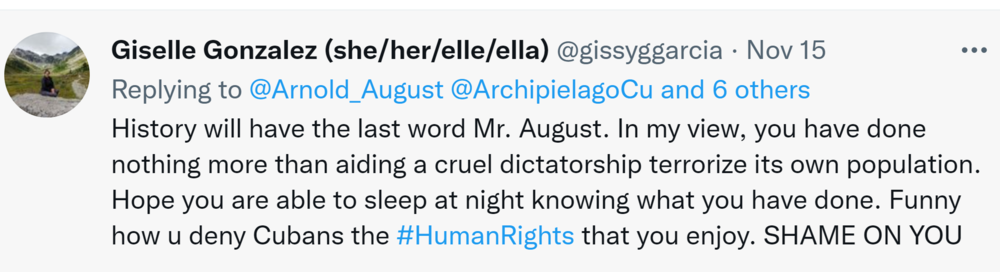
In this next post, García González unwittingly ratifies my contention that it was not “repression” that scuttled their 15N debacle but rather ideas. She accuses me of aiding the Cuban government. Thank you. Mission accomplished. However, it could not have been physical repression, as I was in Canada and could not have participated in any physical confrontation in Cuba against the mercenaries, which I would never do as a Canadian.
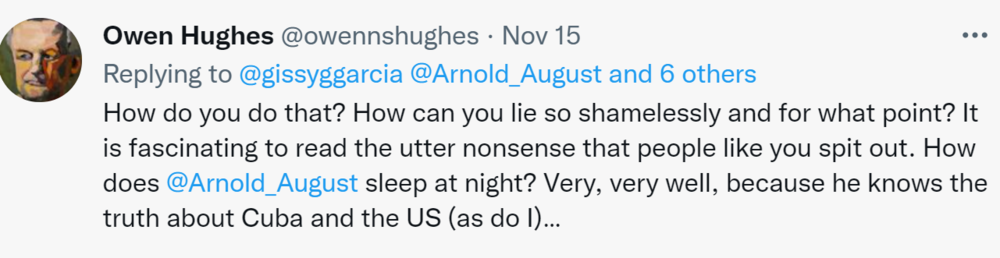
Shame? No, pride. Here is how at least one other Canadian, Owen Hughes, responds.
The same Archipiélago coordinator, a day later, on November 16, still licking their wounds, frustratingly reminds us:

I am quite sure that some so-called left outlets in the US and Canada will appreciate this, as it comes “from Cuba.” “They should know!” However, as for myself and The Canada Files, I stick to Marx as a useful guide to explain why 15N failed. Fidel is also very good, as Iroel Sánchez pointed out and cited above.
Featured image: President Miguel Diaz- Canel surrounded by people in Guantánamo

Arnold August
Arnold August is a Canadian journalist and lecturer, the author of Democracy in Cuba and the 1997–98 Elections, Cuba and Its Neighbours: Democracy in Motion and Cuba–U.S. Relations: Obama and Beyond. As a journalist, he collaborates with many websites in Latin America, Europe, North America and the Middle East. He is a contributor to Orinoco Tribune. His website: www.arnoldaugust.com