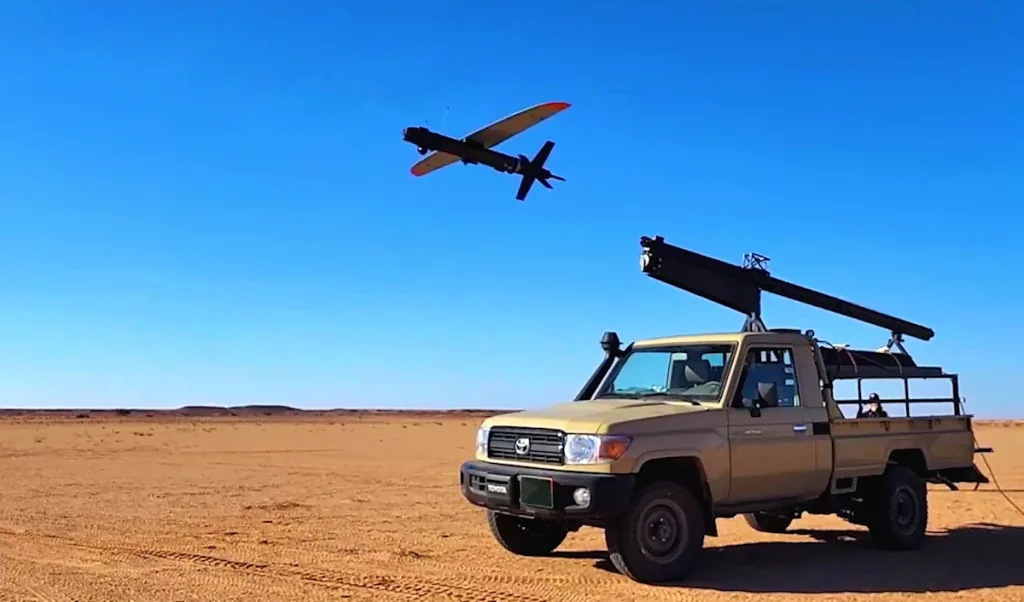
Israeli BlueBird drone. File photo.

Orinoco Tribune – News and opinion pieces about Venezuela and beyond
From Venezuela and made by Venezuelan Chavistas
Israeli BlueBird drone. File photo.
By Islam Khatib – Dec 111, 2025
Israel’s BlueBird Aero Systems, considered a leader in unmanned aerial vehicles (UAVs), made headlines with its expansion into Morocco. The company, which specializes in tactical drones and loitering munitions, has inaugurated a production facility in Morocco to manufacture its new SpyX “kamikaze” drone. This move marks a milestone in Israel-Morocco defense cooperation on the heels of their recent normalization of relations.
Morocco’s 2026 defense budget, projected at $15.7 billion, reflects both an internal arms buildup and a recalibrated military doctrine aimed at consolidating territorial control and projecting regional influence. The increase in spending is tied to its occupation of and counterinsurgency operations in Western Sahara, but extends beyond. Rabat is increasingly asserting itself as a militarized power, importing weapons and doctrine and exporting the very tactics and tools refined through years of operations in occupied Western Sahara.
Central to this evolution is its integration of unmanned systems, surveillance infrastructure, and precision strike capabilities tailored to the demands of asymmetrical conflict. This latest Israeli expansion into Morocco is hardly unexpected. Liberation movements in occupied Western Sahara have long sounded the alarm, especially as the Moroccan Armed Forces have been deploying BlueBird UAVs over the land since at least 2022.
The impact of Israeli drone technology on Sahrawi people and fighters has been repeatedly documented. Between 2021 and 2024, Moroccan forces killed 86 people using drone strikes, including two children, with another 170 others injured or displaced. In 2021, Polisario fighters described Israeli drones as their most feared weapon, with one commander stating: “I have only this Kalashnikov when I’m shooting at the base, and they have all this new technology. Most frightening of all are the drones.” The constant aerial surveillance has fundamentally altered Sahrawi life, forcing nomadic people to abandon traditional tactics, instead traveling at night without lights through the desert to evade detection. The establishment of the BlueBird production facility represents an escalation that will make these capabilities permanent and locally sustainable.
BlueBird and the transfer of Israeli drone doctrine
BlueBird Aero Systems’ expansion into Morocco reflects a strategic alignment between Rabat’s defense industrial ambitions and Israel’s growing security architecture in North Africa. The local production of the SpyX loitering munition, combined with the transfer of Israeli UAV doctrine, allows Morocco to absorb and reproduce drone warfare capabilities that were once the domain of advanced militaries.
Established in 2002, BlueBird is a private Israeli manufacturer of micro, mini, and tactical UAVs designed for ISR and precision engagement. The SpyX, its most strategic asset, is a compact loitering munition engineered for preemptive strikes and surgical neutralization of high-value targets. Its integration into Moroccan production lines signals a shift in the regional defense calculus.
BlueBird Aero Systems built its reputation on battlefield application. Its systems include the SpyLite and ThunderB, which have been deployed in multiple contexts by the Israeli military: first in the 2006 Lebanon War, then in its wars on Gaza and operations in the West Bank. During the 2014 war on Gaza, the company’s SpyLite UAVs logged over 700 ISR sorties, which are intelligence, surveillance, and reconnaissance flights used to locate, track, and direct fire on ground targets, each lasting more than three hours. These platforms have since become fixtures in Israeli drone doctrine, marketed unapologetically as “combat-proven” tools tested across the Palestinian territories and southern Lebanon.
The company’s operational track record made it a natural target for strategic consolidation. In 2020, Israel Aerospace Industries (IAI) acquired a 50% stake in BlueBird. The move formalized what had long been an alignment of priorities, pairing BlueBird’s agility in tactical UAV development with IAI’s industrial-scale production and global reach. The IAI partnership accelerated BlueBird’s expansion into international markets and laid the groundwork for projects like the Morocco venture, where battlefield-tested Israeli technology now feeds directly into North Africa’s emerging defense infrastructure.
BlueBird’s export record reveals a calculated diffusion of Israeli drone warfare architecture into varied security ecosystems worldwide. Its systems have been absorbed by both conventional militaries and internal security forces operating under the banner of border control, counterinsurgency, and territorial surveillance. In Greece, the Hellenic Police acquired the SpyLite as early as 2013 for EU-framed Frontex operations, later expanding to ThunderB platforms. In Latin America and East Africa, BlueBird drones have entered the arsenals of the Chilean and Ethiopian armies, and at least one additional African military, according to the company website, whose identity remains undisclosed, has deployed BlueBird systems operationally.
BlueBird Aero Systems has not publicly announced any projects in other Arab countries so far. Unlike larger Israeli contractors (IAI, Rafael, Elbit) that have inked deals in the UAE and Bahrain, BlueBird’s most significant foray in the Arab world to date is the Moroccan project. It’s worth noting that BlueBird’s partial owner, IAI, has been active in the UAE (even before formal ties, IAI reportedly sold some drones to the UAE via third parties, and after 2020 it signed collaborations like anti-drone defenses with Emirati firms). It’s conceivable that BlueBird’s UAVs may eventually find their way to Gulf states as part of Israel’s expanding defense exports, but if so, it’s being kept discreet for now.
SpyX loitering munition
The centerpiece of BlueBird’s Moroccan venture is the SpyX loitering munition, a compact, precision-guided strike drone built for asymmetric conflict. Unlike traditional UAVs that return after reconnaissance, the SpyX is a disposable system, designed to hover over a battlefield, identify a target, and dive directly into it with an explosive payload. It combines surveillance and strike in a single platform, giving front-line units a weapon that acts like a smart missile with eyes.
With a 50 kilometer operational range and up to two hours of loiter time, the SpyX gives ground forces the ability to monitor and strike deep inside any territory without relying on traditional air support. In contexts like Gaza and Lebanon, this means maintaining constant surveillance over densely populated or irregular terrain including refugee camps and hilltop villages while waiting for a target to appear. In Western Sahara, it enables overwatch across vast expanses and populated neighborhoods.
The drone’s silent electric motor minimizes acoustic detection, crucial in civilian-dense areas or open landscapes where early warning could allow “targets” to evade. Its dual-sensor payload, which fuses high-resolution daylight optics with infrared thermal imaging, allows operators to identify and track individuals or vehicles under varied lighting and weather conditions. Whether it’s tracking people or vehicles, the real-time video tracker provides the precision needed to execute or abort a strike within seconds, according to company marketing and brochures made available on their website.
The SpyX system is built for mobility and discretion. Man-portable and launchable without a runway, it is designed for low-signature operations by special forces, counterinsurgency teams, and border units operating in terrain where infrastructure is limited or non-existent. This is a battlefield tool made for reach and deniability. Its transfer to Moroccan production lines gives Israel a regional manufacturing foothold capable of supplying allied regimes across Africa. The strategic calculus is to preempt the emergence or strengthening of resistance movements in neighboring regions, from Western Sahara to the Sahel and the Horn of Africa, by ensuring rapid access to precision strike capabilities built and deployed close to the field.
Normalization for sovereignty
Following the 2020 normalization agreement under the US-brokered Abraham Accords, Rabat secured the US recognition of Moroccan ‘sovereignty’ over Western Sahara. In July 2023, Israel followed suit, becoming the second country to formally recognize Rabat’s claim and signaling its long-term strategic investment in Moroccan security architecture.
In November 2021, the two countries signed a formal Memorandum of Understanding on Defense, enabling arms deals, intelligence sharing, and technology transfer. By early 2022, Morocco had signed a $500 million contract with IAI for the Barak MX air and missile defense system, and acquired the Dome anti-drone system from Israeli firm Skylock, part of the Avnon Group.
That same year, Rabat purchased at least 150 WanderB-VTOL and ThunderB-VTOL drones from BlueBird Aero Systems, and had already taken delivery of three IAI Heron UAVs, medium-altitude, long-endurance drones used for surveillance in Western Sahara. These procurements made Israel one of Morocco’s top arms suppliers, now accounting for 11% of Rabat’s total arms imports, according to SIPRI, which is a dramatic shift from its traditional reliance on the US and France. Morocco has also launched production partnerships with India (via Tata Advanced Systems Maroc, opened in 2023), Turkey (a Baykar UAV factory now under construction in Benslimane), and the United States (cooperation with General Dynamics on Abrams tank support). These developments have direct implications for the people of occupied Western Sahara, where these drones are likely to be deployed.
A North African security landscape beyond Egypt?
The recent Moroccan‑Israeli defense partnership should be seen as part of Israel’s broader effort to extend its reach beyond the traditional Cairo axis. While Egypt “remains central” to the Zionist project, Israel is building multiple pillars.
Following the breakdown in ceasefire talks, Egypt and Qatar have found themselves vying for the role of chief mediator in an attempt to both provide a so-called ‘humanitarian solution’ to the genocidal war in Gaza and appeasing Israeli security demands. Yet, in Israeli strategic thinking, no matter how much Cairo or Doha deliver in terms of de-escalation channels or negotiations, their engagement is still viewed with suspicion. Both are seen as mediators too close to the “other side,” too embedded in regional currents that Israel considers threatening, particularly when it comes to their long-standing ties with Palestinian factions. Morocco, by contrast, carries none of that baggage. Israeli-aligned think tanks are explicit about this. They note that the partnership with Morocco “provides a particular presence and potential influence in North Africa, an arena that has historically remained distant.”
Egypt’s response to this new dynamic reveals a complex hedging strategy. Egypt’s government has publicly welcomed Rabat’s closer ties to Israel. In May 2025, Egyptian and Moroccan ministers even launched new bilateral committees to coordinate on Middle East, African and Mediterranean issues. Both states emphasize a “shared Arab stance on Palestine” as they jointly reaffirmed support for a ‘two-state solution’. Simultaneously, Cairo and Rabat are deepening their economic ties. The 2025 Egypt-Morocco Investment and Trade Forum set a target of $500 million in Moroccan exports to Egypt by 2026. These economic moves reinforce high-level political coordination, including joint statements at the 162nd Arab League session affirming “mutual solidarity, shared destiny, and common objectives.”
What emerges is a new duality in the Maghreb. The Israel-Morocco defense axis introduces a competing power center in North Africa that is more agile, less burdened by legacy politics, and far more open to Israeli military and industrial integration. While Egypt’s influence has traditionally oriented toward East Africa, Morocco now extends westward into the Sahel and Atlantic, carving out distinct strategic space. For Israel, Morocco provides a second African pillar that is more diplomatically unencumbered than Cairo.
BlueBird’s Morocco facility marks a watershed in Israel’s post-normalization defense diplomacy. The significance extends well beyond bilateral relations. What we are witnessing is the operationalization of a new regional security architecture in which technological transfer doubles as strategic entrenchment. Morocco has moved from a discreet intelligence liaison to a host nation for Israeli military-industrial infrastructure. This is a qualitative leap that fundamentally alters the North African defense landscape. This model is capable of hardening a two-tiered regional order: states aligned with Israel gain access to advanced strike systems and battlefield autonomy, while those who reject normalization become targets of those very systems. For example, in response to Morocco’s new technologies, Algeria has compensated by acquiring Russian Iskander-E ballistic missiles and Chinese VT-4 tanks, positioning itself as North Africa’s largest military power, yet it faces American export restrictions on advanced UAV systems and struggles with supplier diversification, relying on Russia for approximately 75% of its military equipment.
This is precisely the dynamic Israel seeks to institutionalize across the region, normalization rewarded with advanced military capabilities and manufacturing autonomy, while rejection or in Algeria’s case, shy or hesitant rejection, results in strategic isolation and dependence on less integrated supply chains from countries increasingly constrained by Western pressure.