By Mark Weisbrot – Oct 21, 2020
The November coup was backed by the Trump administration, and the Organization of American States (OAS) leadership played a central role in laying the foundations for it. Sunday’s election thus has enormous potential implications not only for Bolivia, where it was a necessary step toward the restoration of democracy, but also for the region, in terms of democracy, national independence, economic and social progress, and the struggle against racism.
First, the election: Unofficial quick count results show Arce winning with more than 50 percent of the vote, and at least 20 percentage points ahead of his closest competitor, Carlos Mesa, a former president. A majority is decisive, but even if the final, official count were to put Arce below 50 percent, his margin over Mesa is virtually certain to be large enough to win the election in the first round (to win in the first round, a contender must get more than 50 percent of the vote, or at least 40 percent with a 10-point margin over the runner-up). Mesa has already conceded, and the de facto president, Jeanine Áñez, congratulated Arce on his victory on Sunday night.
It’s not difficult to see why Arce would have won even if he were not up against a violently repressive, racist government installed by a coup. As minister of the economy ever since Morales took office in January 2006, Arce can claim much credit for what any economist would say was a remarkably successful economic turnaround for Bolivia. When Morales was first elected, income per person was less than it had been 26 years prior. By contrast, in the 14 years of his Movement Toward Socialism (MAS) government (2006–19), it grew by about 52 percent. This is a sizable improvement in living standards (sixth out of 34 countries in the region), following on the heels of a stupendous long-term economic failure.
Poor Bolivians, who are disproportionatelyindigenous, benefited even more than others from the MAS government’s economic successes. Poverty was reduced by 42 percent and extreme poverty by 60 percent. Poorer Bolivians also benefited disproportionately from a very large increase in public investment, including in schools, roads, and hospitals.
RELATED CONTENT: Bolivia Election 2020 – A Socialist and Indigenous People’s Victory
By contrast, the 11 months of coup government since last November have been a disaster. The International Monetary Fund estimates that the Bolivian economy will shrink by 7.9 percent in 2020. Of course, most of the world has suffered economic damage from Covid-19, but Bolivia’s death toll as a percentage of its population has been extreme because of the coup government’s mismanagement. Bolivia ranks third of 150 countries in the number of people per million who have died from the Covid-19. This is criminal negligence.
Bolivians also suffered from more deliberate crimes under the current government. These included two massacres by security forces, in which they killed at least 22 people—all of them indigenous. The overt racism of not only the security forces but also the leaders of the coup itself and the de facto government, as well as that government’s repression and political persecution, was documented in a July report by Harvard Law School’s International Human Rights Clinic and the University Network for Human Rights. This report found that the month of the coup was “the second-deadliest month in terms of civilian deaths committed by state forces since Bolivia became a democracy nearly 40 years ago.”
All of this would not have happened if the right-wing forces—who were unable to win an election for 14 years—had not been able to pull off the coup d’état. And for this, they had a lot of help: On October 21 of last year, the day after the election, the OAS released a statement alleging that there was a “drastic and hard-to-explain change in the trend of the preliminary results after the closing of the polls.” The organization provided no evidence, and the allegations were soon refuted. But the OAS kept repeating the allegation for weeks and then months, and it became the political foundation for the coup of November 10, and a justification for the abuses that followed.
As was clear from the beginning from publicly available election data, what actually happened was quite simple: Later-reporting areas weremore pro-MAS than those that reported earlier. This happens in many elections, and, not surprisingly, is happening again this year, as the official count is tabulated in the days after Sunday’s election.
RELATED CONTENT: How Bolivia Fights Fascism – It Takes More Than the Ballot Box
On Monday afternoon, the Associated Press reported, “The formal official count had Mesa with a 41% to 39% lead over Arce with 24% of the vote tallied on Monday, but those votes appeared to be largely from urban areas rather than the rural heartlands that have been the base of Morales’ support.” And indeed, Arce soon pulled ahead and was on his way to a lead that will approximate the more than 20-point lead that the quick count reported Sunday night.
But when the same, easily explainable trend manifested itself last year, pushing Evo Morales’s lead from 7.9 percentage points to a more than 10-point margin—enough to win in the first round—the OAS created a false story about fraud. Most of the major media accepted its story. The OAS published three reports in the months following its initial press release, but never even considered the question of whether the later-reporting areas were politically different from the ones that reported earlier. This was an electoral observation mission staffed by professional election observers who would have to know at least as much about this as someone who watches election returns on television. It is simply not believable that this common and widely understood election phenomenon never even occurred to the organization.
On November 25, four members of the US Congress asked the OAS if the organization had thought of this possibility, but nearly a year later have still not received an answer to this or 10 other basic questions they asked. Two of these representatives, Jan Schakowsky and Jesús “Chuy” García (both Democrats from Chicago) have called for Congress to investigatewhat the OAS did (Congress approves about 60 percent of OAS funding).
The OAS has refused to answer most questions from journalists, at least on the record; and it never answered a letter from 133 economists and statisticians that raised the same issues and questions put forth by members of Congress about the OAS’s false statements.
But the General Secretariat of the OAS did respond to a June 7 article inThe New York Times that cited statistical evidence indicating that the OAS allegations of a stolen election were false. The office unleashed a torrent of abuse at the Times, arguing that it “intends to deny the Bolivian People the possibility of electing a new president that is not Evo Morales in a new election.” Attacking more than 90 years of Times reporting, the Secretariat attributed this alleged partiality toward Morales to the newspaper’s “well-documented controversial history with truth in relation to dictatorships and totalitarianism,” including those of Stalin, Castro, and even Hitler. This, from an organization that is supposed to represent countries with a combined population of more than a billion people.
All this shows how important it is to stop the OAS from being used by the US government as an instrument of regime change. The OAS has done this before: In Haiti’s 2000 election, where the OAS changed its analysis to provide the pretext for a cutoff of almost all international aid, culminating in the US-backed coup of 2004; and in 2011, when the OAS did something that perhaps no other electoral observation mission ever did, when it simply overturned the results of the first round of Haiti’s presidential election.
Of course, we also need to stop regime change from being Washington’s default policy for dealing with left governments in Latin America. In the 21st century, the majority of people in Latin America and the Caribbean elected left governments, which were more independent than their predecessors. Washington intervened to undermine almost all of them, including in Argentina, Brazil, Bolivia, Haiti, Honduras, Nicaragua, Venezuela, and Paraguay—and almost certainly more, for which the evidence is still only circumstantial—in some cases contributing to actual regime change.
These interventions can be devastating and long-lasting in their effects, as can be seen in a number of the above countries that fell victim to US regime-change operations in just this century. That is why this reversal of regime change in Bolivia is so important—not only for Bolivia, but for the entire hemisphere.
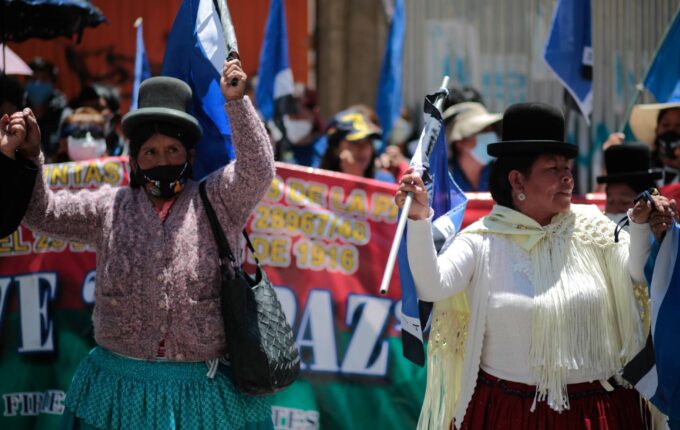
Featured image: Supporters of MAS (Movement Toward Socialism) wave flags during a celebration the day after 2020 elections in La Paz, Bolivia. (Gaston Brito Miserocchi / Getty Images)

Mark Weisbrot
Mark Alan Weisbrot is an American economist and columnist. He is co-director with Dean Baker of the Center for Economic and Policy Research in Washington, D.C. Weisbrot is President of Just Foreign Policy, a non-governmental organization dedicated to reforming United States foreign policy.