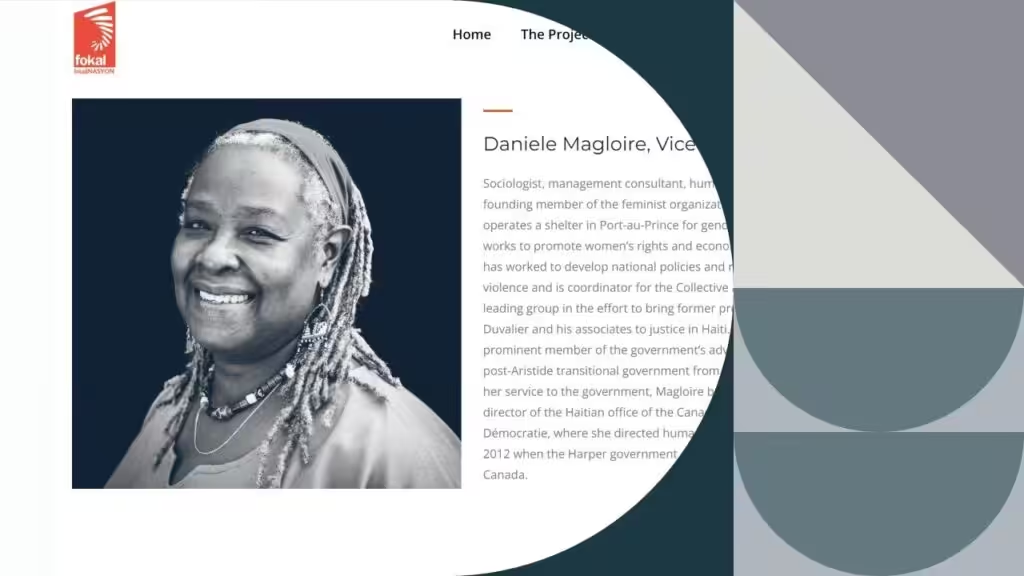
Daniele Magloire's profile on FOKAL's website. Photo: The Canada Files.
Daniele Magloire's profile on FOKAL's website. Photo: The Canada Files.
By Travis Ross – Oct 16, 2024
Editor’s note: This is part two of Travis Ross’ multi-part series on Canadian imperialism’s manufacturing of Haitian imperial feminist collaborators.
Haitian feminist leaders like Danièle Magloire, Michèle Duvivier Pierre-Louis, and Sabine Lamour practice what is referred to as Imperialist or Colonial Feminism, defined as “the appropriation of women’s rights in the service of empire.”
They are ideal candidates for Canadian government funding as their interests align with Canada’s feminist foreign policy framework.
These imperial feminists may speak in the language of human rights and promote causes that speak to the needs of women in Haiti. In the end, however, their class allegiances prevail.
They avoid critiquing the interventionist policies of their funding partners – Washington and Ottawa – in their analysis of women’s rights in Haiti.
From the imperialist governments’ perspective, they are the ideal Haitian spokespeople on the international level, because they do not fundamentally challenge their benefactors’ policies. Their class status is maintained in part due to funding for their organizations from governments like Canada, the U.S., and France. This funding helps to amplify the voices of these organizations and their leaders in the media.
The mainstream media in and outside Haiti become vectors for the propaganda these leaders and their organizations produce in the form of press releases, speeches, statements, and reports.
These imperialist feminist NGOs and leaders only represent one sector of the feminist movement in the Caribbean.
Imperialist feminists face backlash for supporting coup against Aristide
This dynamic in the feminist movement in the Caribbean was explained by Peggy Antrobus, a former General Coordinator of Development Alternatives with Women for a New Era (DAWN). She is one of many feminists in the Caribbean who signed a joint-statement against U.S. involvement in Haiti and the removal of President Jean-Bertrand Aristide. It is entitled, “Caribbean Women Denounce the US-Backed Coup in Haiti” and was published soon after the 2004 coup in Haiti. It was a response to a CONAP joint-statement (Danièle Magloire’s Canadian-funded NGO) falsely claiming Aristide was not democratically elected and had brought violence to the country.
Antrobus analyzed the divide among feminist organizations in the Caribbean regarding the 2004 coup. Her analysis points to underlying class allegiances that correlate with these organization’s acceptance or rejection of the propaganda campaign that framed Aristide as a tyrant. The popular, democratically elected leader was deposed in a violent U.S. and Canadian-backed coup on Feb. 29, 2004.
“There is definitely a gender dimension and I think it has to do with the level of poverty in Haiti. I believe poverty has enormous gender implications. It is class interests that create poverty, but once you have a class of poor people gender takes over. The reality of what it means to be poor, lack of food, shelter, healthcare, education, all of those basic needs, is a reflection of women’s practical gender interests. In that sense there is feminization of poverty.”
Antrobus links these class allegiances with foreign-funded NGOs to preserve the status quo in Haiti:
“It is not surprising in a situation where you have such poverty that you would have many NGOs working on issues such as housing, education, health, violence, and gender-based violence, all things that accompany poverty. While women are the most exploited there is also space for organizing on their behalf in the sense of charity or good-works. The work of many organizations focusing on alleviating poverty is not reflected in their politics. In fact, many of them may be quite conservative and guided by instincts of charity and good works. It is possible for people to be very sympathetic to the poor, to do good works, and to raise money for programs but basically they do not want to change the status quo. In fact, one of the ways to maintain the status quo is to pay attention to basic needs so that you keep the lid on the pot and prevent it from erupting. In that sense, women can be used to preserve the status quo.”
Antrobus goes on to explain how this divide over the emphasis on class extends to an organizations’ fundamental understanding of gender-based violence:
“We must begin to understand the connections between race, class, and gender and be able to articulate it in a way middle-class and white women can understand: Many of the things they are unhappy about have everything to do with patriarchy, capitalism, and racism.”
“… it is important to use the broader definition of violence and link it to the whole concept of human security, which includes freedom from fear and freedom from want. There are two parts, one is the violence of poverty and deprivation and the other is the physical violence. Clearly, women and children are most affected by this if you are looking at both sides of violence.”
Antrobus argues that class allegiances prevailed in CONAP and SOFA: “It comes back to class. In my opinion, they [SOFA, CONAP] represent the privileged few.”
She links these organizations’ reductive critique of class to their reliance on funding from imperialist governments:
“This situation highlighted for me how vulnerable civil society organizations are to political manipulation. Many of the NGOs who are involved in the anti-Aristide mobilization have been getting a lot of US government money through USAID as well as from the International Republican Institute and the National Democratic Institute.
[The International Republican Institute and the National Democratic Institute are offshoots of the NED, a CIA-front].”
Feminist leaders like Magloire, Lamour, and Pierre-Louis continue to represent a nexus of imperialist feminism that links funding from imperialist governments to NGOs in Haiti.
They ignore or only pay lip service to class in their analysis of gender-based violence and poverty experienced by women in Haiti.
For example, in a “memoir” published by Avocats sand Frontères Canada (ASFC) on February 13, 2019, in collaboration with Kay Fanm titled L’impunité des violences faites aux femmes et aux flles en Haïti (Impunity for violence against women and girls in Haiti), the only attempt at a class analysis in contained in one paragraph. It explains that “in the process of filing a complaint and the legal proceedings” women living in poverty “have difficulty understanding the language used by police officers, lawyers, judges” because they have “little education”.
The memoir was published with funding from the Canadian government through the AJULIH project.
Affirming Antrobus’ analysis, these western-backed NGOs do offer charitable services to Haitian women in Haiti.
Kay Fanm and SOFA manage a network of women’s shelters in Haiti. SOFA manages 22 clinics in Haiti that function as women’s health centers and shelters for victims of violence. Kay Fanm also runs similar programs that provide support to hundreds of women across Haiti.
Some of the funding provided through the AJULIH project has resulted in assistance being provided to women who were victims of gender-based violence. For example, a report by Global Affairs Canada (GAC) noted that in 2019-20, Kay Fanm, MOUFHED, AFASDA and Fanm Decide provided “legal aid and judicial assistance to about 100 women and girls who had been the victims of gender-based violence.”
Four out of the five partners in Haiti under this program also benefited from GAC’s AJULIH program. Kay fanm, Solidarite Fanm Ayisien (SOFA), Asosyasyon Fanm Soley Dayiti (AFASDA) &, Fanm Deside.
While these NGOs do implement programs that benefit Haitian women on the ground in Haiti, they also provide cover for imperialist interventionist policies in Haiti and subsequent support for neoliberal reforms imposed by their partners – the governments of the United States, Canada, and, to a lesser extent, France.
Imperial feminists erase the effects of the 2004 Coup on Haitian women
Dr. Jemima Pierre, Professor of Global Race in the Institute of Race, Gender, Sexuality and Social Justice at the University of British Columbia, and others have argued that Haiti lost its nominal sovereignty after the 2004 coup. And that Haiti’s current crisis can be traced back directly to the 2004 coup.
Pierre points out that the coup “led directly to The UN occupation under MINUSTAH” which “was marked by its brutality towards Haitian people. Civilians and pro-democracy activists were attacked and assassinated. UN soldiers also caused a cholera epidemic that killed between 10,000 and 40,000 people.”
This includes MINUSTAH soldiers who committed hundreds of acts of rape and sexual assault on Haitian women and minors, even operating a child-sex ring. Multiple cases of rape and poverty-compelled prostitution left at least 265 children abandoned when MINUSTAH left Haiti.
In addition to the atrocities committed by U.S. – funded paramilitaries, the PNH, and MINUSTAH, gains made by the Aristide government to improve the lives of women were lost.
Many gains for women were achieved under Aristide: For the first time ever Haitian women held the posts of Prime Minister. Claudette Werleigh was PM of Haiti from 1995-1996. Women also occupied the positions of Minister of Foreign Affairs, Minister of Finance and Chief of Police.
In 1995, Aristide also established the Ministry of Women’s Affairs (MWA) to work for women’s welfare. Its purpose included help for rape victims, improving literacy and access to education, vital health services like pre-natal care and inclusion of women to benefit from increases in the minimum wage.
More fundamentally, Aristide’s policies benefited the poor majority of Haiti. Consequently, a majority of Haitian women also benefited from these policies
While the Latortue regime brought some key updates to the MWA, these were completely overshadowed by the devastating consequences of the coup.
In 2006, during the lead up to the first (s)election after the 2004 coup – Fanmi Lavalas was banned from running – Gérard Latortue, Haiti’s interim prime-minister, released the “Livre blanc du gouvernement de transition” (the Transitional Government’s White book). Adeline Magloire Chancy, the new Minister of Women’s Affairs (appointed by the council of the Wise, which included Daniele Magloire and Ariel Henry) wrote the preamble for the document.
In it, Chancy celebrates the accomplishments of the Latortue regime. Noting that “The decree of July 6, 2005 published in Le Moniteur of August 11, 2005 modifies the Code criminal by identifying rape as a crime against the person.” Making rape punishable by “severe penalties ranging from 10 years to life imprisonment.”
Chancy then shares her hope that “the organizations of women who fought for the existence and strengthening of this ministry will continue to carry the voice and to stimulate the essential movement of citizens for a fair society.” This provided a nod to the imperialist feminists who helped destabilize Haiti to facilitate the coup.
Chancy’s hope came true. Haitian feminist organizations like CONAP, SOFA, Kay Fanm, and Enfofanm continue to prosper with the help of funding from foreign governments and likeminded private foundations.
They also continue to erase their role in the destabilization campaign leading up to the 2004 coup, as well as their role in the illegal Latortue/Boniface regime that was installed afterwards.
For example, in a 2020 essay, Lamour notes that “Haitian feminists were the first to denounce the excesses of MINUSTAH”. And soon after began “a battle for the deoccupation of Haitian territory”. She omits the role of Haiti’s elite feminists in the destabilization campaign that led to the 2004 coup, the selection of the coup regime, and the subsequent occupation of Haiti by MINUSTAH soldiers.
The occupation under MINUSTAH was consolidated through the creation of the Core Group, the current colonial rulers of Haiti led by the U.S. government, of which Canada is a member.
The UN’s MINUSTAH and the subsequent reduced MINUJUSTH force occupied Haiti from 2004-2019.
During this 15-year foreign occupation, Haiti’s state was hollowed out and dismantled by a series of PHTK governments brought to power through sham elections resulting from meddling from the governments of the U.S. and Canada.
We Keep Resisting: US and Canada Sanction Samidoun (Statement)
While Canadian-funded NGOs such as CONAP, the RNDDH, and SOFA have recognized some of the human-rights abuses committed by MINUSTAH, they consistently refuse to acknowledge their role in the destabilization campaign against Aristide and Lavalas that led to the 2004 coup and the subsequent UN occupation under MINUSTAH.
Indeed, Antrobus’ observation in 2004 that these organizations were “vulnerable to political manipulation” due to their funding partners, overlooked how these partnerships brought the leaders of these organizations in closer proximity to Haiti elites and oligarchs. Those who benefited most from Aristide’s ousting.
For example, a press release published by CONAP on March 11, 2004 in response to the joint-statement “Caribbean Women Denounce the US-Backed Coup in Haiti”, concluded that Aristide’s “resignation” constituted “a victory for the Haitian people and for the women’s movement.”
CONAP did not hesitate to link women’s social progress with support for the coup.
The CONAP press release was published on the Haitian Democracy Project (HDP) website. The IJDH’s Brian Concannon describes HDP as “a right-wing think tank founded by Republican State Department and other officials and by Haitian elites.” HDP’s co-founder is Haitian oligarch Rudolph Boulos.
HDP had direct ties to the Group of 184, an elite civil society front with connections to the U.S. government and the paramilitaries attacked government institutions in the lead up to the 2004 coup. Author Jeb Sprague described HDP “was one of the primary groups lobbying in the United States for Aristide to step down and organized protests in front of the Haitian Embassy.”
CONAP’s propaganda sharply contrasted the views of women in Haiti’s masses.
Following Aristide’s imminent return to Haiti in March of 2011, a statement was published by “women in tent cities, in sweatshops, market women and small vendors” – members of Oganizasyon Fanm Vanyan (Brave Women’s Organisation). The statement quickly garnered international support:
“Since 2004, women have been facing increasing hardship, terrible living conditions, verbal abuse, lack of shelter … they take away all our rights: to housing, to send our children to school, to work, to vote”, it said. The statement emphasized how Haitian women had “to manage for many years without Titid [Aristide], without Mildred [his wife and colleague] … we need them now so that together we can look for solutions.”
The sharp contrast between the narrative imperialist feminist groups present about the 2004 coup, versus the reality of that event as an imperialist intervention that violated Haiti’s sovereignty, points to the class antagonisms at play. Women in the Haitian masses cannot compete with liberal bourgeois feminist groups whose voices are amplified via funding from imperialist governments and associated private foundations. Their voices are muted, while imperialist feminists speak on their behalf, playing their role in maintaining the imperialist stranglehold on Haiti.
Two consistent components of the discourse Haitian imperialist feminists propagate are: to pay lip service to Haiti’s poor masses and the realities of poverty and to parrot imperialist propaganda and frame Aristide’s removal as a victory for feminism.
In the aforementioned essay by Lamour, she celebrated CONAP for leading “a relentless fight during the previous decade for the visibility of the political work of feminists.” Lamour also emphasized the feminist movement’s ability to “take the forefront to make demands and outline directions” when “a problem arises at the national level”, including the “fall of Lavalas power”.
Lamour completely erases CONAP (and SOFA’s) role in the relentless propaganda campaign against Aristide’s democratically elected government.
The statement also frames the Haitian feminist movement as limited to western-backed feminist groups. The voices of Haitian women who supported Lavalas and Aristide are silenced by the steady funding from western governments and foundations like OSF.
Magloire continues to launder anti-Lavalas propaganda through Kay Fanm’s partnership with Avocats sans Frontieres Canada (ASFC).
In a 2018 report for ASFC titled Mémoire portant sur la lutte contre l’impunité en Haiti (Memoir on the struggle against impunity in Haiti), edited by Magloire, she continues to repeat long-discredited allegations against Aristide. (Magloire is also featured on the cover of the report). The report was published with ASFC with funding from Global Affairs Canada’s (GAC) AJULIH program.
For example, the report repeats the allegations that Aristide was involved in the assassination of journalist Jean Dominique. Dominique, Haiti’s most popular journalist and a Lavalas supporter, was murdered on April 3, 2000. Opponents of Aristide, who was not yet elected to office, attempted to argue that Aristide had ordered the murders. Mario Joseph, managing director of the Bureau des Avocats Internationaux (BAI), argued that these opponents were attempting to use the “investigation as a political tool for undermining the Lavalas movement.” He also argued that, two years after Dominique’s murder, the investigation “was primarily being used for political purposes.”
ASFC’s role in providing funding from GAC for its AJULIH project has also provided opportunities for the white washing of some of their Haitian partners role played in the destabilization campaign against Aristide and Lavalas. A previous investigation by The Canada Files demonstrated that ASFC had produced a report that omitted the RNDDH’s role in the destabilization campaign and the orchestrated terror campaign against Lavalas immediately following the 2004 coup.
Similarly, ASFC produced an article titled Haitian feminism: portrait of a strong movement that is posted to their website. The article author Jasmine Laroche presents CONAPs “denunciation of political violence perpetrated by Aristide’s chimères against women” to be a “significant advancement driven by the women’s movement”. Laroche also celebrates their partner organization SOFA who receives funding through the AJULIH project, as an exemplary feminist organization while omitting any mention of their role in the destabilization campaign.
Laroche then celebrates SOFA founding member Dr. Lise-Marie Déjean, the first Minister of the Status of Women, who she notes was “chosen from the ranks of feminist activists in 1994.” Laroche carefully omits the fact that it was Aristide who selected Dejean for the role after extensive consultation from the feminist movement in Haiti.
Meanwhile, Pierre-Louis continues to actively represent FOKAL. In 2021, she spoke at Bard University on the topic of “Agency and Popular Political Movements”. Her audience was likely unaware of how her actions as the head of FOKAL undermined the agency of thousands of Haitian women by repeating the anti-Aristide propaganda that helped to lay the groundwork for the 2004 coup. Nor that she aided in crushing Haiti’s popular movement, Lavalas.
Two decades after the 2004 coup, the class allegiances of these imperialist feminists prevail. Magloire and Lamour simply will not recognize the profoundly devastating consequences their role in the destabilization campaign against Aristide had on a majority of Haitian women.
While the economic privileges afforded to them by their class allegiances and to imperialist governments and private foundations provide some explanation, there is another critical historical factor that shouldn’t be overlooked. A factor that is best explored through the lens of another key Haitian imperialist feminist, Magali Comeau Denis.

Travis Ross is a teacher based in Montreal, Québec. He is also the co-editor of the Canada-Haiti Information Project at canada-haiti.ca. Travis has written for Haiti Liberté, Black Agenda Report, TruthOut, and Rabble.ca. He can be reached on Twitter.